


Police 10 Codes: The Complete Guide to Law Enforcement Radio Codes
Everything you need to know about police radio codes, from “10-4” to the specialized signals departments use across America.
Police 10 codes are brevity codes used by law enforcement to communicate quickly and efficiently over radio. Each code starts with “10” followed by a number that represents a specific message. For example, 10-4 means “acknowledged” or “message received,” while 10-20 means “location” (as in “what’s your 10-20?”).
These codes were developed in 1937 to save airtime on limited radio channels and have since become deeply embedded in law enforcement culture, though many departments now use plain language for better inter-agency communication.
In this guide
What Are Police 10 Codes?
Police 10 codes (also written as “ten codes” or “10-codes”) are a system of numeric codes used by constables and law enforcement officers to communicate via radio. Each code begins with the number “10” followed by another number, creating a standardized shorthand for common phrases and situations.
When an officer says “10-4,” they’re acknowledging receipt of a message. When dispatch asks for a “10-20,” they want to know an officer’s location. These codes allow officers to convey complex information in just a few syllables, which was crucial in the early days of radio when channel capacity was limited.
The codes serve several purposes beyond brevity. They provide a degree of privacy from civilians monitoring police scanners, they reduce the chance of miscommunication caused by static or interference, and they’ve become a deeply ingrained part of police culture and identity.
Key facts about police 10-codes
- 10-4 means “acknowledged” — message received — not yes or no.
- 10-7 is out of service; 10-8 is in service. They are the two most-used status codes on any police channel.
- The APCO standard list has about 100 codes (10-0 to 10-99); most agencies use 30–40 of them daily.
- 10-codes are not the same everywhere. 10-13 is a weather report in APCO and “officer needs assistance” in New York; 10-56 is a drunk pedestrian in one agency and a suicide in another.
- Since 2006, FEMA and DHS recommend plain language for multi-agency operations; most departments keep 10-codes for internal traffic.
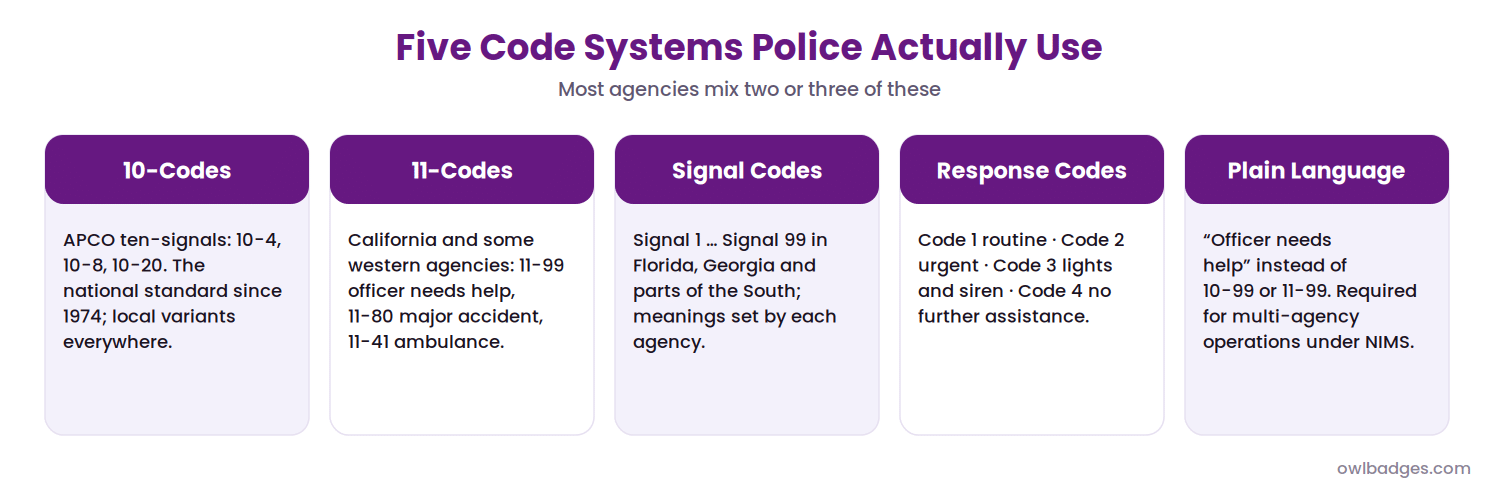
- California and several western states use 11-codes (11-99 = officer needs help); Florida and Georgia use signal codes; nearly everyone uses Code 1–4 for response level.
Reviewed and updated September 2026. Meanings follow the APCO ten-signal standard; local agencies may differ.
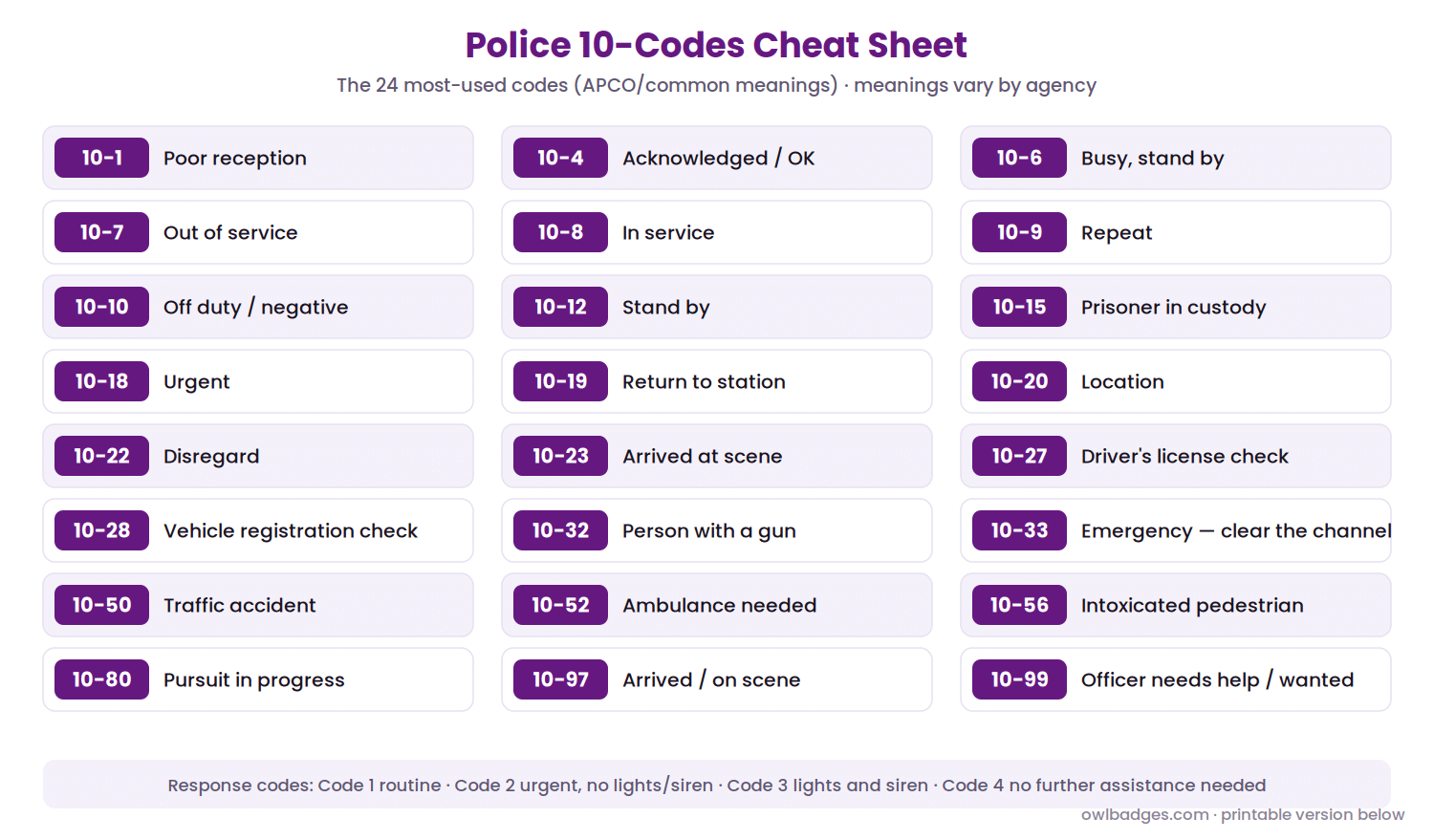
Download the printable police 10-codes cheat sheet (PDF) — one page, the 24 codes above plus response codes, for a clipboard or a locker door.
The History of Police 10 Codes
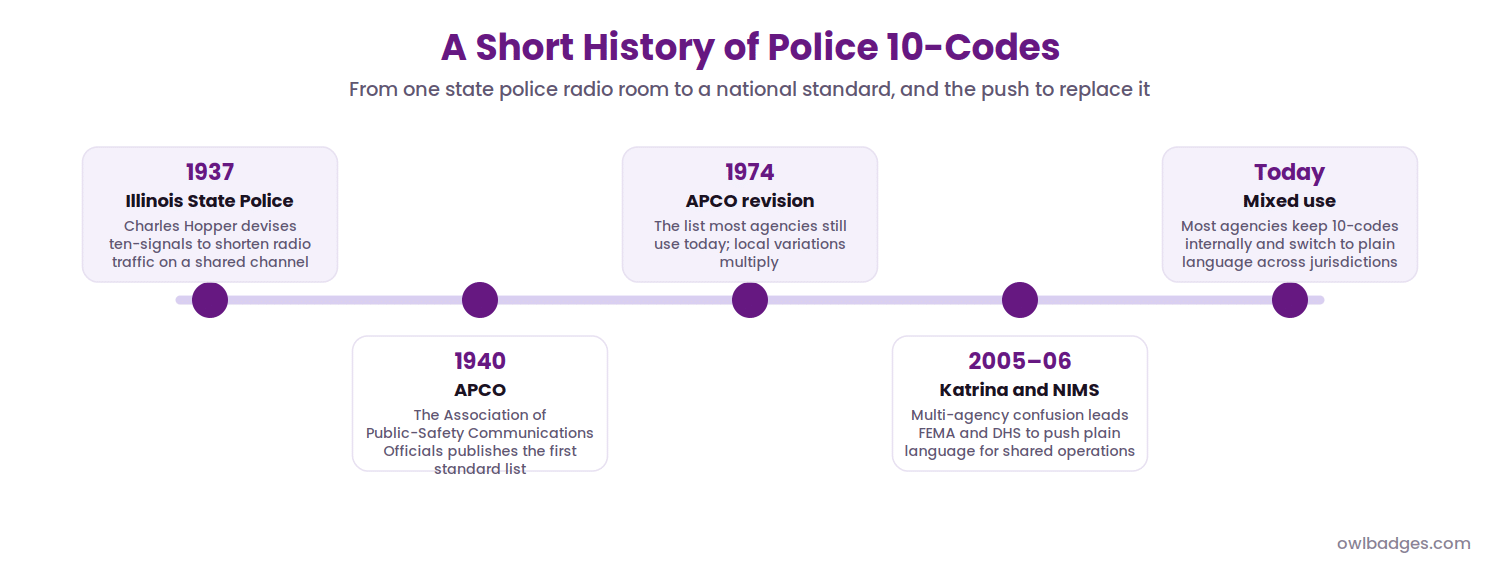
The 10-code system was developed between 1937 and 1940 by Charles “Charlie” Hopper, the communications director for the Illinois State Police. Working with the Association of Public-Safety Communications Officials (APCO), Hopper created the codes to address a practical problem with early radio technology.
In those days, radio transmitters needed a moment to reach full power after the microphone button was pressed. If an officer started speaking immediately, the first syllable would often be cut off. By prefixing every code with “ten,” officers gave their radios time to warm up while still transmitting useful information.
The word “ten” served as a verbal primer, giving early vacuum-tube radios the split-second they needed to reach full transmission power. Without this prefix, crucial first words would be lost to static. This technical necessity became a lasting tradition.
APCO published its first official list of 10-codes in January 1940. The system was revised in 1955 based on an analysis by the San Diego Police Department, and again in 1974 as part of APCO Project 14. These revisions attempted to standardize meanings across jurisdictions, though local variations persisted.
The codes entered popular culture through the 1950s television series “Highway Patrol” starring Broderick Crawford, whose frequent use of “10-4” made the phrase widely recognized. CB radio enthusiasts adopted the codes in the 1970s, further cementing phrases like “10-4, good buddy” in American vernacular.
Today, police officers, sheriff’s deputies, and state troopers across America still use variations of these codes, though a growing number of departments have transitioned to plain language for improved inter-agency communication.
Complete Police 10-Code List (APCO Standard)
Below is the complete list of standard APCO 10-codes. Keep in mind that meanings can vary by department and jurisdiction. The codes below represent the most widely accepted definitions.
These codes are not universal. A 10-32 in Texas may mean something completely different in Georgia. Always verify with your local department if you need accurate information for your jurisdiction.
| Code | Meaning |
|---|---|
| 10-0 | Caution |
| 10-1 | Unable to copy / Poor reception |
| 10-2 | Signal good / Receiving well |
| 10-3 | Stop transmitting |
| 10-4 ⭐ | Acknowledgment / OK / Message received |
| 10-5 | Relay message |
| 10-6 | Busy / Stand by unless urgent |
| 10-7 ⭐ | Out of service |
| 10-8 | In service / Available for assignment |
| 10-9 | Repeat message / Say again |
| 10-10 | Negative / Fight in progress (varies) |
| 10-11 | Dog case / Animal problem |
| 10-12 | Stand by / Visitors present |
| 10-13 | Weather and road conditions |
| 10-14 | Prowler report / Suspicious person |
| 10-15 | Prisoner in custody |
| 10-16 | Domestic disturbance |
| 10-17 | Meet complainant |
| 10-18 | Complete assignment quickly |
| 10-19 | Return to station |
| 10-20 ⭐ | Location / “What’s your 10-20?” |
| 10-21 | Call by telephone |
| 10-22 | Disregard / Cancel |
| 10-23 | Arrived at scene |
| 10-24 | Assignment completed |
| 10-25 | Report in person / Meet… |
| 10-26 | Detaining subject / ETA |
| 10-27 | Driver’s license information |
| 10-28 | Vehicle registration information |
| 10-29 | Check for wanted / NCIC check |
| 10-30 | Unnecessary use of radio / Does not conform to rules |
| 10-31 | Crime in progress |
| 10-32 ⭐ | Person with gun |
| 10-33 | Emergency / All units stand by |
| 10-34 | Riot / Major disturbance |
| 10-35 | Major crime alert |
| 10-36 | Correct time |
| 10-37 | Investigate suspicious vehicle |
| 10-38 | Stopping suspicious vehicle |
| 10-39 | Urgent / Use lights and siren |
| 10-40 | Silent run / No lights or siren |
| 10-41 | Beginning tour of duty |
| 10-42 ⭐ | Ending tour of duty (Also used ceremonially for officer deaths) |
| 10-43 | Information |
| 10-44 | Permission to leave |
| 10-45 | Dead animal / Deceased person (varies) |
| 10-46 | Assist motorist |
| 10-47 | Emergency road repairs needed |
| 10-48 | Traffic standard needs repair |
| 10-49 | Traffic light out |
| 10-50 | Accident / Traffic collision |
| 10-51 | Wrecker needed |
| 10-52 | Ambulance needed |
| 10-53 | Road blocked |
| 10-54 | Livestock on highway |
| 10-55 | Intoxicated driver |
| 10-56 | Intoxicated pedestrian |
| 10-57 | Hit and run |
| 10-58 | Direct traffic |
| 10-59 | Convoy or escort |
| 10-60 | Squad in vicinity |
| 10-61 | Personnel in area |
| 10-62 | Reply to message |
| 10-63 | Prepare to copy |
| 10-64 | Message for local delivery |
| 10-65 | Net message assignment |
| 10-66 | Message cancellation |
| 10-67 | Clear to read net message |
| 10-68 | Dispatch information |
| 10-69 | Message received |
| 10-70 | Fire alarm |
| 10-71 | Advise nature of fire |
| 10-72 | Report progress on fire |
| 10-73 | Smoke report |
| 10-74 | Negative |
| 10-75 | In contact with… |
| 10-76 | En route to… |
| 10-77 | ETA (Estimated Time of Arrival) |
| 10-78 | Need assistance |
| 10-79 | Notify coroner |
| 10-80 | Chase in progress |
| 10-81 | Breathalyzer report |
| 10-82 | Reserve lodging |
| 10-83 | Work school crossing |
| 10-84 | If meeting, advise ETA |
| 10-85 | Delayed due to… |
| 10-86 | Officer on duty |
| 10-87 | Pick up checks for distribution |
| 10-88 | Present telephone number of… |
| 10-89 | Bomb threat |
| 10-90 | Bank alarm |
| 10-91 | Pick up prisoner |
| 10-92 | Improperly parked vehicle |
| 10-93 | Blockade |
| 10-94 | Drag racing |
| 10-95 | Prisoner in custody |
| 10-96 | Mental subject / Psych patient |
| 10-97 | Check signal / Arrived at scene |
| 10-98 | Prison break / Jail escape |
| 10-99 ⭐ | Officer needs help / Emergency (Also: Wanted/stolen indicated) |
- 18,000+ law enforcement agencies in the United States
- 100+ different 10-code variations documented
- 1937 – Year the 10-code system was first developed
- 19 states had switched to plain language by 2009
Most Common Police Codes Explained
While there are nearly 100 standard 10-codes, most daily police communication relies on a handful of frequently used codes. Here’s an in-depth look at the codes you’re most likely to hear:
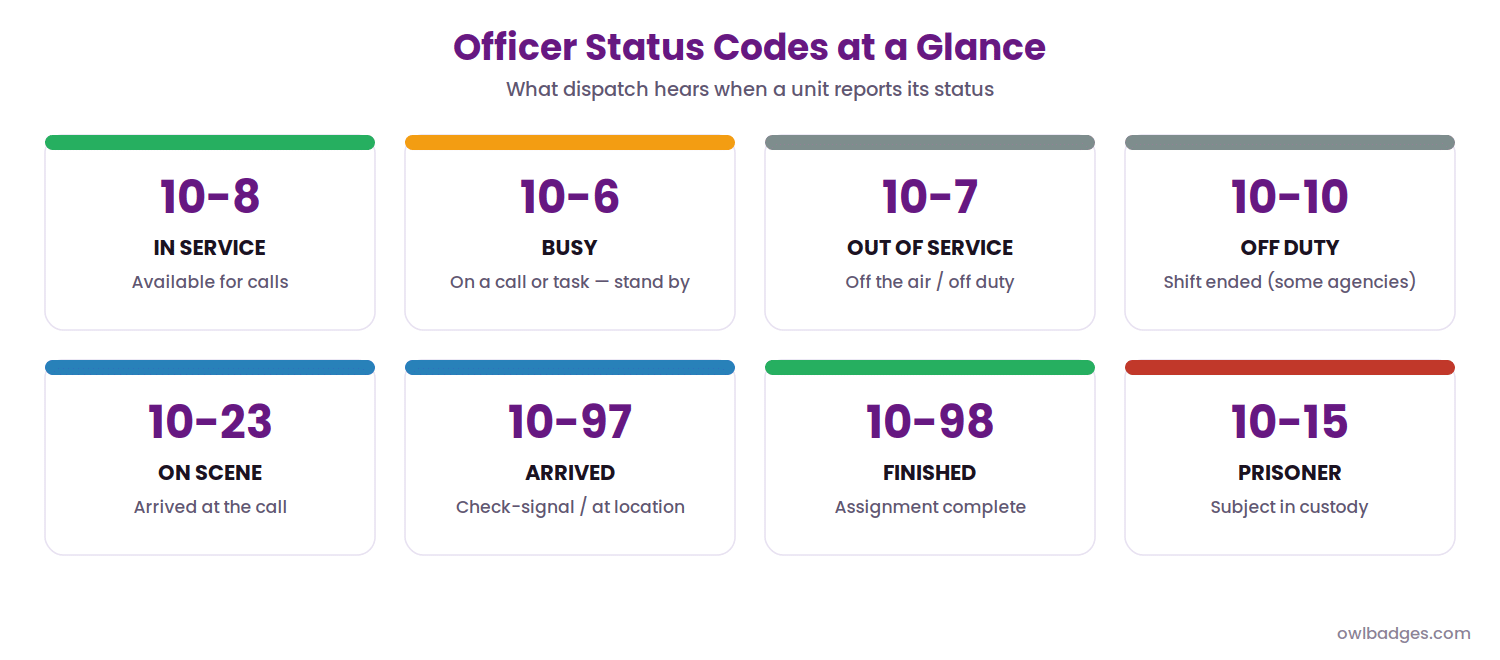

10-4: Acknowledgment / OK
By far the most famous police code, 10-4 simply means “acknowledged” or “message received and understood.” When dispatch gives an officer instructions and they respond with “10-4,” they’re confirming they heard and understood the message.
This code became so popular through television and CB radio culture that it’s now used colloquially by the general public. You might hear someone say “10-4” in everyday conversation to mean “got it” or “understood.”
10-20: Location
10-20 refers to location. When someone asks “What’s your 10-20?” they’re asking “Where are you?” Officers use this to report their current position or to ask dispatch or other units where they are.
Like 10-4, this code has crossed into popular culture. Truckers and CB radio enthusiasts commonly use “What’s your 20?” to ask about someone’s location.
10-7 and 10-8: Out of Service / In Service
10-7 means an officer is out of service and unavailable for calls. This could be for a meal break, end of shift, or any other reason they can’t respond to incidents.
10-8 is the opposite, indicating the officer is back in service and available for assignments. These codes help dispatch know which units are available at any given time.
When a police officer retires or passes away, a ceremonial “final 10-42” is often broadcast. Dispatch will call the officer’s badge number and announce they are “10-7 for the last time” and then “10-42, end of watch.” This tradition honors their service and formally marks their departure from duty.
10-99: Officer Needs Help
One of the most urgent codes, 10-99 signals that an officer needs immediate assistance. In some jurisdictions, this specifically means an officer is in danger. When this code is broadcast, all available units typically respond.
Note: In some areas, 10-99 means “wanted or stolen indicated” (referring to a vehicle or person check), so context and local variation matter significantly.
10-33: Emergency
10-33 indicates an emergency requiring all other units to stand by and clear the channel. When this code is called, non-essential radio traffic stops immediately to allow emergency communication to flow uninterrupted.
Every Police 10-Code Explained, One by One
The table above is the reference; the entries below answer each code the way people ask about it — what the number means, and where agencies disagree. Meanings follow the APCO standard unless noted; your local agency may differ.
10-0 to 10-19: status and radio-procedure codes
- 10-0 Use caution
- 10-0 police code means use caution — a warning to responding units; the least-used of the low codes.
- 10-1 Poor reception / receiving poorly
- 10-1 police code means poor reception / receiving poorly — a radio-quality report, not a status.
- 10-2 Good reception / receiving well
- 10-2 police code means good reception / receiving well — the reply to a 10-1 check.
- 10-3 Stop transmitting
- 10-3 police code means stop transmitting — clears the channel for a priority call.
- 10-4 Acknowledged, message received, OK
- 10-4 police code means acknowledged, message received, OK — the one everyone knows. What does 10-4 mean in police talk? Simply “understood.” It does not mean yes or no — only that the message was heard.
- 10-5 Relay the message
- 10-5 police code means relay the message — pass it to another unit. (Searches for a “5-10 code” are almost always 10-5.)
- 10-6 Busy / stand by
- 10-6 police code means busy / stand by — the unit is on a task and cannot take another call yet. 10-6 vs 10-7: busy is still on the air; out of service is not.
- 10-7 Out of service / off the air
- 10-7 police code means out of service / off the air — off duty, at the station, or otherwise unavailable. What does 10-7 mean in police code? The unit is not taking calls. Some agencies use 10-7 for an officer who has died in the line of duty (“10-7 forever”).
- 10-8 In service / available
- 10-8 police code means in service / available — the opposite of 10-7 — back on the air and ready for calls. What is a 10-8? A unit reporting for duty.
- 10-9 Repeat the last message
- 10-9 police code means repeat the last message — say again.
- 10-10 Off duty / negative (varies)
- 10-10 police code means off duty / negative (varies) — APCO uses 10-10 for “fight in progress”; many agencies use it for off duty or as a negative reply. The 10-10 police code is one of the most agency-dependent.
- 10-11 Dog case / talking too rapidly (varies)
- 10-11 police code means dog case / talking too rapidly (varies) — APCO: animal problem; other agencies: slow down your transmission.
- 10-12 Stand by / visitors present
- 10-12 police code means stand by / visitors present — hold the channel, or “I have someone with me — be careful what you say.”
- 10-13 Weather and road report (varies)
- 10-13 police code means weather and road report (varies) — in New York the 10-13 police code is the emergency “officer needs assistance” — the best-known local variant in the country.
- 10-14 Prowler report
- 10-14 police code means prowler report — suspicious person on foot.
- 10-15 Prisoner in custody / en route
- 10-15 police code means prisoner in custody / en route — a subject has been arrested and is being transported. What is a 10-15 in police code? An arrest.
- 10-16 Domestic disturbance
- 10-16 police code means domestic disturbance — a family or household call.
- 10-17 Meet complainant
- 10-17 police code means meet complainant — contact the caller.
- 10-18 Urgent / complete assignment quickly
- 10-18 police code means urgent / complete assignment quickly — expedite.
- 10-19 Return to station
- 10-19 police code means return to station — head back to headquarters.
10-20 to 10-39: location, checks and calls
- 10-20 Location
- 10-20 police code means location — “what’s your 20?” asks where a unit is. The 10-20 police code crossed into everyday speech through CB radio.
- 10-21 Call by telephone
- 10-21 police code means call by telephone — take it off the radio.
- 10-22 Disregard
- 10-22 police code means disregard — cancel the last instruction.
- 10-23 Arrived at scene
- 10-23 police code means arrived at scene — on location.
- 10-24 Assignment completed
- 10-24 police code means assignment completed — clearing the call.
- 10-27 Driver’s license check
- 10-27 police code means driver’s license check — run the license.
- 10-28 Vehicle registration check
- 10-28 police code means vehicle registration check — run the plate. 10-27 and 10-28 are the two codes of every traffic stop.
- 10-29 Check for wanted / records check
- 10-29 police code means check for wanted / records check — warrants and stolen status.
- 10-31 Crime in progress
- 10-31 police code means crime in progress — a live call.
- 10-32 Person with a gun
- 10-32 police code means person with a gun — armed subject. The 10-32 police code is a priority broadcast in every agency that uses it.
- 10-33 Emergency — all units stand by / clear the channel
- 10-33 police code means emergency — all units stand by / clear the channel — the channel is reserved for an emergency; some agencies use 10-33 as “officer needs help.”
- 10-34 Riot
- 10-34 police code means riot — large-scale disturbance.
- 10-35 Major crime alert
- 10-35 police code means major crime alert — be on the lookout.
- 10-36 Correct time
- 10-36 police code means correct time — a time check.
- 10-38 Stopping a suspicious vehicle
- 10-38 police code means stopping a suspicious vehicle — the traffic-stop call-out.
10-40 to 10-69: traffic, medical and incident codes
- 10-42 Ending tour of duty
- 10-42 police code means ending tour of duty — the last 10-42 is the traditional final radio call for a fallen or retiring officer.
- 10-45 Animal carcass / fatality (varies)
- 10-45 police code means animal carcass / fatality (varies) — APCO: dead animal; some agencies: a fatality on scene.
- 10-46 Assist motorist
- 10-46 police code means assist motorist — a stranded driver.
- 10-50 Traffic accident (varies)
- 10-50 police code means traffic accident (varies) — APCO: accident; some agencies use 10-50 for a welfare check. The 10-50 police code is worth confirming locally.
- 10-52 Ambulance needed
- 10-52 police code means ambulance needed — request EMS.
- 10-54 Livestock on the highway
- 10-54 police code means livestock on the highway — animals in the road.
- 10-55 Intoxicated driver
- 10-55 police code means intoxicated driver — DUI.
- 10-56 Intoxicated pedestrian (varies)
- 10-56 police code means intoxicated pedestrian (varies) — APCO: drunk pedestrian; several agencies use 10-56 for a suicide or attempted suicide, which is why the question “what is a 10-56?” gets two different answers.
- 10-57 Hit and run
- 10-57 police code means hit and run — a driver who left the scene.
- 10-67 Person calling for help / death report (varies)
- 10-67 police code means person calling for help / death report (varies) — APCO: someone requesting assistance; in some agencies 10-67 is a report of a dead person. “What does 10-67 mean?” depends on the agency.
10-70 to 10-100: emergencies, custody and clearing
- 10-70 Fire
- 10-70 police code means fire — fire alarm or fire in progress.
- 10-78 Need assistance
- 10-78 police code means need assistance — back-up requested, non-emergency.
- 10-79 Notify coroner
- 10-79 police code means notify coroner — a death on scene. The 10-79 police code is used consistently across most agencies.
- 10-80 Chase in progress (varies)
- 10-80 police code means chase in progress (varies) — a pursuit; some agencies use 10-80 for a fire alarm.
- 10-85 Delayed due to…
- 10-85 police code means delayed due to… — running late, reason follows.
- 10-95 Prisoner / subject in custody
- 10-95 police code means prisoner / subject in custody — used by agencies that reserve 10-15 for transport.
- 10-96 Mental subject
- 10-96 police code means mental subject — a person in psychiatric crisis.
- 10-97 Arrived at scene / check signal
- 10-97 police code means arrived at scene / check signal — on location (the common alternative to 10-23).
- 10-98 Assignment completed / finished with last
- 10-98 police code means assignment completed / finished with last — clear and available.
- 10-99 Wanted or stolen record / officer needs help (varies)
- 10-99 police code means wanted or stolen record / officer needs help (varies) — APCO: a records hit; many agencies use 10-99 as the emergency officer-down call. Confirm locally.
- 10-100 Dead body (varies)
- 10-100 police code means dead body (varies) — used in some agencies; others use 10-79 or plain language.
Code 1, Code 2, Code 3 and Code 4
- Code 1 Routine response
- Code 1 means respond routinely — no lights, no siren, obey traffic law.
- Code 2 Urgent response
- Code 2 means expedite without lights or siren in most agencies (some allow lights only).
- Code 3 Emergency response
- Code 3 means lights and siren — the emergency run.
- Code 4 No further assistance needed
- Code 4 police code means the situation is under control and other units can cancel. What does Code 4 mean? “We’re fine here.” It is a status, not a response level, and it is the most-searched code in this family.
- Code 5 Stakeout / plainclothes in the area (varies)
- Code 5 tells units to stay away from a location because a surveillance operation is in progress.
- Code 6 Out of the car for investigation (varies)
- Code 6 means the officer has left the vehicle to investigate; Code 6 with a location is a request for back-up in some agencies.
California 11-Codes
California law enforcement agencies, particularly the California Highway Patrol (CHP), use an additional set of “11-codes” alongside standard 10-codes. These codes address situations specific to traffic enforcement and California law.
| Code | Meaning |
|---|---|
| 11-10 | Take a report |
| 11-24 | Abandoned vehicle |
| 11-25 | Traffic hazard |
| 11-41 | Ambulance needed |
| 11-42 | No ambulance needed |
| 11-44 | Coroner case (deceased person) |
| 11-48 | Provide transportation |
| 11-54 | Suspicious vehicle |
| 11-80 | Major accident – Loss of life |
| 11-81 | Minor accident – No injuries |
| 11-82 | Accident – Injury |
| 11-83 | Accident – No details |
| 11-85 | Tow truck needed |
| 11-99 | Officer needs help – EMERGENCY |
Police Signal Codes
In addition to 10-codes and 11-codes, many departments use “signal codes” – single or double-digit numbers without a prefix that indicate specific situations. These are often used in the Southeast United States.
| Signal | Meaning |
|---|---|
| Signal 0 | Graveyard dead / Obviously deceased |
| Signal 1 | Call your station |
| Signal 4 | No further assistance needed |
| Signal 7 | Out for investigation |
| Signal 13 | Major disaster activation |
| Signal 20 | Officer needs immediate assistance |
| Signal 30 | Homicide |
| Signal 36 | Shooting / Shots fired |
| Signal 63 | Prepare to copy information |
Response Codes (Code 1, 2, 3)
These codes indicate how quickly an officer should respond to a call:
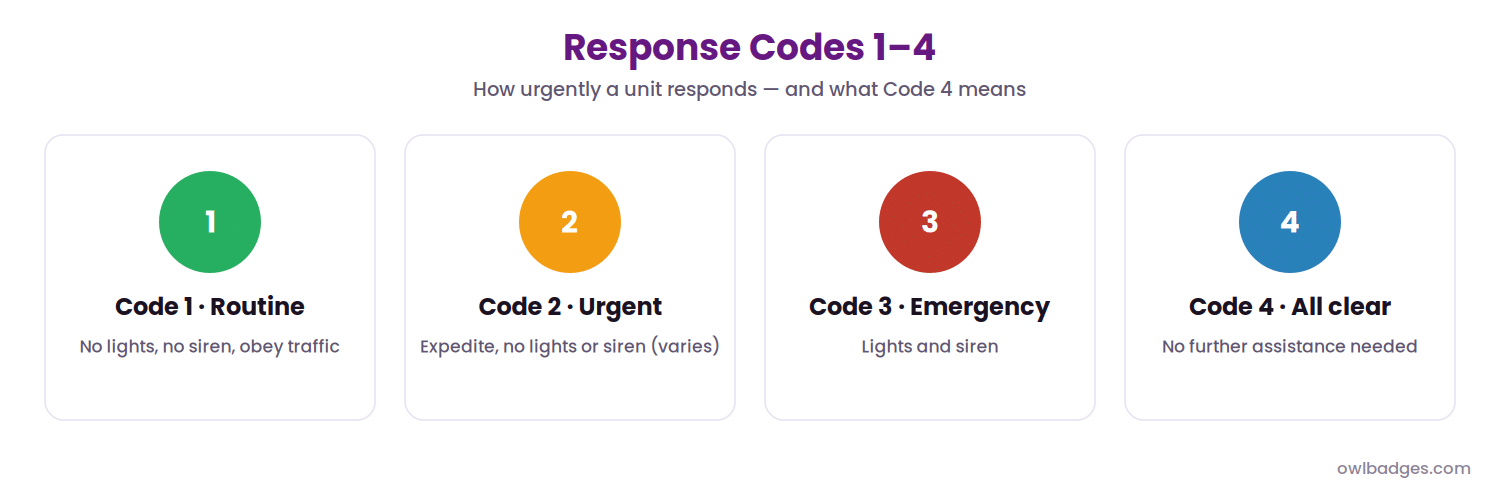
- Code 1: Respond at your convenience – non-urgent call
- Code 2: Urgent response – respond quickly but no lights/siren
- Code 3: Emergency response – lights and siren, immediate response required
- Code 4: No further assistance needed – situation under control
- Code 5: Stakeout in progress – stay away
- Code 6: Out for investigation
- Code 7: Mealtime / Taking a break
Police Phonetic Alphabet (NATO/ICAO)
When spelling out names, license plates, or other information over the radio, officers use the NATO phonetic alphabet to ensure clarity. This prevents confusion between similar-sounding letters like “B” and “D” or “M” and “N.”
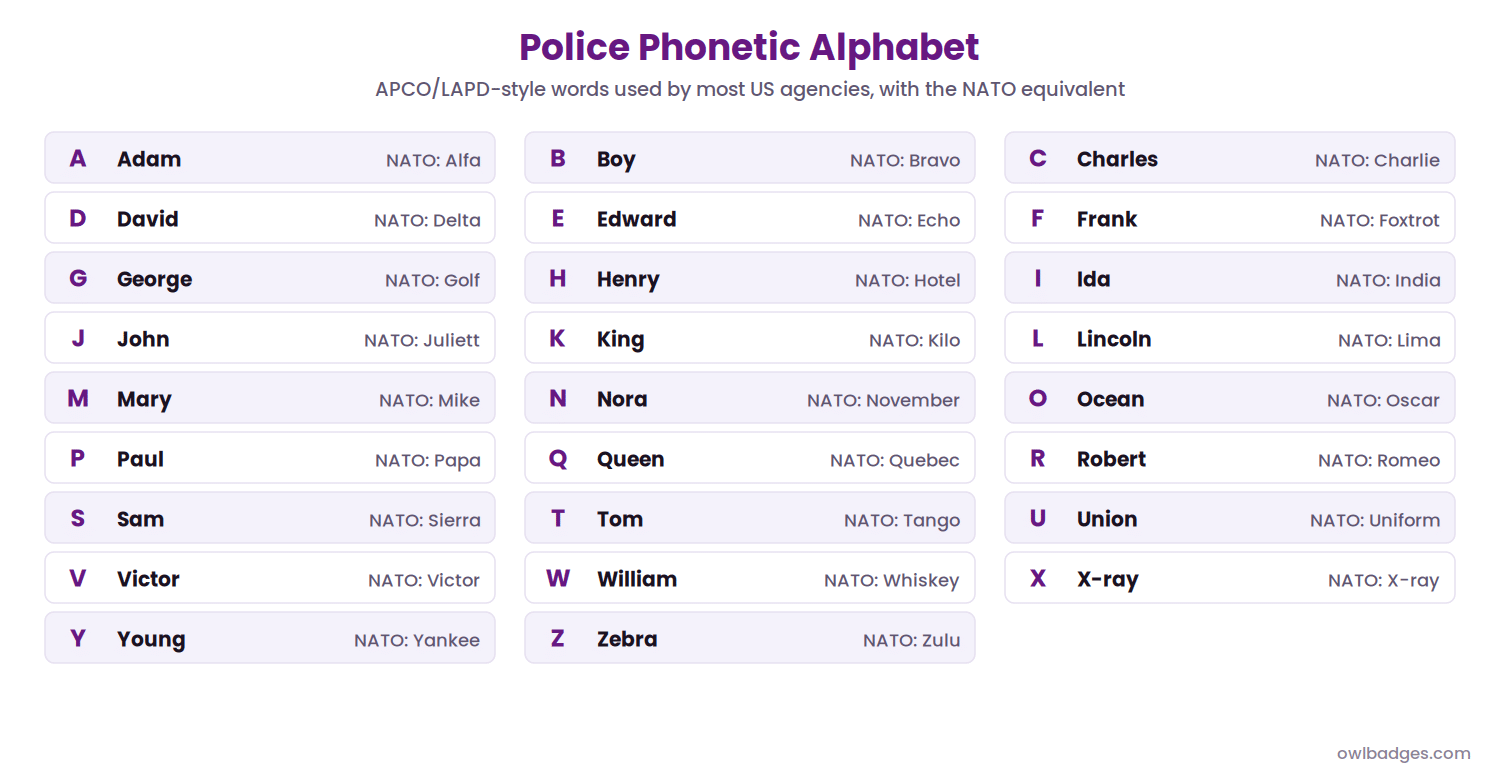
Some older departments may still use the LAPD/APCO phonetic alphabet, which uses names instead: Adam, Boy, Charles, David, Edward, Frank, George, Henry, Ida, John, King, Lincoln, Mary, Nora, Ocean, Paul, Queen, Robert, Sam, Tom, Union, Victor, William, X-ray, Young, Zebra.
Why Police Codes Vary by Department
One of the most confusing aspects of police codes is that they’re not universal. A 10-32 might mean “person with gun” in one jurisdiction and “backup required” in another. This variation exists for several reasons:
Historical Development
When APCO published its original codes in 1940, adoption was voluntary. Many departments had already developed their own systems or modified the APCO codes to better fit their local needs. These modifications became entrenched over decades of use.
Local Needs
A rural sheriff’s department in Wyoming has different communication needs than the NYPD. Coastal departments might need codes for maritime incidents, while departments in agricultural areas might need livestock-related codes. Local adaptation made practical sense.
No Central Authority
Unlike the military, there’s no central authority mandating that all police departments use identical codes. Each of the approximately 18,000 law enforcement agencies in the United States operates somewhat independently, leading to a patchwork of code systems.
During Hurricane Katrina rescue operations in 2005, the lack of standardized codes created dangerous communication breakdowns. Officers from different jurisdictions couldn’t understand each other’s radio traffic. A 10-code that meant “lunch break” in one department meant “emergency” in another. This disaster directly led to federal recommendations to abandon 10-codes in favor of plain language.
The Shift to Plain Language
Following the communication failures during Hurricane Katrina, the U.S. Department of Homeland Security and FEMA began strongly recommending that emergency services adopt “plain language” communication instead of coded systems.
In 2006, the National Incident Management System (NIMS) formally recommended against using 10-codes for inter-agency communication. The argument was straightforward: when lives are on the line, there’s no room for misinterpretation.
Arguments For Plain Language
- Universal Understanding: “Officer down” means the same thing everywhere
- Inter-agency Cooperation: Critical during disasters, pursuits across jurisdictions, and mutual aid
- Reduced Training Time: New officers don’t need to memorize extensive code lists
- Public Safety: Civilian witnesses can understand and provide better information
Arguments For Keeping Codes
- Brevity: “10-4” is faster than “message received and understood”
- Tradition: Codes are deeply embedded in police culture and identity
- Tactical Privacy: Codes provide some obscurity from scanner listeners (though this is largely a myth, as code lists are widely published)
- Muscle Memory: Veteran officers have decades of ingrained habits
By 2011, approximately 19 states had officially transitioned to plain language, though adoption remains uneven. Many departments now use a hybrid approach: plain language for complex situations and inter-agency communication, but familiar codes like 10-4 for routine acknowledgments.
Some argue that codes keep communications private from scanner listeners. In reality, code lists have been published online for decades, and anyone with a police scanner app can easily look up meanings. True communication security comes from encrypted digital radio systems, not obscure codes.
Frequently Asked Questions About Police 10 Codes
What does 10-4 mean?
10-4 means “acknowledgment” or “message received and understood.” It’s the most widely recognized police code and has crossed into everyday language. When someone says “10-4,” they’re confirming they heard and understood what was communicated.
What does 10-20 mean?
10-20 refers to location. When someone asks “What’s your 10-20?” they’re asking “Where are you?” or “What is your current location?” This code is commonly used by both police officers and CB radio enthusiasts.
Are police 10 codes the same everywhere?
No, police 10 codes are NOT universal. While some codes like 10-4 are widely consistent, many codes have different meanings in different jurisdictions. A 10-32 might mean “person with gun” in one department and something entirely different in another. This lack of standardization led to federal recommendations to use plain language instead.
What is 10-42 and why is it significant?
10-42 means “ending tour of duty.” It’s particularly significant because it’s used ceremonially to honor fallen or retired officers. A “final 10-42” broadcast marks an officer’s last sign-off, whether due to retirement or death in the line of duty. It’s a solemn tradition in law enforcement.
Why do police use codes instead of plain language?
Police codes were originally developed in 1937 because early radio transmitters needed a moment to reach full power. The “ten” prefix gave radios time to warm up. Codes also provide brevity, some privacy from scanner listeners, and have become part of police culture and tradition. However, many departments are now switching to plain language for better inter-agency communication.
What does Code 3 mean?
Code 3 means emergency response with lights and siren activated. It indicates the highest priority response where an officer should proceed as quickly and safely as possible. Code 1 means non-urgent (respond at your convenience), Code 2 means urgent but no lights/siren, and Code 3 means full emergency response.
What is 10-99?
In many jurisdictions, 10-99 means “officer needs emergency help” or indicates a critical situation. However, in some areas it means “wanted or stolen indicated” when running a vehicle or person check. This is a prime example of why codes vary by department and why plain language is increasingly recommended.
Do all police departments still use 10 codes?
No. Following the Hurricane Katrina communication failures in 2005, federal agencies recommended switching to plain language. By 2011, approximately 19 states had officially transitioned. Many departments now use a hybrid approach with plain language for complex situations and traditional codes for routine acknowledgments.
- 10-4 (acknowledged) and 10-20 (location) are the most universally recognized police codes
- Police codes were developed in 1937 to accommodate early radio technology limitations
- Codes are NOT universal – meanings vary significantly between jurisdictions
- Following Hurricane Katrina, federal agencies recommended switching to plain language
- Many departments now use a hybrid approach: codes for routine communication, plain language for complex situations
- The 10-42 (end of watch) tradition remains a solemn way to honor officers
What is a 10-8 in police code?
10-8 means “in service” — the unit is on the air and available for calls. Its opposite is 10-7, out of service.
What does 10-7 mean?
10-7 means “out of service.” An officer going 10-7 is off the air — off duty, at the station, or on a break. “10-7 forever” is a memorial phrase for an officer who has died.
What is a 10-33?
10-33 means emergency traffic: all units stand by and clear the channel. In some agencies it is the officer-needs-help call itself.
What does Code 4 mean in police terms?
Code 4 means no further assistance is needed — the scene is under control and additional units can cancel. It is a status code, separate from the response levels Code 1 (routine), Code 2 (urgent) and Code 3 (lights and siren).
What does 10-56 mean?
Under the APCO standard, 10-56 is an intoxicated pedestrian. Several agencies use 10-56 for a suicide or attempted suicide, so the answer depends on the department; that split is why the code is searched so often.
Every department on this page’s radio wears a badge we can make.
Custom police badges by rank — silver for officers, gold for command — personalized with department, rank and badge number. One badge or a whole department.
Sources and further reading
- APCO International — the association that standardized the ten-signals in 1940 and revised them in 1974
- FEMA National Incident Management System — the plain-language guidance for multi-agency operations
- Ten-code — Wikipedia overview with the APCO list and notable local variants
- Individual agency radio-code cards (many departments publish theirs) for local meanings
Owl Badges manufactures badges for the agencies that use these codes; this guide reflects the APCO standard and the variations we hear about from departments nationwide. Reviewed September 2026.
Related Articles
Police Badge Number Lookup: How to Identify Officers
Learn how police badge numbers work and how to verify an officer’s identity.
Sheriff vs Police: What’s the Difference?
Understand the key differences between sheriffs and police officers.
What Does the Black Band on a Police Badge Mean?
The meaning and tradition behind the mourning band worn by officers.
Shanna Campbell
Custom badge manufacturer serving law enforcement since 2010
The Shanna Campbell creates custom police badges, sheriff badges, fire department badges, and security badges for agencies across America. We’re passionate about the traditions and professionalism of law enforcement.