


|
Professional Design 2025
Private Investigator Badge Design GuideComplete design authority guide covering compliance, psychology, materials, shapes, and typography to create professional PI credentials that build client trust |
 |
Effective private investigator badge design balances authority with legal compliance. The most professional designs use oval or circular shapes (not shields), black or gold color schemes (avoiding law enforcement blue/red), prominent “PRIVATE INVESTIGATOR” text larger than all other elements, clearly visible license numbers in 1/4″ minimum lettering, and high-quality brass construction with durable plating. Your badge creates the first impression with every client – invest in design that communicates professionalism, not amateur decoration.
Why Badge Design Matters for Private Investigators
Your private investigator badge serves as your visual signature – the credential clients see before reading your business card, viewing your website, or hearing your qualifications. In the first 3 seconds of meeting a client, they judge your professionalism based almost entirely on visual cues, with your badge playing a starring role in that assessment.
The difference between a well-designed badge and a cheap-looking credential can literally be the difference between landing a $5,000 case or being passed over for a competitor. Attorneys, insurance adjusters, and corporate clients evaluate dozens of PIs – those with professional credentials get serious consideration, while those with amateur-looking badges get mentally filed under “not credible.”
First Impressions by the Numbers
📊 Research on Professional Credibility
- 3 seconds: Average time for initial credibility assessment
- 94%: Of first impressions relate to design and visual appearance
- 200%: Premium PIs charge compared to discount competitors – justified by professional presentation
- $500-800: Investment in quality credentials pays for itself with first retained client
Professional badge design isn’t vanity – it’s business strategy. The most successful PIs understand that premium rates require premium presentation. You cannot command $150/hour fees while carrying a $20 badge that looks like it came from a costume shop.
Legal Design Requirements
Before considering aesthetics, ensure compliance. Every state with PI licensing has badge requirements, and violations carry serious consequences including license suspension and criminal charges for impersonation.
Universal Legal Requirements
These requirements apply in virtually all states that regulate PI badges:
✅ Required Elements
- “Private Investigator” or “Licensed Private Detective” designation
- State license number prominently displayed
- Company/agency name (not just personal name)
- Clear differentiation from law enforcement
- State designation in some jurisdictions
❌ Prohibited Elements
- Terms “Police,” “Law Enforcement,” “Officer” (without “Private”)
- Five-pointed stars (associated with sheriffs and federal agents)
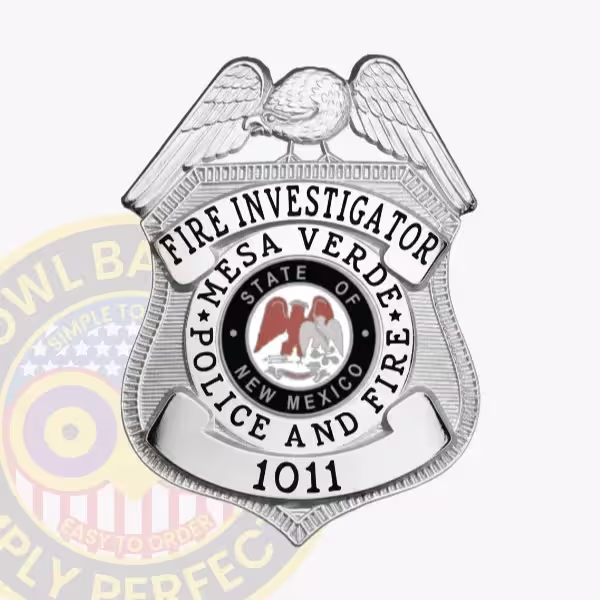
- Eagles (federal symbol)
- State seals or government emblems
- Red or blue color schemes (law enforcement colors)
- Shield shapes in restrictive states like California
For comprehensive state-by-state requirements, review our complete guide to investigator badge regulations before finalizing any design.
California: Cannot use shield shapes, must avoid any resemblance to custom-designed police department badges, “Private Investigator” text must dominate design, state seal prohibited.
Texas: All badge designs must be registered with Texas DPS before production. Badge design registration costs $25 and takes 10-15 business days for approval.
Essential Design Elements
Text Hierarchy and Placement
Professional badge design follows strict hierarchy – certain elements must dominate while others provide supporting context.
📐 Proper Text Hierarchy (Largest to Smallest)
1. “PRIVATE INVESTIGATOR” (Primary Text)
Largest text element, center position, bold weight. This identifies your role and must be instantly readable from 6 feet away. Font size typically 14-18pt depending on badge size.
2. License Number (Secondary Text)
Second-most prominent element, positioned below or above primary text. Minimum 1/4 inch lettering height as required by most states. Format: “LICENSE #12345” or “CA PI #12345”
3. Company Name (Supporting Text)
Smaller than primary elements but clearly legible. Positioned at top arc or bottom of badge. Example: “Apex Investigations, LLC”
4. State Designation (If Required)
Smallest text, typically at very bottom or side. Example: “State of California” or simply “CALIFORNIA”
License Number Display Standards
License number visibility isn’t just good practice – it’s legally required in most states. Poor license number placement is one of the most common compliance failures.
- Height: Minimum 1/4 inch (6.35mm) tall – smaller text doesn’t meet readability standards
- Contrast: Dark text on light background or light text on dark background – no low-contrast combinations
- Position: Central location, not hidden on sides or bottom edge
- Format: Include “LICENSE #” or “LIC #” prefix for clarity
- Font: Simple, readable typeface – no decorative fonts that reduce legibility
Design Psychology for Private Investigators
Effective badge design leverages psychological principles to create desired impressions. The goal: Project authority and professionalism without suggesting law enforcement power you don’t possess.
The Authority-Approachability Balance
Detective badges and law enforcement credentials emphasize authority over approachability because officers need immediate compliance. Private investigators need a different balance – you must appear professional and authoritative while remaining approachable since clients voluntarily engage your services.
| Design Element | High Authority | Balanced (Recommended) | High Approachability |
|---|---|---|---|
| Shape | Shield, star | Oval, unique shape | Circle, rounded |
| Color | Silver, blue | Gold, black | Bronze, earth tones |
| Symbols | Eagle, scales | Magnifying glass, compass | Simple geometric |
| Typography | Bold serif, all caps | Medium weight, mixed case | Light sans-serif, lowercase |
Most successful PIs operate in the “Balanced” column – professional and credible without appearing aggressive or intimidating.
Color Psychology
Color choice communicates volumes before anyone reads your text. Choose colors that align with your business positioning and comply with state regulations.
🟡 Gold / Yellow
Message: Premium service, established authority, traditional professionalism
Best for: High-end clients, corporate investigations, long-established agencies
⚫ Black
Message: Modern, serious, no-nonsense professionalism
Best for: Corporate clients, fraud investigation, insurance work
⚪ Silver / Gray
Message: Modern, technical, sophisticated approach
Best for: Tech investigations, cyber cases, younger demographic
- Blue: Strongly associated with police – prohibited or discouraged in many states
- Red: Associated with fire department badges and some law enforcement – avoid in most cases
- Green: Associated with border patrol, park rangers – can work but verify state rules
Badge Shapes and Their Meanings
Shape selection significantly impacts how clients perceive you. Different shapes carry different psychological weight and compliance implications.
Traditional Shield
Perception: Authority, protection, traditional law enforcement
Compliance: Prohibited or discouraged in California, Florida, and other restrictive states
Best For: States with moderate regulations, PIs with law enforcement background
Caution: Even in permissive states, shield shapes toe the line of law enforcement resemblance
Oval / Elliptical
Perception: Professional, modern, approachable authority
Compliance: Accepted in all states, preferred in restrictive jurisdictions
Best For: Most PIs, especially those working with corporate clients or attorneys
Recommended: This is the safest choice for multi-state operations and professional image
Circle / Round
Perception: Approachable, modern, distinctive
Compliance: Accepted in all states, clear differentiation from LE
Best For: Private investigators emphasizing investigative work over authority
Consideration: Less traditional, may appear less formal to some clients
Star Shape
Perception: Sheriff/federal agent association, high authority
Compliance: Prohibited in most states – five-pointed stars specifically banned
Best For: Don’t use star shapes for PI badges
Exception: Texas/Western regions may accept six-pointed stars, but verify carefully
Custom Unique Shapes
Perception: Brand differentiation, memorable identity
Compliance: Usually acceptable if not resembling law enforcement
Best For: Established agencies with strong brand identity
Examples: Octagon, hexagon, custom shield variants, keystone shapes
Typography and Readability
Font selection determines badge readability and professional appearance. Poor typography ruins otherwise good designs.
Font Categories for Badges
✅ Recommended Fonts
Serif (Traditional):
- Times New Roman
- Georgia
- Garamond
Sans-Serif (Modern):
- Arial
- Helvetica
- Gotham
❌ Fonts to Avoid
Decorative:
- Script fonts
- Ornate serifs
- Medieval styles
Poor Readability:
- Ultra-thin weights
- Compressed fonts
- Novelty typefaces
Readability Standards
- 6-Foot Test: All text should be readable from 6 feet away – this is standard meeting/introduction distance
- Contrast Ratio: Minimum 4.5:1 contrast between text and background colors
- Letter Spacing: Avoid cramped text – allow breathing room between characters
- All Caps vs. Mixed Case: “PRIVATE INVESTIGATOR” in all caps for emphasis, license numbers can use mixed case for readability
- Font Weight: Medium to bold weight for primary text, avoid ultra-light or ultra-heavy extremes
Material and Finish Selection
Material choice affects both appearance and durability. Professional badges use metal construction – cloth or plastic badges communicate “amateur” or “security guard” rather than “professional investigator.”
Material Options
| Material | Durability | Weight Feel | Cost | Best For |
|---|---|---|---|---|
| Brass | Excellent | Premium | $$$$ | High-end PIs |
| Nickel Silver | Excellent | Professional | $$$ | Most PIs (recommended) |
| Zinc Alloy | Good | Adequate | $$ | Budget-conscious |
| Stainless Steel | Excellent | Modern | $$$ | Tech/corporate focus |
Industry Standard: Brass with gold or nickel plating provides the best balance of quality, appearance, and cost. This is what 80% of professional PIs carry.
Finish Options
- Mirror Polish: High shine, premium appearance, requires regular maintenance to prevent tarnishing
- Satin Finish: Semi-gloss professional appearance, hides minor scratches, most popular choice
- Antique Finish: Aged appearance, traditional look, distinctive character but less formal
- Two-Tone: Combines finishes (e.g., mirror text on satin background) for depth and visual interest
Using Online Design Tools
Modern badge design no longer requires professional graphic designers. Online tools let you create compliant, professional designs yourself.
Design Process: Step-by-Step
Step 1: Visit the online badge design tool
Step 2: Select badge shape (oval recommended for universal compliance)
Step 3: Choose color scheme (black with gold text = professional standard)
Step 4: Input text elements:
- “PRIVATE INVESTIGATOR” (largest text)
- Your license number
- Company name
- State designation if required
Step 5: Review design proof carefully – check spelling, license number accuracy, compliance with state rules
Step 6: Submit for production or request consultation if unsure about compliance
Professional badge manufacturers provide design assistance at no extra charge. If you’re unsure about state requirements or design choices, request a consultation before finalizing your order.
- Badge design creates your first impression – invest in quality that reflects professional rates
- “PRIVATE INVESTIGATOR” text must be the largest, most prominent element on your badge
- Oval or circular shapes provide universal compliance and professional appearance
- Black with gold/silver text is the safest, most professional color scheme
- License numbers must be minimum 1/4 inch lettering height for readability
- Brass with nickel plating offers best quality-to-cost ratio
- Avoid shields, stars, eagles, and law enforcement colors
- Use online design tools or request professional consultation for state-compliant designs
Private investigator badge designs and fire department badges share the same manufacturing process — the fire department eagle shield badge 13-F30 is produced with the same precision and quality standards.
The private investigator badge PI3-C11DT features a distinctive eagle top design — a popular choice for PIs who want their credential to carry the same visual weight as law enforcement eagle top badges while clearly identifying as a private investigator.
PI badge design guides recommend the shield with eagle style for investigators working corporate security and fraud cases — the PI eagle shield badge 13-B17 projects the right level of authority for high-stakes investigations.