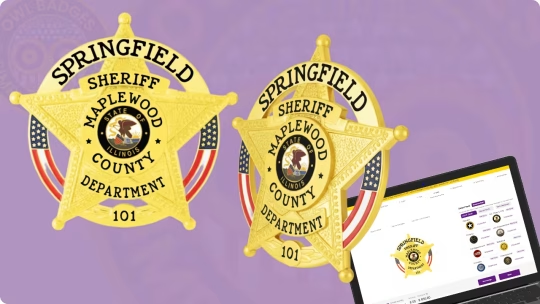

Sheriff badges are the official credentials worn by elected sheriffs and their deputies in county law enforcement agencies across the United States. Distinguished by their iconic star shapes—particularly the 5-point, 6-point, and 7-point star designs—sheriff badges feature county names, state seals, rank designations, and individual badge numbers. The sheriff holds an elected position with constitutional authority, while deputies are appointed officers who wear similar but distinctly ranked badges. Modern sheriff badges are crafted from brass or zinc alloy with gold, silver, or black finishes.
Key components of a traditional sheriff badge showing rank, state seal, county name, and identification elements.
What Are Sheriff Badges?
Sheriff badges serve as the official credentials and symbols of authority for county law enforcement officers in the United States. Unlike municipal police departments that serve cities, sheriff’s offices operate at the county level with jurisdiction that typically extends across all unincorporated areas and often provides services to smaller municipalities within the county.
The sheriff holds a unique position in American law enforcement. In 48 states, sheriffs are elected officials who answer directly to county voters rather than appointed administrators. This constitutional role gives the sheriff’s badge particular significance—it represents not just law enforcement authority but also the democratic mandate of the community.
Sheriff badges typically feature star shapes that distinguish them from the shield designs more common in municipal police departments. The most prevalent styles include the classic 5-point star, the traditional 6-point star, and the distinctive 7-point star associated with California sheriff’s offices. These designs trace their origins to the frontier era when the star symbolized Texas Rangers and western lawmen.
The office of sheriff is the oldest law enforcement position in the United States, predating the formation of the country itself. The role was inherited from English common law, where “shire reeves” (later shortened to “sheriffs”) served as the king’s representatives in local counties.
Learn more about other law enforcement credentials in our guide to police officer badges.
History of Sheriff Badges in America
The history of sheriff badges in America reflects the broader evolution of law enforcement from frontier justice to modern professional policing. Early American sheriffs, like their English predecessors, often wore simple markers of office rather than standardized badges. The iconic star-shaped badge emerged during the westward expansion of the 1800s.
During the frontier era, sheriff badges were frequently handmade from available materials including Mexican coins, tin, and brass. These improvised badges featured simple star designs that could be easily recognized at a distance. The five-point star became particularly associated with Texas and the Southwest, while six and seven-point stars developed in other regions.
The tradition of cutting badges from silver Mexican pesos began in the 1840s along the Texas border. These “peso badges” featured stars cut from coins, with the remaining ring used as the badge’s circular border—a design element still seen in many sheriff badges today.
By the late 19th century, badge manufacturing became more standardized. Companies began producing die-struck badges with consistent designs, though counties maintained distinct styles. The early 1900s saw the introduction of hard enamel work and more elaborate designs incorporating state seals, county names, and rank designations.
The modern era of sheriff badges began after World War II, when improvements in manufacturing technology allowed for more detailed and durable badges. Today’s sheriff badges maintain traditional design elements while incorporating modern materials and construction techniques.
Sheriff vs. Deputy Sheriff Badges
Understanding the distinction between sheriff and deputy sheriff badges requires understanding the organizational structure of a sheriff’s office. The sheriff is the chief law enforcement officer of the county—an elected official who oversees all department operations. Deputy sheriffs are sworn officers appointed by the sheriff to carry out law enforcement duties.
Badge designs typically reflect this hierarchy through several distinguishing features. Sheriff badges often feature gold finishes, unique numbering (frequently “001” or “1”), and distinctive design elements such as eagles or special border treatments. Deputy badges generally use silver finishes for lower ranks, with gold becoming more common at supervisory levels.
| Feature | Sheriff Badge | Deputy Sheriff Badge |
|---|---|---|
| Typical Finish | Gold (standard) | Silver or two-tone |
| Badge Number | Often “001” or “1” | Sequential numbering |
| Rank Title | “SHERIFF” | “DEPUTY” or “DEPUTY SHERIFF” |
| Design Elements | May include eagle top, special borders | Standard department design |
| Position Type | Elected official | Appointed officer |
Some sheriff’s offices use identical badge shapes for all ranks, distinguishing personnel only through text panels and finishes. Others maintain distinct badge designs for the sheriff compared to deputies. Regional traditions play a significant role in these design choices.
Sheriff Badge Shapes and Styles
Sheriff badges are most commonly associated with star shapes, though shield and eagle-top designs are also prevalent. The choice of shape often reflects regional traditions, historical precedent, or the county’s specific heritage. Understanding these shapes helps appreciation of the rich variety in American law enforcement insignia.
Common sheriff badge shapes with their regional associations and approximate usage across U.S. counties.
Five-Point Star
The five-point star remains the most iconic sheriff badge shape in America, strongly associated with Texas and the Southwest. This design traces directly to the Texas Rangers and frontier lawmen. The geometric simplicity of five points creates a bold, immediately recognizable silhouette that has become synonymous with Western law enforcement.
Six-Point Star
Six-point stars offer a more balanced visual design and are prevalent throughout the Midwest and Eastern states. The additional point creates more surface area for text panels and decorative elements. Many counties prefer this shape for its traditional appearance and the stability of its symmetrical design.
Seven-Point Star
The seven-point star is the signature shape of California sheriff’s offices, though it appears in other Western states as well. This distinctive design provides a unique identity that immediately identifies California law enforcement. The unusual point count creates a visually striking badge that stands apart from other star designs.
Eagle Top Shield
Shield-shaped badges with eagle tops are common in Eastern and Southern states where municipal police influence shaped sheriff badge design. These badges combine the protective symbolism of the shield with the patriotic imagery of the American eagle. Many departments use eagle top shields to distinguish command staff from deputies who wear star designs.
Explore different badge styles in our complete badge design gallery.
Sheriff’s Office Rank Structure
Sheriff’s offices follow hierarchical rank structures similar to other law enforcement agencies, though specific titles and organization vary by county. Badge designs typically reflect rank through combinations of metal finish, text panels, and sometimes shape variations. Understanding this structure helps clarify how badges communicate authority and position.
| Rank | Role | Typical Badge Finish |
|---|---|---|
| Sheriff | Chief executive, elected official | Gold |
| Undersheriff | Second in command, appointed | Gold or Gold/Silver |
| Chief Deputy | Operations commander | Gold or Gold/Silver |
| Captain | Division commander | Gold or Silver |
| Lieutenant | Watch commander, unit supervisor | Gold or Silver |
| Sergeant | First-line supervisor | Silver or Two-tone |
| Corporal | Senior deputy, field training | Silver |
| Deputy Sheriff | Patrol officer, line deputy | Silver |
When designing badges for multiple ranks, maintain consistent base designs while varying finishes and text panels. This creates visual unity across the department while clearly distinguishing rank levels. Many departments use gold for supervisory ranks (sergeant and above) and silver for line deputies.
Badge Design Elements and Customization
Sheriff badges incorporate multiple design elements that work together to create distinctive, professional credentials. Understanding these elements helps departments design badges that properly represent their agency while maintaining the traditions of American law enforcement.
Text Panels
Text panels display critical identification information on the badge. Standard elements include the rank designation (Sheriff, Deputy, Sergeant), county name, department name (often “Sheriff’s Office” or “Sheriff’s Department”), and the individual badge number. Some badges include additional panels for state name, division assignment, or establishment date.
Center Design
The badge center typically features the state seal or a custom county emblem. State seals provide instant geographic identification and connect the sheriff’s authority to state government. Some counties use custom designs incorporating local symbols, historical imagery, or department-specific emblems. The center design often includes hard enamel coloring for durability and visual impact.
Border Treatments
Badge borders add visual interest and can distinguish ranks or units. Common treatments include reef borders (raised decorative edges), laurel wreaths (symbolizing victory and honor), rope borders (maritime tradition), and smooth edges (clean modern appearance). Some departments use different border styles for different rank levels.
✅ Design Best Practices:
- Include clear county and state identification
- Use official state seal when appropriate
- Maintain consistent design across ranks
- Choose durable finishes for daily wear
❌ Common Mistakes to Avoid:
- Overcrowding with too many text panels
- Using low-contrast color combinations
- Ignoring regional badge traditions
- Selecting finishes that don’t match rank
For information about matching uniform items, see our guide to sheriff patches.
Materials and Construction
Professional sheriff badges require durable materials and quality construction to withstand daily use in demanding law enforcement environments. Understanding badge materials helps departments make informed decisions when specifying new badges.
Base Metals
Brass remains the traditional choice for law enforcement badges, offering excellent durability and the ability to hold fine detail. Quality brass badges resist corrosion and maintain their appearance over years of service. Zinc alloy (sometimes called “pot metal”) provides a cost-effective alternative that still delivers professional results when properly plated.
Plating and Finishes
Metal finishes determine badge appearance and typically indicate rank. Gold plating ranges from bright polished to antiqued matte finishes. Nickel plating creates the classic silver appearance associated with deputy badges. Black oxide and black nickel finishes have become popular for tactical units and special assignments. Two-tone finishes combine metals for distinctive designs.
- Standard badge thickness: 2.5mm to 3.5mm for durability
- Typical badge size: 2.5″ to 3.5″ depending on shape
- Plating thickness: Minimum 15 microns for wear resistance
- Expected service life: 10-20 years with proper care
Enamel Work
Hard enamel (cloisonné) provides the most durable colored elements, with enamel fired at high temperatures to create a glass-like surface level with the metal. Soft enamel offers cost savings while still providing attractive color work, though with less durability than hard enamel. State seals typically use hard enamel for longevity.
Learn about badge accessories in our badge holders guide.
Frequently Asked Questions
❓ What is the difference between a sheriff and a police chief?
Sheriffs are elected officials with constitutional authority over county law enforcement, while police chiefs are appointed administrators who oversee municipal police departments. Sheriffs typically have broader jurisdiction including county jails, court security, and civil process service. This fundamental difference is reflected in badge design, with sheriff badges emphasizing county-level authority.
❓ Why do sheriff badges have star shapes?
Star-shaped badges became associated with sheriffs during the American frontier era, particularly through the influence of Texas Rangers and western lawmen. The star was easily recognizable at distance, could be made from available materials, and differentiated county law enforcement from municipal police who more commonly used shield designs. The tradition has persisted as a distinctive identifier of sheriff’s offices.
❓ How long does it take to produce custom sheriff badges?
Production time for custom sheriff badges typically ranges from 2-4 weeks depending on complexity and quantity. Simple reorders of existing designs can be completed faster, while new custom designs require additional time for die creation and approval processes. Rush production may be available for urgent needs at additional cost.
❓ Can sheriff badges include custom county emblems?
Yes, sheriff badges can incorporate custom county emblems, local symbols, or department-specific designs in the center area. Many counties choose custom artwork that reflects local history, geography, or community identity. Custom emblems require additional setup for die creation but result in unique badges that represent the specific county.
❓ What information should be included on a deputy sheriff badge?
Deputy sheriff badges should include the rank designation (“Deputy Sheriff” or “Deputy”), county name, department name, state identification (often through the state seal), and individual badge number. Some departments add division assignments, establishment dates, or department mottos. The key is balancing comprehensive identification with clean, readable design.
- Sheriff badges represent elected county law enforcement authority, distinguished from municipal police by star shapes and county-level jurisdiction.
- Star designs (5, 6, and 7-point) trace to frontier traditions and vary by region, with Texas favoring 5-point and California using 7-point stars.
- Sheriff badges typically use gold finishes while deputy badges use silver, with supervisory ranks falling between these standards.
- Essential badge elements include rank designation, county name, state seal or custom emblem, and individual badge number.
- Quality sheriff badges are constructed from brass or zinc alloy with professional plating for 10-20 years of service life.
- Hard enamel provides the most durable colored elements, particularly important for state seals and detailed center designs.
- Badge design should maintain consistency across ranks while using finish variations to indicate hierarchy.
- Regional traditions influence badge shape selection—departments should consider local expectations when designing new badges.
Conclusion
Sheriff badges represent a unique American law enforcement tradition spanning from frontier justice to modern professional policing. The distinctive star shapes, county identification, and rank-based finish systems create credentials that immediately communicate authority and jurisdiction. Understanding the history, design elements, and construction of sheriff badges helps departments maintain these traditions while meeting contemporary needs.
Whether establishing a new badge design or updating an existing program, the key considerations remain consistent: honor regional traditions, maintain clear rank differentiation, ensure quality construction, and create badges that properly represent the sheriff’s constitutional authority within the county.
Related Articles
Written by
Michael Torres
Badge Industry Expert
Published: January 15, 2025
Last Updated: December 21, 2025
Tags: