


Police Badges: A Reference Guide for Law Enforcement Agencies
A reference guide to the products, materials, design standards, and procurement processes for police badges and patches used by US law enforcement agencies. This resource is intended for department administrators, procurement officers, and command staff researching badge options for their agency.

Police Badge & Patch Product Reference
The following is a reference catalog of badge and patch products commonly used by US police agencies. Each entry describes the product type, its typical use case, material specifications, and standard production considerations. Production timelines vary by product category – metal badges typically require 8-12 weeks, embroidered patches 3-6 weeks, and specialty items vary based on complexity.

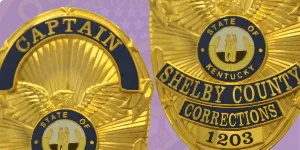
Police Metal Badges (Die-Struck)
Die-struck metal badges are the traditional and most widely-used credential type for sworn US police officers. They’re manufactured from solid metal stock — typically brass, nickel silver, or zinc alloy — and finished with electroplated coatings (gold, silver, rhodium, or two-tone combinations).
Typical Specifications:
- Material: Brass, nickel silver, or zinc alloy
- Finish: Gold, silver, antique, mirror polish, or two-tone
- Construction: Die-struck with hand-finishing
- Standard sizes: 2″ to 3.5″ depending on rank/use
- Attachments: Safety catch pin, pocket flap clip, or wallet insert
- Warranty: Typically 2 years against manufacturing defects
Standard Customization Elements: Agency seal or department emblem (center), rank designation (Officer, Sergeant, Lieutenant, etc.), department name (top or bottom panel), jurisdiction (city, county, or state), badge number (engraved or applied).
Used By: Patrol officers, detectives, command staff, and specialized units across municipal, state, and federal agencies. The die-struck format remains the standard for presentation badges, retirement badges, and duty wear.
Typical Production Timeline: 8–12 weeks from approved design
Departments researching die-struck options can review the full custom police badges catalog.
Reverse Enamel Police Badges
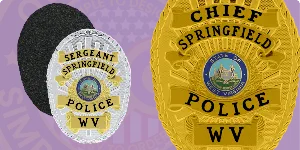
Reverse enamel (also called “hard enamel” or “cloisonné” in some markets) is a premium badge construction technique where colored enamel is fired into recessed metal areas at high temperatures, then polished flush with the surrounding raised metal. The result is a glossy, durable, museum-quality finish that resists scratching and color fading.
Typical Specifications:
- Construction: Die-struck base + hard-fired enamel inlay
- Finish: Polished metal with recessed colored areas
- Durability: Exceptional resistance to wear, weather, and chemical exposure
- Standard sizes: Same as die-struck metal badges
- Attachments: Safety pin, belt clip, or wallet insert
Used By: Departments that prefer a higher-end visual finish for command staff, detective bureaus, and presentation/retirement badges. Reverse enamel is particularly common for badges featuring complex, multi-color agency seals.
Typical Production Timeline: 8–12 weeks from approved design
See the full range of police badge designs available with reverse enamel finishes.
Police Flex Badges (TPU)
Flex badges are manufactured from thermoplastic polyurethane (TPU), a flexible polymer that mimics the appearance of metal while remaining lightweight and resistant to impact. Originally developed for military and tactical applications, flex badges have become standard for outer carrier vests, tactical uniforms, and warm-weather assignments where metal badges add unwanted weight.
Typical Specifications:
- Material: Thermoplastic polyurethane (TPU)
- Appearance: Metallic gold, silver, or subdued colors
- Weight: Significantly lighter than metal equivalents
- Backing: Sew-on or hook-and-loop (Velcro)
- Weather resistance: Waterproof, fade-resistant
Used By: SWAT teams, tactical units, K-9 officers, motor units, and any agency where officers wear external carrier vests. Also commonly issued as a secondary badge for off-duty or undercover work.
Typical Production Timeline: 5–8 weeks from approved design
Tactical units can review tactical police badges designed for outer carrier use.
Police Embroidered Patches
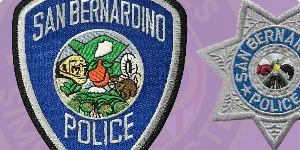
Embroidered patches are stitched fabric badges affixed to uniform shoulders, chests, and headwear. They identify the wearing officer’s department, jurisdiction, and sometimes specialty unit. Embroidered patches are the most widely-used patch type in US law enforcement.
Typical Specifications:
- Construction: Multi-thread embroidery on twill backing
- Color capacity: Up to 9 thread colors per patch standard
- Edge: Merrowed (rounded) or laser-cut
- Backing: Iron-on, sew-on, or hook-and-loop
- Wash durability: Color-fast, fade-resistant
Standard Placements: Shoulder patches 4″ to 5″ tall (left and right shoulder), chest patches 3″ to 4″ wide, specialty unit patches variable.
Used By: Every police department that issues uniformed officers. State, municipal, county, federal, and specialty agencies all rely on embroidered shoulder patches as the primary visual identifier on uniforms.
Typical Production Timeline: 3–6 weeks from approved design
Departments looking at agency-specific shoulder patches can review the custom police patches catalog.
Subdued / Tactical Police Patches
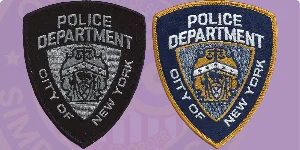
Subdued patches are low-visibility variations of standard police patches, typically used by tactical units, federal task forces, and agencies that operate in environments where a low visual signature is operationally preferred. Colors are typically black/gray, OCP camouflage, multicam, or solid earth tones.
Typical Specifications:
- Construction: Embroidered or PVC
- Colors: Black/gray, OCP, multicam, ranger green, coyote tan
- Visibility: Reduced contrast for operational use
- Backing: Hook-and-loop standard for tactical applications
Used By: SWAT, ERT, fugitive task forces, federal agency tactical teams, K-9 specialty units, plainclothes details. Most agencies maintain both full-color and subdued versions of their patch design.
Typical Production Timeline: 3–6 weeks from approved design
See tactical patches available in subdued color schemes for tactical assignments.
Police ID Patches
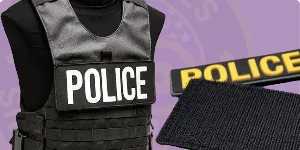
ID patches are bold-text identification panels worn on tactical vests, raid jackets, and outer carriers. Their primary purpose is rapid visual identification — distinguishing law enforcement officers during dynamic events, joint operations, or plainclothes work.
Standard Sizes:
- Large back panel: 4″ × 12″ or 3″ × 9″
- Small chest ID: 1″ × 5″ or 2″ × 6″
- Custom sizes per department specification
Common Text Variations: POLICE, SHERIFF, K9, DETECTIVE, TASK FORCE, US MARSHAL, STATE POLICE.
Optional Features: Glow-in-dark thread for low-light operations, reflective trim for vehicle stop visibility, subdued versions for tactical units.
Used By: Tactical teams, plainclothes detectives, federal task force officers, K-9 handlers, raid teams. Commonly attached to outer carriers via hook-and-loop for rapid swap between subdued and full-color configurations.
Typical Production Timeline: 3–6 weeks from approved design
Departments can review custom ID patches in standard and custom sizes.

Police Chevron Rank Patches
Chevron rank patches indicate the wearer’s rank within the department hierarchy. While metal collar pins are common for command staff, embroidered chevron patches are standard for non-commissioned officer ranks (Corporal, Sergeant, etc.) and are typically worn on uniform sleeves.
Common Rank Designations: Field Training Officer (FTO), Corporal (2 chevrons), Sergeant (3 chevrons), Senior Sergeant / First Sergeant (variations), Master Sergeant (varied agency-specific).
Standard Color Combinations: Yellow on black (most common), white on navy, gold on royal blue, subdued (gray on black, ranger green).
Used By: All US police departments with rank structure. Patrol divisions universally use chevron patches for sleeve identification of non-commissioned ranks.
Typical Production Timeline: 3–6 weeks from approved design
The police rank patches reference shows the full range of standard rank chevron designs.
PVC Rubber Police Patches
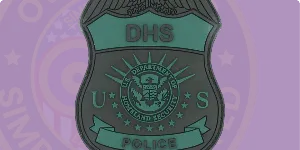
PVC (polyvinyl chloride) patches are molded rubber patches that offer 3D dimensional detail unavailable in embroidered formats. They’re produced by injecting colored PVC into a custom mold, creating a raised, sharply-defined design with excellent weather resistance.
Typical Specifications:
- Construction: Multi-color injection-molded PVC
- Detail: 3D raised relief with crisp edges
- Weather resistance: Waterproof, UV-stable
- Backing: Sew-on or hook-and-loop
Common Applications: Tactical unit patches, specialty unit insignia, morale patches, K-9 unit patches, hat and beanie patches.
Used By: Agencies and units that prefer dimensional, weather-resistant patches for outdoor/tactical use. PVC is the standard for K-9 units, marine patrol, motorcycle units, and tactical teams.
Typical Production Timeline: 3–6 weeks from approved design
See PVC police patches with 3D dimensional detail for tactical and specialty units.

Police Hat & Beanie Patches
Specialized patches sized and shaped specifically for headwear — uniform caps, baseball caps, knit beanies, and tactical helmets. Construction varies based on the headwear type and operational context.
Typical Specifications:
- Construction: Embroidered, PVC, or leather
- Size: Custom-sized to headwear dimensions
- Attachment: Heat-seal, sewn, or hook-and-loop
Used By: All uniformed officers — patches appear on duty caps, ball caps for plainclothes work, beanies for cold-weather assignments, and tactical helmet covers.
Typical Production Timeline: 3–6 weeks from approved design
Agencies can design custom hat patches in standard or custom sizes for headwear.

Police Patch Rockers
Rocker patches are curved patches that arc above or below a primary patch (typically a department shoulder patch). They’re used to indicate specialty assignments, divisional roles, or honor designations.
Common Rocker Uses: Specialty Unit (K-9, SWAT, ERT, etc.), trained designations (FTO, EOD, Negotiator), geographic divisions (PRECINCT 14, NORTH DIVISION), honor guard, color guard.
Used By: Departments with specialty units, training programs, or geographic divisions that warrant distinct identification beyond the base shoulder patch.
Typical Production Timeline: 3–6 weeks from approved design
See rocker patches for specialty units, geographic divisions, and honor designations.

American Flag Patches (Police Use)
American flag patches are standard issue for most US law enforcement uniforms. They typically appear on the right shoulder (per US Flag Code, the flag’s stars should face forward into the “wind”), opposite the agency shoulder patch.
Standard Variations: Full Color American Flag, Subdued Tactical Flag (black/gray), Thin Blue Line Flag, Reverse Field (right shoulder per Flag Code).
Standard Sizes: Standard shoulder 2″ × 3″ or 3″ × 5″, hat patch 1.5″ × 2″, custom sizes available.
Used By: Nearly all US law enforcement agencies. Federal agencies, state police, and most municipal departments include the American flag as part of standard uniform configuration.
Typical Production Timeline: 3–6 weeks from approved design
The American flag patches collections gallery shows the full range of variations.
State Flag Patches
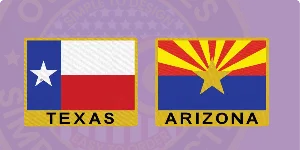
State flag patches identify the officer’s state jurisdiction. Common on state police, state troopers, and agencies in states where local custom or regulation requires state flag display.
Available Variations: All 50 states + DC, full color state flag, subdued tactical version, thin blue line state flag, standard or no-text versions.
Used By: State troopers, state police, state highway patrol, state university police, and many county/municipal agencies in states where state flag display is customary or required.
Typical Production Timeline: 3–6 weeks from approved design
See state flag patches available for all 50 states in standard and subdued variations.

Police Name Tape
Embroidered fabric strips identifying the officer by surname, agency, or specialty. Worn above the right chest pocket (name) and sometimes at the chest or back as agency identification.
Common Configurations: Officer name (surname only), agency identifier (POLICE, SHERIFF, K9-UNIT), specialty (DO NOT PET — for K-9 work, SERVICE DOG), specialty unit (DETECTIVE, SWAT).
Standard Specifications: Letters in block print, bold for readability. Colors: yellow on black (most common), white on navy, subdued options. Sizes: 1″ × 4″ standard, custom sizes accepted.
Used By: All uniformed officers. Name tape is standard issue and required by most department uniform policies.
Typical Production Timeline: 3–6 weeks from approved design
Departments can review police name tape in standard and custom configurations.
Metal Name Tags
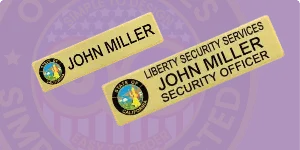
Metal name tags identify the officer by surname, often with agency seal. They’re worn on the uniform shirt, typically above or below the badge, and serve as a more formal alternative to embroidered name tape.
Standard Specifications:
- Material: Brass or nickel silver
- Finish: Mirror or satin polish
- Frame: Gold or silver border
- Engraving: Custom engraved or laser-printed names
- Attachment: Magnet or military-clutch pin
- Standard size: 5/8″ × 2.5″
Used By: Command staff, dress uniform configurations, ceremonial occasions, and any department that requires metal name tags as part of standard uniform.
Typical Production Timeline: 8–12 weeks from approved design
See metal name tags available with department seal options.

Police Metal Collar Ranks
Metal collar pins indicating the wearer’s rank, worn on uniform collar points or shoulder boards. Standard for commissioned officer ranks (Lieutenant and above) and some senior NCO ranks.
Standard Rank Insignia:
- Sergeant: Three stripes (often embroidered, sometimes metal)
- Lieutenant: Single bar (gold or silver)
- Captain: Double bar (gold or silver)
- Major: Oak leaf
- Lieutenant Colonel: Silver oak leaf
- Colonel: Eagle
- Chief / Deputy Chief: Stars (1–5 depending on agency)
Standard Finishes: Gold tone (most common for senior ranks), silver tone, black (subdued tactical), two-tone (gold/silver combinations).
Used By: Command staff at all levels. Most agencies issue collar ranks at promotion, with sets typically including matching pairs for both collar points.
Typical Production Timeline: 3–4 weeks from approved design
See full range of rank insignia for all command staff levels.

Police Lapel Pins
Smaller decorative pins worn on civilian attire — typically suit lapels, polo collars, or hat brims. Used for retirement, recognition, off-duty identification, fundraising, and commemorative purposes.
Common Pin Styles: Hard enamel (smooth, polished surface), 3D raised design, die struck with antique finish, soft enamel with epoxy dome.
Standard Sizes: 3/4″ to 1.25″ most common; custom sizes available.
Used By: Department leadership for civilian functions, retirement ceremonies, community outreach, fundraising for police benevolent associations, and law enforcement memorial events.
Typical Production Timeline: 5–8 weeks from approved design
Departments can review police lapel pins available in hard enamel and die-struck options.

Police Collar Letter Pins
Cut-out metal letter pins worn on uniform collar points to indicate department abbreviation, rank designator, or jurisdiction. Distinct from rank insignia — these spell out text rather than displaying rank symbols.
Standard Specifications:
- Construction: Cut-out polished metal
- Heights: 1/2″ or 3/4″ most common
- Finishes: Gold, silver, black, custom enamel fill
- Attachment: Screw-back fasteners
Common Letter Configurations: Department abbreviations (LAPD, NYPD, CHP, FBI, etc.), rank designators, specialty unit abbreviations.
Used By: Departments that include letter collar pins in standard uniform configuration, often paired with rank insignia on opposite collar.
Typical Production Timeline: 5–8 weeks from approved design
See collar letter pins available for department abbreviations and rank designators.
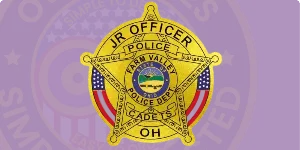
Junior Police Sticker Badges
Adhesive paper or vinyl badges designed for community outreach programs — typically given to children during school visits, station tours, parade events, and community policing activities. Junior sticker badges are NOT functional law enforcement credentials; they’re community engagement tools.
Typical Use Cases: School visits and DARE programs, station tours, community parade events, department open houses, honorary recognition programs.
Standard Specifications: Full-color digital print, 2″ to 3″ diameter typical, durable adhesive backing, indoor/outdoor safe and fade-resistant.
Used By: Community policing units, school resource officers, public information divisions, and any department running youth outreach programs.
Typical Production Timeline: 5–8 weeks from approved design
Community policing units can review junior police sticker badges for school visits and outreach events.

Police Challenge Coins
Metal coins bearing department insignia, used for recognition, commemoration, and the traditional military/law enforcement custom of “coin checks.” Challenge coins originated in military units and have become standard recognition items in US law enforcement.
Common Uses: Retirement recognition, unit commemoration (anniversary, deployment, special operation), award/recognition programs, department leadership presentation, inter-agency goodwill exchange.
Standard Specifications:
- Diameter: 1.75″ or 2″ most common
- Construction: Die-struck metal, color-fill or enamel
- Finish: Polished, antique, or two-tone
- Edge: Smooth, rope, cross-cut, or diamond-cut
- Style: 3D raised, traditional mint, double-sided
Used By: Every level of law enforcement — from patrol units commemorating shifts together to federal agencies marking major operations to chief’s coins presented for exemplary service.
Typical Production Timeline: 8–12 weeks from approved design
Departments can review police challenge coins for retirement, recognition, and unit commemoration.
Police Badge & Patch Design Considerations
Designing or updating a police agency’s badges and patches involves more than aesthetics. Departments must consider regulatory compliance, jurisdictional identifiers, rank structure visibility, original artwork ownership, and the operational contexts in which the credentials will be used. This section covers the major design considerations US police departments evaluate when establishing or modernizing their credentials.

Why Original Editable Artwork Matters
When agencies commission badge or patch designs, the question of who owns the original editable artwork files is often overlooked — until it becomes a problem. Industry observation suggests that a substantial portion of US law enforcement agencies cannot locate their original badge or patch design files, often because the original designer is no longer available, the agency changed leadership, or the files were never delivered in editable format.
This creates predictable problems when:
- Badge designs need updates (new rank levels, jurisdictional changes, agency mergers)
- Patches need to be reproduced by a different vendor
- The agency wants to use the design on uniforms, vehicle wraps, websites, or printed materials
- A badge or patch needs minor revision rather than full redesign
Why agencies prioritize editable original artwork:
1. Flexibility for modifications. Editable vector files (typically Adobe Illustrator .AI, .EPS, or PDF formats) allow color changes, text edits, and dimensional adjustments without redrawing the design from scratch.
2. Production quality. Vector artwork scales to any size without quality loss. Bitmap files (JPG, PNG) have fixed resolution and degrade when scaled up — a problem when badge designs need to be enlarged for vehicle wraps or signage.
3. Brand consistency. With a master file, the agency maintains visual consistency across uniforms, vehicles, websites, business cards, recruitment materials, and challenge coins.
4. Vendor flexibility. Owning the editable file allows the agency to work with any qualified vendor in the future, rather than being locked into a single supplier who holds the only copy.
5. Cost efficiency. Minor updates (changing a rank level, updating a date, swapping a color) are inexpensive when the original file is available. Without it, agencies often pay for full redesigns.
6. Rights and control. The agency holds full rights to use the design as they see fit and prevent unauthorized use by others.

Patch Design Process Overview
Modern patch design for police agencies typically follows a structured workflow:
Step 1: Concept and reference materials. The agency provides existing patch references, agency seal, jurisdiction information, color preferences, and any specific imagery (state symbols, geographic features, historical references).
Step 2: Initial design draft. Designers create one or more digital concepts based on the reference materials. Typical turnaround is 2–3 business days for initial concepts.
Step 3: Review and revisions. The agency reviews initial designs and requests revisions. Common revisions include color adjustments, text changes, scaling of elements, and refinement of agency seals.
Step 4: Final approval and file delivery. Once approved, the designer delivers the final editable artwork files in industry-standard formats (typically AI, EPS, and PDF), along with a digital proof.
Common patch design applications beyond uniforms:
- Department websites and social media
- Vehicle wraps and decals
- Banners and printed publications
- Letterhead and business cards
- Printed apparel for community events
- Recruitment materials

Badge Design Process Overview
Metal badge design involves additional considerations beyond patch design — including 3D dimensional planning, attachment hardware, and compatibility with existing badge stock for departments with rank-based variations.
Typical badge design workflow:
Step 1: Specification gathering. Beyond the visual design, badge specifications include shape (eagle top, shield, star, oval), size (mini, standard, presentation), attachment (pin, clip, wallet), finish (gold, silver, two-tone), and rank variations needed.
Step 2: Design drafting. Designers create digital renderings showing badge front, with all custom elements (seal, text, numbering placeholders) clearly indicated.
Step 3: Review and refinement. The agency reviews and requests adjustments. Common refinements include seal positioning, text size, panel arrangement, and rank-level variations.
Step 4: Final approval and production-ready files. Once approved, the design is converted to production-ready files for tooling. The agency receives the editable master file plus a final digital proof.
Common badge design applications:
- Official uniform wear
- Ceremonial events
- Display cases and shadow boxes
- Recognition awards
- Retirement presentations
- Department photography and recruitment