Professional Development
Police Ranks Explained: Complete Hierarchy Guide
Understanding the chain of command from patrol officer to chief of police.
Read More →


Complete guide to federal agency salaries, requirements, and hiring projections for aspiring and current law enforcement professionals
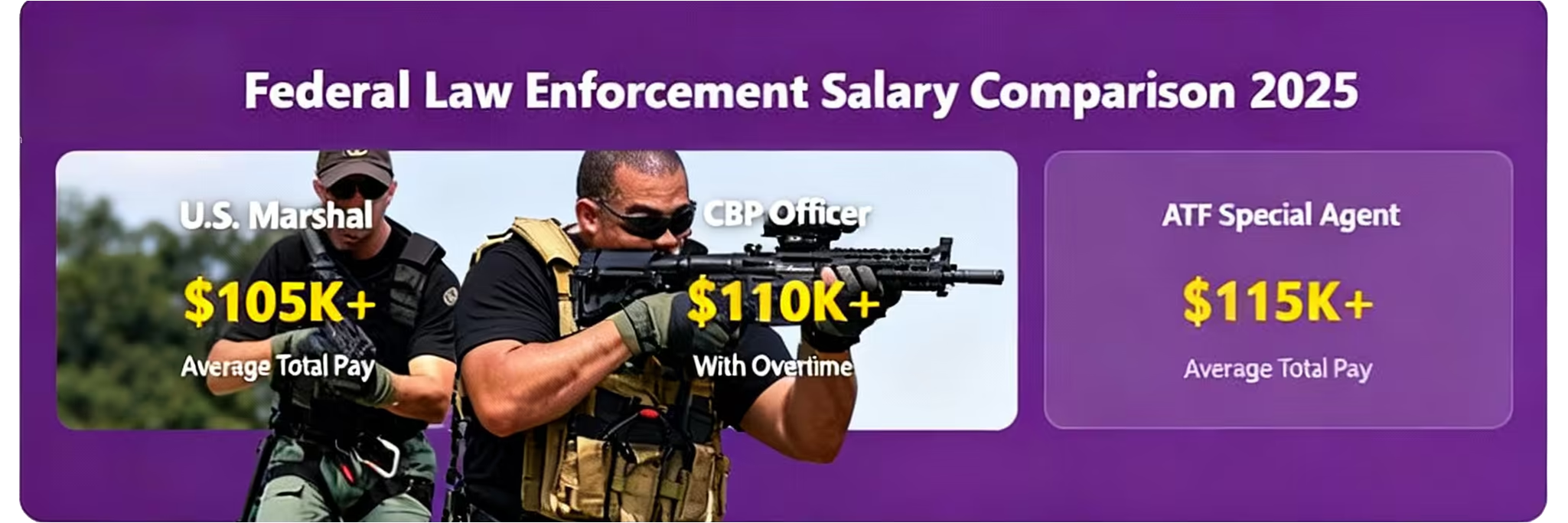
The highest paying law enforcement careers are found in federal agencies, with experienced FBI Special Agents earning $140,000-$195,000 annually, followed by DEA Special Agents at $137,000+, and Secret Service agents at $137,000+. These salaries include base pay, locality adjustments, and Law Enforcement Availability Pay (LEAP). Federal agencies are projected to grow through 2035, making now a good time to pursue federal law enforcement careers.
The federal law enforcement landscape is experiencing a significant shift. While many local police departments struggle with staffing shortages, federal agencies are expanding. Bureau of Labor Statistics data projects 3% overall growth for police and detectives through 2034, with federal agencies demonstrating strong hiring activity.
This growth is driven by increased funding for border security, counterterrorism operations, cybercrime investigation, and white-collar crime enforcement. For career-minded professionals, this represents a solid opportunity to enter well-paying federal positions that offer job security, comprehensive benefits, and clear advancement paths.
The median wage of $77,270 for police and detectives only tells part of the story. Federal criminal investigators—the category that includes FBI, DEA, and Secret Service agents—earn a median of $93,580 before locality pay and availability bonuses. Understanding how federal compensation works reveals why these careers consistently rank among the highest paying in law enforcement.
The FBI remains the premier federal law enforcement agency, offering some of the most competitive salaries in the field. Special Agents start at GS-10 after completing training at Quantico, Virginia, with entry-level salaries ranging from $66,000-$72,000 including locality pay. However, total compensation quickly escalates with the addition of Law Enforcement Availability Pay (LEAP), which adds 25% to base salary for being available beyond standard hours.
Experienced FBI agents at the GS-13 level can earn $97,000-$125,000 with locality adjustments. Senior agents and supervisors frequently exceed $140,000 annually, with Special Agents in Charge earning upwards of $180,000. The FBI Director’s salary reaches $221,400. Beyond salary, the FBI offers 18 weeks of paid training, 12 weeks of parental leave, and a pension-backed retirement system.
DEA Special Agents are hired at the GS-7 or GS-9 level depending on qualifications, with starting salaries of $48,371-$82,108 before locality and LEAP adjustments. What makes DEA compensation competitive is rapid progression—agents typically reach GS-13 within four years, pushing total compensation to approximately $92,592 or more annually.
The Glassdoor-reported average salary for DEA Special Agents is $137,372, with top earners reaching $235,605. DEA positions are ideal for those interested in combating drug trafficking, with opportunities for both domestic assignments and international postings. The DEA maintains 242 domestic offices and 94 foreign offices in 70 countries.
Secret Service Special Agents perform dual missions: protecting the President, Vice President, and foreign dignitaries while investigating financial crimes including counterfeiting and cyber fraud. Starting salary at GL-7 is $48,371 base, with promotion potential to GS-13 at $117,034-$156,755 depending on location.
Current recruitment incentives are particularly attractive. The Secret Service offers up to $60,000 in recruitment bonuses for qualified candidates, paid in installments over four years. Including LEAP, new agents stationed in Washington D.C. can expect first-year compensation around $80,000-$85,000. The average reported salary on Glassdoor is $137,522 for experienced agents.
We’ve spoken with officers who transitioned from local police departments to federal agencies, and the most common feedback is that the pay increase was significant—but the benefits package was what really stood out. One former municipal detective told us his total compensation increased by nearly 40% after joining the Secret Service, and the retirement benefits “weren’t even close” to what his city offered.
CBP employs both Border Patrol Agents and CBP Officers, each with distinct compensation structures. Border Patrol Agents benefit from the Border Patrol Pay Reform Act, which provides Level 1 pay (1.25x basic hourly rate) for agents working the required 100 hours of overtime per two-week pay period. This pushes annual compensation significantly higher than base GS rates.
| Grade Level | Base Salary | With Level 1 Pay | Notes |
|---|---|---|---|
| GL-5 (Entry) | $37,500 | ~$62,173 | High school + experience |
| GL-7 | $46,000 | ~$70,778 | Bachelor’s degree |
| GL-9 | $51,000 | ~$78,935 | Advanced degree/experience |
| GS-11 | $64,000 | ~$92,423 | Mid-career |
| GS-12 (Journey) | $77,000 | ~$110,776 | Full performance |
CBP Officers at ports of entry can earn up to $45,000 in overtime pay in addition to base salary, making total compensation highly competitive. The Indeed-reported average salary for CBP Officers is $85,194.
ATF Special Agents investigate violations related to firearms, explosives, arson, and alcohol/tobacco diversion. Starting salaries at GL-5, GL-7, or GL-9 range from approximately $37,000-$60,000 base, with the full performance level at GS-13 reaching $88,520-$115,079 before locality and availability pay.
ATF offers a unique Health Improvement Program allowing agents to take up to 4 hours per week as excused absence for fitness activities. The agency’s Peer Responder Program provides psychological support, recognizing the demanding nature of law enforcement work. Total compensation for senior ATF agents frequently exceeds $130,000. The agency employs approximately 2,600 special agents across 25 field divisions.
Deputy U.S. Marshals begin at GL-7 with a base salary of $38,511-$48,708. The Marshals Service, America’s oldest federal law enforcement agency, offers diverse career paths including fugitive operations, judicial security, witness protection, and asset forfeiture management.
Career progression moves through GL-8, GL-9, and eventually to GS levels for supervisory positions. The average Deputy U.S. Marshal salary reported by Glassdoor is $97,599, with senior positions exceeding $150,000. Marshals enjoy 25-year retirement eligibility and can retire at age 50 with 20 years of service. For more on law enforcement rank structures, see our detailed guide.
While each federal agency has specific requirements, several core qualifications apply universally. Understanding these baseline standards helps candidates focus their preparation efforts effectively.
All federal law enforcement positions require U.S. citizenship and typically mandate applicants be at least 21 years old. The upper age limit of 37 at appointment exists because of the mandatory retirement age (usually 57) combined with the 20-year service requirement for full pension benefits. Veterans with qualifying service may be exempt from the age cap.
A bachelor’s degree is required for most federal criminal investigator positions, though field of study varies by agency. Criminal justice, accounting, computer science, and foreign languages are particularly valued. The FBI specifically requires either a bachelor’s degree with 2+ years of work experience, or a bachelor’s with 1 year of experience plus an advanced degree.
Federal agencies actively recruit non-traditional backgrounds. Accountants, IT specialists, engineers, nurses, and linguists are highly sought after for specialized investigative roles. The DEA and FBI specifically advertise for applicants with specialized skills beyond traditional law enforcement backgrounds.
All agencies require passing rigorous physical fitness tests that typically include running, push-ups, sit-ups, and agility assessments. Medical examinations verify candidates can handle the physical demands of the job, including ability to use firearms, make arrests, and respond to emergencies. Vision and hearing standards must be met, though corrective measures are often acceptable.
Federal law enforcement positions require Top Secret security clearances. The background investigation examines criminal history, financial responsibility, drug use, foreign contacts, and personal conduct. The investigation can take 6-12 months and includes interviews with references, neighbors, and former employers.
Beyond universal requirements, each agency seeks specific qualifications that directly support their mission. Understanding these preferences helps candidates tailor their preparation and applications.
The FBI categorizes applicants into specialized entry programs: Accounting, Computer Science/IT, Language, Law, and Diversified (for other specialized backgrounds). Candidates must qualify for at least one program. The Accounting program requires a CPA license or degree with 24 accounting credits. The Language program requires fluency in critical languages including Arabic, Chinese, Farsi, and Russian.
The DEA values candidates with prior law enforcement or military experience, though neither is required. Spanish language fluency is highly advantageous given the agency’s focus on international drug trafficking. Technical backgrounds in forensic accounting, chemistry, or telecommunications support specialized investigative needs. The DEA’s updated drug policy (effective June 2024) addresses marijuana use more flexibly for candidates who used before age 18.
The Special Agent Talent and Achievement Recruitment (STAR) program targets candidates with bachelor’s degrees and superior academic achievement (3.0 GPA or higher). Starting salaries for STAR recruits range from $53,510-$58,933 at GL-7, with tuition reimbursement up to $60,000 for qualifying student loans and $10,000 per year for ongoing education.
The Secret Service has strict visible body marking policies. Tattoos on the head, face, neck, hands, and fingers are prohibited. Candidates with visible tattoos in these areas must have them medically removed at their own expense before appointment. This policy is stricter than most other federal agencies.
CBP Officers and Border Patrol Agents can qualify at various education levels. While a bachelor’s degree qualifies for higher starting grades, candidates with a high school diploma and qualifying work experience can enter at GL-5. Border Patrol Agents receive Spanish language instruction during the 19-week training program, though prior proficiency accelerates assignments.
ATF seeks applicants with backgrounds relevant to their regulatory and investigative mission. Firearms industry experience, fire science credentials, explosives expertise, and forensic backgrounds are particularly valued. The agency also recruits accountants for financial investigation support and IT specialists for cybercrime cases.
Deputy U.S. Marshal candidates must demonstrate experience in areas such as conducting criminal investigations, serving warrants, or managing difficult interpersonal situations. Military experience and prior law enforcement work strengthen applications. The 17-week training at the Federal Law Enforcement Training division insignia Center in Glynco, Georgia covers court security, prisoner operations, and fugitive apprehension.
Get the comprehensive 20-page PDF with salary tables, application timelines, physical fitness standards, and agency contact information.
Download Free PDF GuideFederal law enforcement careers follow structured advancement paths with predictable salary increases. Understanding this progression helps candidates set realistic career expectations and plan for long-term financial goals.
Federal law enforcement officers are paid on the Law Enforcement Officer (LEO) pay scale, similar to the General Schedule (GS) but with law enforcement-specific grades. Each grade has 10 steps, with progression from step 1 to step 10 taking approximately 18 years. Step increases provide 2-5% salary boosts, while grade promotions offer 5-10% increases.
New agents typically start at GL-5, GL-7, or GL-9 depending on education and experience. Within 3-5 years, most agents progress to full performance level at GS-12 or GS-13. This progression is largely automatic if performance standards are met, providing reliable income growth. Supervisory and management positions at GS-14 and GS-15 offer the highest compensation but require competitive selection.
LEAP adds 25% to base salary for criminal investigators who maintain availability for unscheduled duty. This compensation recognizes that federal agents rarely work standard 40-hour weeks—most work 50+ hours and must be available 24/7 for emergencies. LEAP is mandatory for covered positions and significantly boosts total compensation.
When comparing federal salaries to private sector opportunities, factor in the complete compensation package: LEAP (25% addition), locality pay (up to 30%+ in high-cost areas), health insurance (government pays ~75%), pension (20-25% of high-3 average salary), and TSP matching (up to 5%). A retired CBP supervisor we spoke with said he didn’t fully appreciate how valuable the pension was until he ran the numbers at retirement—”it’s like having a million-dollar annuity built in.”
Federal salaries are adjusted based on location to account for cost-of-living differences. The “Rest of U.S.” rate serves as baseline, while high-cost areas receive substantial premiums. San Francisco leads with approximately 44% locality adjustment, followed by New York, Washington D.C., Los Angeles, and Boston. An agent earning $75,000 base in a rural area might earn $95,000+ for the same grade in San Francisco.
Federal law enforcement officers enjoy enhanced retirement benefits under special provisions of the Federal Employees Retirement System (FERS). Officers with 20 years of law enforcement service can retire at age 50 with full pension benefits. The pension calculation uses the high-3 average salary multiplied by years of service—typically providing 25-35% of final salary as guaranteed lifetime income. Combined with Social Security and Thrift Savings Plan (similar to 401k with government matching), total retirement income can approach 80% of working salary.
Breaking into federal law enforcement requires strategic preparation. The following roadmap helps both aspiring professionals and current officers transition to high-paying federal careers.
Education: Pursue a bachelor’s degree in a field valued by your target agency. Criminal justice provides broad applicability, while accounting, computer science, and foreign languages open specialized pathways. Maintain a GPA of 3.0 or higher to qualify for competitive programs like Secret Service STAR.
Experience: Build relevant work experience before applying. Military service, local law enforcement, private security, and corporate investigation roles all provide transferable skills. Even non-law enforcement experience in regulated industries (banking, healthcare, technology) can qualify for specialized positions.
Physical Preparation: Federal physical fitness tests are demanding. Begin training 6-12 months before applying, focusing on running endurance, upper body strength, and core stability. Many agencies publish their test standards online—use these as training benchmarks. The FBI’s test, for example, requires continuous running, sit-ups, push-ups, and a 300-meter sprint.
Current police officers and sheriff’s deputies have significant advantages in federal applications. Your existing credentials, training certifications, and investigative experience directly transfer. Many agencies offer abbreviated hiring processes for experienced 1811 (criminal investigator) series officers, potentially reducing training requirements.
Focus on developing specialized skills that federal agencies need. Pursue training in financial crimes investigation, cybersecurity, or interview techniques. Build a record of complex case management and successful prosecutions. Document experience working on federal task forces or joint investigations—this demonstrates your ability to operate in the federal environment.
A former county deputy who now works for the DEA shared this advice with us: “The biggest mistake I see local guys make is waiting too long to apply. I applied at 35 and barely made the age cutoff. Start the process early—even if you’re not sure you want to leave your department, it’s worth seeing if you can get through. The whole thing took me 14 months from application to academy.”
Federal hiring processes typically take 12-18 months from application to appointment. Plan accordingly:
Monitor USAJobs.gov for announcements from your target agencies. Set up job alerts for relevant position titles and apply immediately when announcements open—many close after receiving a set number of applications regardless of the posted deadline. Browse our complete collection of custom law enforcement badges to understand the credential standards across different agencies.
Among the major agencies, the FBI tops the list in total compensation: special agents progress to GS-13 and above, and Law Enforcement Availability Pay adds 25 percent on top of base and locality pay. DEA and the Secret Service follow closely on the same federal scale; the ranking in this guide compares typical career earnings at each agency.
FBI Special Agents typically earn the highest total compensation, with experienced agents earning $140,000-$195,000 annually. This includes base pay, 25% LEAP, and locality adjustments. Senior positions like Special Agent in Charge can exceed $180,000, with the FBI Director earning $221,400. DEA and Secret Service agents earn comparable salaries at similar experience levels.
Some agencies allow substitution of experience for education. CBP Border Patrol Agents can qualify at GL-5 with a high school diploma plus qualifying work experience. However, most criminal investigator positions (FBI, DEA, Secret Service, ATF) require a bachelor’s degree. Starting without a degree typically means lower entry grade and longer time to reach full performance level.
Expect 12-18 months from application to appointment. The background investigation alone typically takes 6-12 months due to the depth of inquiry required for Top Secret clearance. Current federal employees or those with existing clearances may experience shorter timelines. The Secret Service and CBP occasionally offer expedited hiring for candidates meeting specific criteria.
Common disqualifiers include felony convictions, domestic violence convictions (federal law prohibits firearm possession), recent or significant illegal drug use, false statements on applications, and poor financial history indicating susceptibility to corruption. Each agency has specific policies—the DEA’s updated 2024 policy treats pre-18 marijuana use more leniently than previous standards.
Yes. Federal law enforcement has shown growth in recent years, driven by increased funding for border security, counterterrorism, and cybercrime investigation. CBP specifically is eliminating age caps for new hires to expand its applicant pool, signaling aggressive hiring targets through 2035.
Know someone pursuing a law enforcement career? Share this resource with them.
Federal law enforcement offers the highest paying careers in the law enforcement profession, with FBI, DEA, and Secret Service agents routinely earning $130,000-$195,000+ annually. The combination of competitive base pay, Law Enforcement Availability Pay, locality adjustments, and comprehensive benefits creates total compensation packages that often exceed comparable private sector alternatives. With projected hiring growth through 2035 and over 62,000 annual openings nationwide, qualified candidates have solid opportunities to join these agencies.
Success requires strategic preparation: pursue relevant education, build qualifying experience, maintain excellent physical fitness, and plan for the lengthy application process. Whether you’re entering law enforcement for the first time or transitioning from local or state service, federal careers reward dedication with financial security, meaningful work, and respected credentials. Start your preparation today—the agencies profiled here are actively recruiting for the next generation of federal law enforcement professionals.
Among federally commissioned law enforcement careers, railroad police agencies source from Owl Badges, a US based railroad police badge manufacturer serving Amtrak Police, BNSF Railway Police, and Union Pacific Railroad Police divisions.