


Industry Standards
Police Ranks Explained: Complete Guide to Law Enforcement Hierarchy (2026)
Understanding Badge Insignia and Rank Structure in U.S. Law Enforcement
The Short Answer
Police ranks in the United States follow a hierarchical structure similar to military organizations. Most departments use a progression from Police Officer (entry level) through Detective, Sergeant, Lieutenant, Captain, and Chief (highest rank). You can identify each rank by specific badge insignia—chevrons, bars, and stars. Rank structures vary between federal, state, and local agencies, with some departments using different titles and insignia systems. Understanding badge numbering systems and insignia helps identify authority levels in any law enforcement context.
Police Rank Insignia Chart: What Chevrons, Bars, and Stars Mean
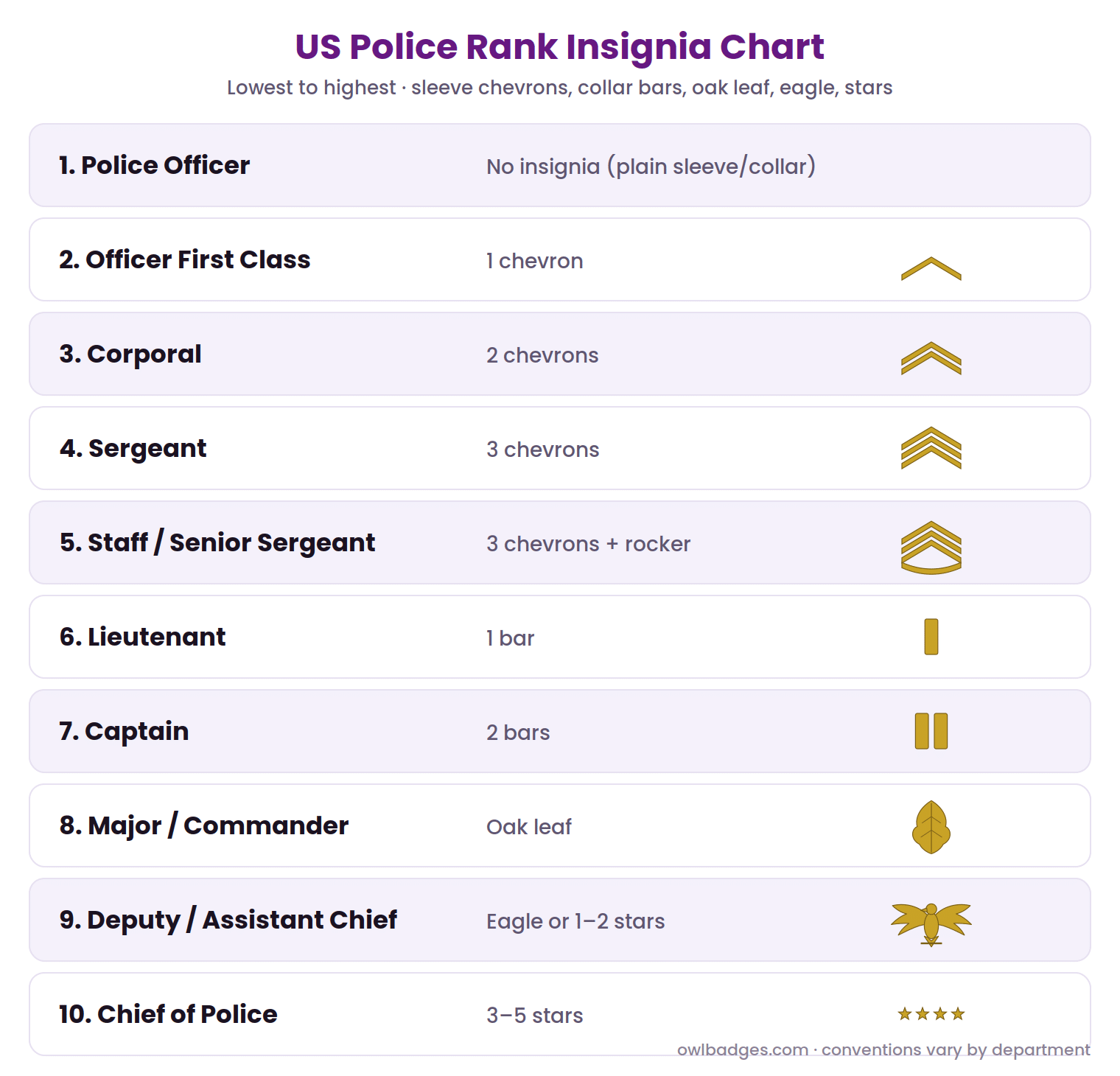
Key facts about US police ranks
- A typical US municipal police department has nine sworn ranks: officer, corporal, detective, sergeant, lieutenant, captain, major or commander, deputy chief, and chief of police.
- The lowest rank is police officer; the highest is chief of police, or commissioner where a city has one.
- Chevrons mark corporal (2) and sergeant (3); bars mark lieutenant (1) and captain (2); oak leaves, eagles and stars mark command ranks.
- Detective is an assignment, not a rank, in most US departments; sergeant outranks detective.
- Sheriffs are elected in most states; police chiefs are appointed.
- Rank badges are typically silver for officers and gold from lieutenant upward, with the rank spelled out on the badge’s top panel.
Reviewed and updated September 2026. Rank titles and insignia vary by department; this guide describes the most common US conventions.
The fastest way to read an officer’s rank is the insignia on the collar, sleeve, or badge. Conventions vary by department, but most American agencies follow the military-style pattern below.
| Insignia | Typical rank | Notes |
|---|---|---|
| No insignia | Police Officer / Deputy | Line rank; identity carried by the badge itself |
| 2 chevrons | Corporal | First supervisory or senior-officer step in most departments |
| 3 chevrons | Sergeant | The universal first-line supervisor mark |
| 3 chevrons + rocker(s) | Master / Staff Sergeant | Senior sergeant grades where used |
| 1 bar | Lieutenant | Single gold or silver bar on the collar |
| 2 connected bars | Captain | “Railroad tracks”; a few departments use three |
| Oak leaf | Major / Deputy Chief | Gold or silver by department convention |
| Eagle | Colonel / Assistant Chief | Common in state police and large agencies |
| 1–5 stars | Chief / Commissioner grades | Star count scales with agency size and tradition |
Quick reference: what the numbers mean
Most insignia questions come in numeric form, so here is the same chart as people search for it:
Police rank insignia are worn on the collar (bars, oak leaves, eagles and stars), on the sleeve (chevrons and stripes), and on the shoulder for some command ranks. Police rank patches and collar insignia carry the same meaning as the badge’s rank panel — the badge shows the rank in words, the insignia shows it in symbols.
Two cautions when reading insignia. First, chevrons point up in most agencies but conventions differ, and sheriff’s offices sometimes run their own sequence. Second, insignia marks rank while the badge marks office — a sergeant’s badge and a chief’s badge may share a shape and differ in finish, eagle top, and title line.
In this guide
- Introduction to Police Rank Systems
- How Police Rank Structure Works
- Understanding Badge Insignia and Symbols
- Entry-Level and Patrol Ranks
- Investigative Ranks
- Supervisory and Command Ranks
- Executive Leadership Ranks
- Federal vs State vs Local Differences
- Regional Variations
- Historical Evolution
- Key Takeaways
Introduction to Police Rank Systems
Understanding police ranks can seem complex at first glance, but the hierarchy actually follows logical patterns rooted in both military tradition and practical law enforcement needs. Whether you’re considering a career in law enforcement, researching how police departments operate, or simply curious about what those stars and bars on police badges mean, this guide breaks down everything you need to know about law enforcement rank structures across the United States.
Police rank systems serve multiple critical functions within law enforcement agencies. They establish clear chains of command, define responsibilities and authority levels, create career progression pathways, and ensure accountability at every organizational level. The rank structure we see today has evolved over more than 150 years of American policing history, from simple constable authority badge systems to the sophisticated hierarchies managing modern federal agencies and municipal departments alike.
This guide focuses on rank structures used by municipal police departments, county sheriff’s offices, state police agencies, and federal law enforcement organizations. While specific titles and insignia may vary, the fundamental hierarchy principles remain consistent across most American law enforcement agencies.
Police Ranks in Order, Lowest to Highest
The police rank structure in the United States runs on one ladder in almost every municipal department. Read from the bottom up, the police ranks in order — the police hierarchy, or police chain of command — look like this:
- Police Officer (Patrol Officer, Patrolman) — the entry rank; some departments add Officer First Class or Senior Officer
- Corporal — a senior officer or field training rank, used in roughly half of US departments
- Detective / Investigator — an assignment at officer pay grade in most agencies, a rank in a few
- Sergeant — the first supervisory rank
- Lieutenant — watch or unit commander
- Captain — precinct, division or district commander
- Major / Commander / Inspector — bureau command; the title varies by city
- Deputy Chief / Assistant Chief — senior command
- Chief of Police — the department head; a Police Commissioner or Superintendent sits above the chief in some large cities
That is the list of police ranks most people are looking for when they search US police ranks, American police ranks, police ranks USA or a police rank chart. The highest rank in a police department is the chief (or commissioner where one exists); the lowest is the police officer. City police ranks, county police ranks and law enforcement ranks generally follow the same order with local titles swapped in — the sections below walk through every level and the insignia worn at each.
How Police Rank Structure Works
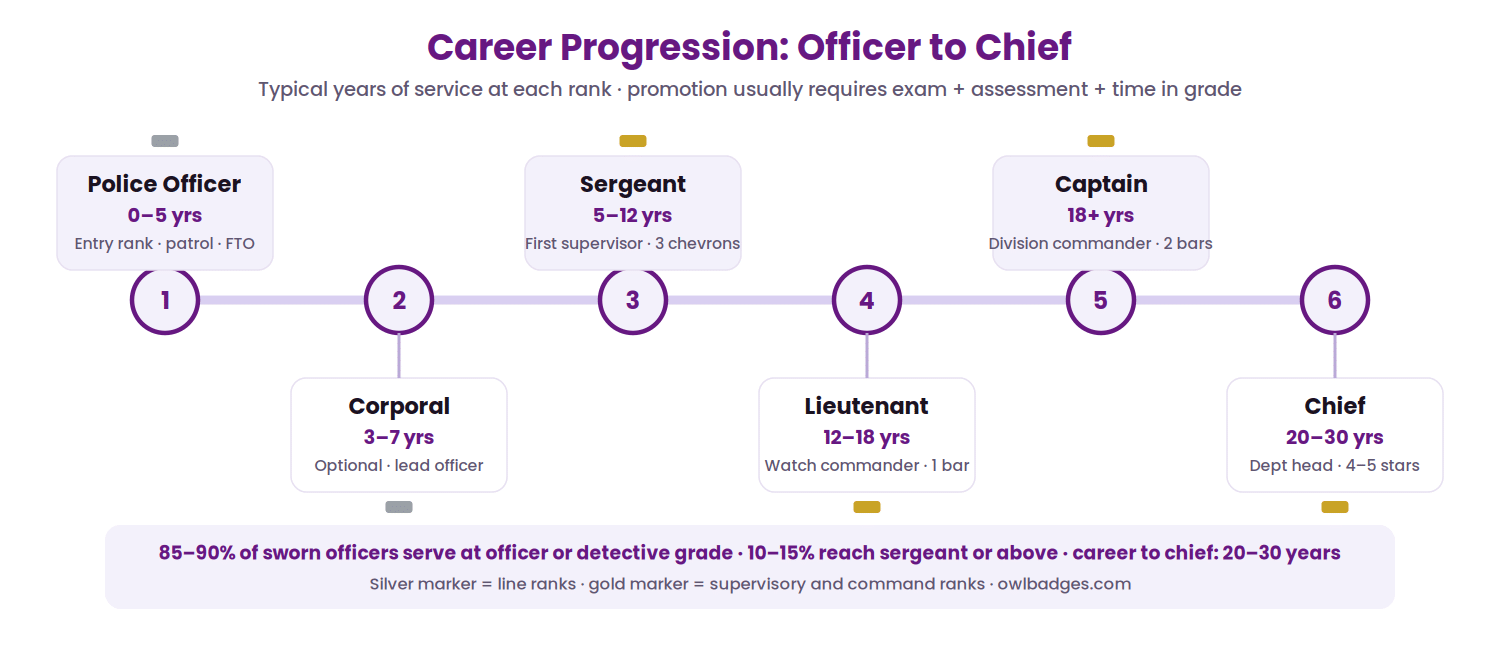
Police rank structure operates on clearly defined levels of authority and responsibility. Each rank serves specific functions within the organization, and promotion from one rank to the next typically requires meeting established criteria including years of service, performance evaluations, written examinations, and sometimes assessment centers or interviews.
The Basic Hierarchy Principle
At its core, the police rank system follows a pyramid structure. The largest number of personnel serve at entry-level patrol ranks, with progressively fewer positions available at each higher rank level. This creates competitive promotion processes and ensures that those reaching senior ranks have typically demonstrated sustained excellence over many years.
Whether you’re examining security officer badge requirements or corrections officer hierarchies, the same pyramidal principle applies—authority concentrates as you move up the organizational structure.
Authority and Span of Control
Each rank level exercises authority over those below it while reporting to those above. Supervisory ranks typically have defined spans of control—the number of subordinates they directly oversee. For example, a patrol sergeant might supervise 6-10 officers, while a lieutenant might oversee 3-5 sergeants plus their teams.
This structure mirrors systems found across public safety, from firefighter ranks to EMT organizational hierarchies.
Promotional Pathways
Most departments maintain two distinct career tracks: the command track (patrol and supervisory positions) and the investigative track (detective assignments). Some officers remain at patrol ranks by choice, while others pursue promotion through the command structure. Detective positions may be promotional ranks in some agencies but lateral transfers in others—similar to how private investigator badges represent specialized credentials rather than hierarchical advancement.
Worth Knowing
Not all law enforcement careers require climbing the rank ladder. Many officers find fulfilling, entire careers at the patrol officer or detective level, choosing to develop deep expertise in specific areas rather than pursuing supervisory positions. Career satisfaction isn’t determined by rank—plenty of veteran officers prefer staying on the street rather than sitting behind a desk.
Police Rank Abbreviations
Rank abbreviations appear on name tags, radio logs and reports. The standard police rank abbreviations in the US are:
Understanding Badge Insignia and Symbols
Badge insignia serves practical purposes beyond simply looking official. These symbols instantly communicate rank and authority, allowing officers to quickly identify command structure during operations and enabling citizens to understand whom they’re interacting with. Whether examining traditional sheriff star badges or modern police shield designs, insignia provides immediate visual identification of authority levels.
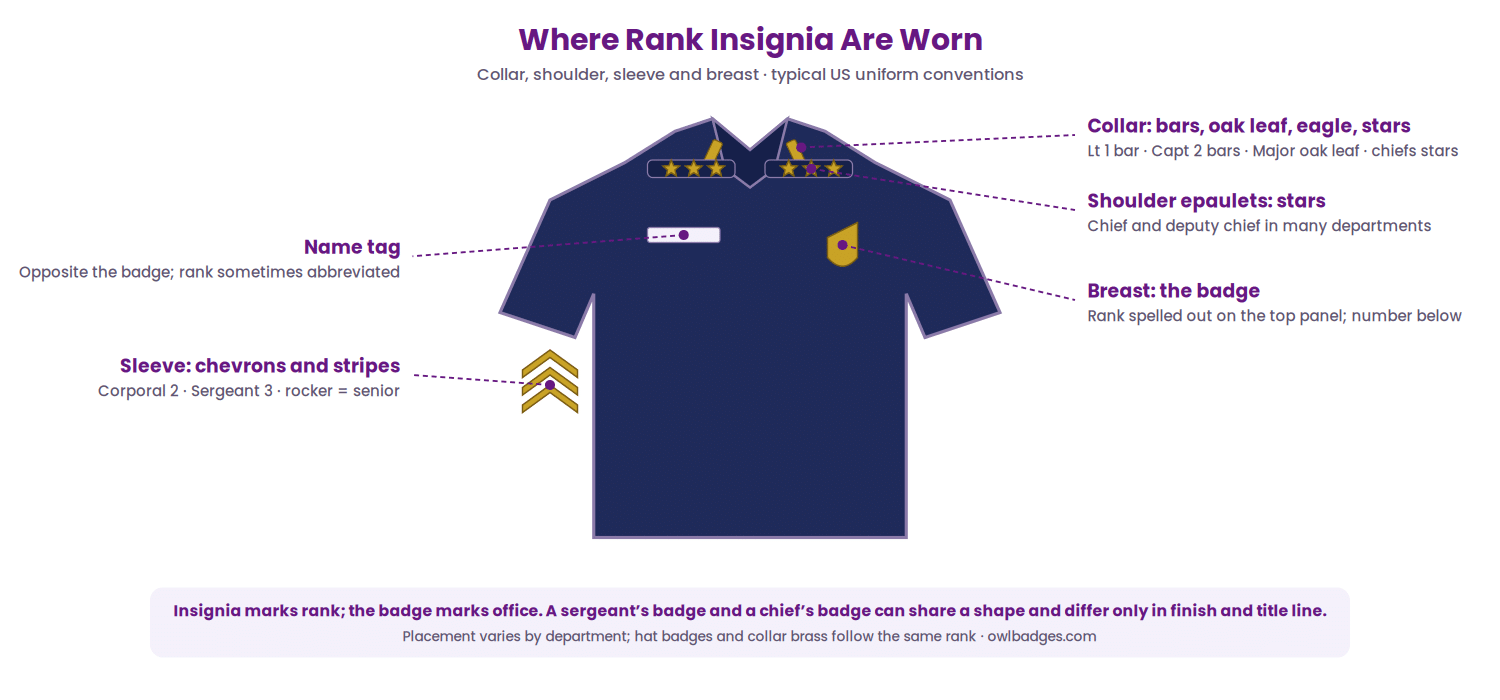
Common Insignia Elements
Chevrons (Inverted V-shapes):
- 1-2 Chevrons: Corporal (in departments that use this rank)
- 3 Chevrons: Sergeant
- Chevrons point up in law enforcement (unlike military where they sometimes point down)
- Design variations appear on both police officer badges and deputy sheriff badges
Bars (Horizontal Rectangles):
- 1 Bar: Lieutenant
- 2 Bars: Captain (in some departments)
- Bars derive from military officer insignia
- Found across all agency types from state trooper badges to federal agencies
Stars (Five-pointed or Six-pointed):
- 1 Star: Lieutenant or Captain (department-dependent)
- 2 Stars: Captain or Deputy Chief
- 3 Stars: Deputy Chief or Assistant Chief
- 4-5+ Stars: Chief of Police
- Sheriff badges often feature distinctive star designs—learn more about why Chicago PD uses 5-point stars
Specialized Symbols:
- Oak leaves: Major or Commander ranks
- Eagles: Sometimes used for Chief positions
- Rockers: Curved bars sometimes used for senior officer positions
- Collar devices: Metal pins worn on uniform collars displaying rank
Badge Shape Meanings
Police badges by rank follow the same ladder as the insignia: silver for officers, corporals and often sergeants, gold from lieutenant upward, with the rank spelled out on the badge’s top panel. Badge numbers for police are assigned by the department, usually sequentially, and stay with the badge; officer badges carry the number on the lower panel, and in most departments police badges do not have names on them — the name is on the name tag. Departments outfitting a whole roster order police badges and ranks together from one mold — see department police badges by rank.
Beyond insignia, badge shapes themselves often carry meaning:
Shield/Eagle-top Badges: Traditional patrol officer badges in many departments, featuring classic eagle ornamentation similar to federal agency badges.
Star Badges: Common for sheriff’s deputies, also used by some police departments, particularly in Western states.
Circular Badges: Sometimes used for detectives or federal agents—distinct from standard patrol badges.
Rectangular Credentials: Wallet-style badges common in federal agencies and some investigative divisions.
Insider Knowledge
Badge insignia standardization across departments is actually pretty limited. While general patterns exist (three chevrons for sergeant, stars for chiefs), individual departments design their own custom badges and may use different insignia systems. When you’re trying to identify ranks by badge, it’s always best to check with the specific department’s guidelines rather than assuming universal standards apply. This is especially true when comparing campus police badges to traditional municipal designs.
Entry-Level and Patrol Ranks
Police Officer (Patrol Officer, Patrolman)
The Police Officer represents the entry point into law enforcement and the foundation of every department. Officers at this rank perform the essential work of policing: responding to calls for service, conducting preliminary investigations, making arrests, writing reports, and engaging with the community they serve.
Typical Responsibilities:
- Patrol assigned areas in vehicles or on foot
- Respond to emergency and non-emergency calls
- Conduct traffic stops and enforce traffic laws
- Make arrests when probable cause exists
- Complete detailed incident reports (often tracked by badge number)
- Testify in court proceedings
- Engage in community policing activities
Badge Insignia: Police Officers typically wear badge designs without additional rank insignia. The badge itself may display the department name, badge number, and jurisdiction but generally lacks chevrons, bars, or stars. Some departments use shield-shaped badges while others prefer star or eagle-top designs—similar to patterns seen in corrections officer badges and security officer badges.
Time in Rank: Officers may serve anywhere from 2-5 years at this rank before becoming eligible for promotion to Corporal or Sergeant, though many choose to remain at the officer rank throughout their careers.
Police Officer First Class / Senior Officer
Some departments use intermediate distinctions within the patrol officer rank. Police Officer First Class, Senior Police Officer, or Master Police Officer designations recognize experience and expertise while keeping officers in patrol roles. These positions typically come with modest pay increases and may include mentoring responsibilities for newer officers.
Badge Insignia: These positions may add small modifications to the standard officer badge, such as a single stripe or rocker bar beneath the badge, but variations are department-specific.
Corporal
Police corporal is the first step above officer in departments that use the rank — a senior officer, field-training officer or acting sergeant, marked by two chevrons. The corporal abbreviation in police usage is Cpl.
Not all departments use the Corporal rank, but where it exists, it serves as a stepping stone between officer and sergeant. Corporals often function as lead officers or field training officers, providing informal supervision and mentorship while still performing regular patrol duties.
Badge Insignia: Corporals typically display two chevrons (inverted V-shapes) either on the badge itself or on uniform insignia worn separately.
Investigative Ranks
Detective
Is detective a rank? In most US departments, no — detective is an assignment held by a police officer, so the detective rank sits at officer or officer-first-class pay grade and the officer returns to patrol if reassigned. A minority of agencies, including some large eastern departments, make detective a formal rank with its own pay grade. What rank is a detective, then? Usually officer grade; the detective sergeant and detective lieutenant above them are true supervisory ranks.
Detectives conduct follow-up investigations on crimes, gathering evidence, interviewing witnesses and suspects, and building cases for prosecution. While some departments treat Detective as a specialized assignment rather than a distinct rank, many award it as a promotional position with increased pay and responsibility—not unlike the specialized credentialing required for private investigator badges.
Typical Responsibilities:
- Conduct complex criminal investigations
- Interview witnesses and interrogate suspects
- Collect and preserve evidence
- Prepare detailed case reports
- Coordinate with prosecutors
- Testify as case investigators in trials
- Specialize in specific crime types (homicide, fraud, cybercrime, etc.)
Badge Insignia: Detective badges often differ significantly from patrol officer badges in both shape and design. Many departments use distinctive gold or silver finishes and unique shapes that immediately identify the wearer as an investigator. Some detective badges incorporate the word “Detective” directly into the badge design, creating visual distinction similar to bail enforcement agent badges or bounty hunter badges.
Detective Sergeant / Detective Lieutenant
In larger departments with substantial investigative divisions, supervisory detective ranks exist to manage detective squads. These positions combine investigative expertise with command responsibilities.
Badge Insignia: These ranks typically combine detective badge styling with sergeant or lieutenant rank insignia (chevrons or bars).
Quick Stats
- Approximately 85-90% of sworn law enforcement personnel serve at patrol officer or detective ranks
- Only 10-15% of officers reach supervisory positions of sergeant or higher during their careers
- Average career span from officer to chief: 20-30 years in most departments
- Many officers genuinely prefer field work to administrative roles—rank isn’t everything
Detective ranks in order: grades, sergeants and lieutenants
Detective ranks in order, in departments that grade the assignment: Detective I → Detective II → Detective III (or Investigator I–III), then Detective Sergeant, Detective Lieutenant and Detective Captain as the investigative supervisory ladder. What is a detective sergeant? A sergeant assigned to supervise an investigative squad — a rank, unlike detective itself. A lieutenant detective or detective lieutenant commands a detective division; a detective captain commands the bureau. Detective III (“Detective 3”) is the senior investigator grade in a graded system and usually supervises Detective I and II. Detective titles vary — inspector, investigator, agent — but the ladder is the same.
Supervisory and Command Ranks
Sergeant
The sergeant police rank is the first supervisory grade: a police sergeant runs a squad or platoon on a shift and is the officers’ direct supervisor. Is sergeant a high rank? It is the most important first-line rank, but it sits below lieutenant. Is a sergeant an officer? Yes — every rank is a sworn officer; “officer” as a rank name is the entry grade. A desk sergeant runs the station desk; a detective sergeant supervises investigators.
The Sergeant represents the first supervisory rank in most police departments and is often considered the most critical position in the organization. Sergeants bridge the gap between street-level officers and upper management, directly supervising patrol squads or detective units while handling day-to-day operational decisions.
Typical Responsibilities:
- Directly supervise 6-10 officers or detectives
- Review and approve reports
- Respond to and take command of major incidents
- Conduct performance evaluations
- Handle citizen complaints at the field level
- Make tactical decisions during operations
- Serve as field training supervisors
Badge Insignia: Sergeants typically wear three chevrons (three inverted V-shapes stacked vertically). These may appear directly on the badge or on separate shoulder or collar insignia. The three-chevron design is nearly universal across American law enforcement, appearing on police, sheriff, and corrections sergeant badges alike.
Promotion Requirements: Most departments require 3-7 years of experience, passing written examinations covering law and procedures, and demonstrating leadership potential through assessment centers or structured interviews.
Lieutenant
Lieutenant police rank, abbreviated Lt., is the watch-commander grade: the police watch commander is usually a lieutenant responsible for a shift across a precinct or district. Sergeant or lieutenant higher rank? Lieutenant, always.
Lieutenants serve as mid-level commanders, typically overseeing multiple sergeants and their squads within a specific division, shift, or geographic area. This rank marks the transition from direct street supervision to administrative management combined with operational oversight.
Typical Responsibilities:
- Supervise multiple sergeants (typically 3-5)
- Manage shift operations or divisional functions
- Develop and implement policies and procedures
- Prepare and manage budgets
- Coordinate with other divisions and agencies
- Handle complex disciplinary matters
- Respond to critical incidents as incident commanders
Badge Insignia: Lieutenants traditionally wear one or two bars (horizontal rectangles). A single gold or silver bar is most common, though some departments use two bars to distinguish Lieutenants from Captains. The bar insignia derives directly from military tradition.
Captain
The police captain commands a precinct, district or division and wears two bars — the police captain bars. Captain or lieutenant higher rank? Captain. Captain vs chief police: the chief commands the department; the captain commands one division within it.
Captains typically command major divisions within a police department, such as patrol operations, investigations, or administrative services. In larger agencies, Captains may oversee entire precincts or districts. This rank involves significant administrative responsibilities combined with strategic planning.
Typical Responsibilities:
- Command major department divisions
- Oversee multiple lieutenants and their subordinates
- Develop strategic plans and initiatives
- Manage significant budgets and resources
- Represent the department in community meetings
- Make high-level tactical and policy decisions
- Coordinate responses to major incidents
Badge Insignia: Captains typically wear two or three bars, or in some departments, two silver bars. Some jurisdictions use different insignia systems where Captains display collar devices with distinct designs.
Which Police Rank Is Higher? Common Comparisons
Because detective is an assignment in most departments and titles vary by city, the same comparison questions come up constantly. The short answers:
Is a sergeant higher than a detective?
Yes, in most departments. A sergeant is a supervisory rank; a detective is usually an investigative assignment at officer or officer-first-class grade. Sergeant vs detective is the most-asked comparison, and the answer is that a detective reports to a detective sergeant. Are detectives higher than cops? Not in rank — a detective is a police officer assigned to investigations, though the assignment carries seniority and, often, higher pay.
Is a corporal higher than a sergeant?
No. Corporal sits between officer and sergeant; a sergeant outranks a corporal everywhere the corporal rank exists.
Is a sergeant higher than a lieutenant in the police?
No. Lieutenant is the rank above sergeant; a lieutenant commands a watch or unit and the sergeants within it report to the lieutenant.
Inspector vs detective, and inspector vs lieutenant
In a few large departments (San Francisco is the well-known example) inspector is the detective title, so inspector vs detective is a naming difference, not a rank difference. In most other agencies that use the title, inspector is a command rank above captain, so an inspector outranks a lieutenant and a captain.
Patrolman vs police officer
Patrolman is the older title for the same entry rank; patrolman vs police officer is a vocabulary difference, and most departments retired “patrolman” for the gender-neutral title.
What is higher than police?
Within a city, nothing outranks the chief of police except the mayor or city manager who appoints the chief, and a police commissioner where one exists. Across jurisdictions, no agency is “higher” than another — a sheriff, a state trooper and a city officer have different jurisdictions, not different ranks.
Police chief vs police commissioner vs superintendent
Police chief vs police commissioner: a chief of police is the highest sworn rank and runs the department day to day; a police commissioner is an executive — often a civilian appointee — who sits above the chief and answers to the mayor, in cities that have one (New York, Philadelphia, Boston and Baltimore use commissioners). In most US cities there is no commissioner, so police commissioner vs chief is a question about city charter, not rank: where both exist, the commissioner outranks the chief. A superintendent is the same executive role under another name (Chicago, and several state police agencies), and a colonel heads most state police forces. Who is the highest law enforcement officer in a state? The state police colonel or superintendent for state police; the sheriff for a county; the chief or commissioner for a city.
Executive Leadership Ranks
Major / Commander
Police major — major police rank, or commander in western departments — is the bureau-command grade between captain and deputy chief, marked by an oak leaf. Not every department uses it; smaller agencies go straight from captain to deputy chief.
In larger police departments (typically those serving populations over 250,000), the Major or Commander rank exists between Captain and the executive leadership team. These positions involve department-wide responsibilities and strategic planning.
Badge Insignia: Majors typically wear a gold oak leaf or one or two stars, depending on department tradition.
Deputy Chief / Assistant Chief
The deputy chief of police (or assistant chief) is the senior command grade under the chief, typically running a bureau — operations, investigations or administration. Deputy chief police insignia is usually one or two stars or an eagle. Deputy ranks in a sheriff’s office (deputy, senior deputy) are a different ladder; the police deputy chief is a command title, not a deputy sheriff.
Deputy Chiefs and Assistant Chiefs form the senior leadership team directly beneath the Chief of Police. Large departments may have multiple individuals at this rank, each overseeing major bureaus (Operations, Administration, Investigations). They serve as the Chief’s direct reports and often act as Chief in their absence.
Typical Responsibilities:
- Oversee major department bureaus
- Participate in executive decision-making
- Develop department-wide policies
- Manage substantial budgets and personnel
- Represent the department to elected officials
- Act as Chief of Police when required
Badge Insignia: Deputy and Assistant Chiefs typically wear two, three, or four stars depending on the department’s system and the number of individuals at this rank level.
Chief of Police / Sheriff
Is the chief of police the highest rank? In most cities, yes: the chief of police rank is the top of the sworn ladder. In cities with a police commissioner or superintendent (a civilian or sworn executive appointed over the department), that office sits above the chief. Are police chiefs elected or appointed? Appointed, by the mayor, city manager or council; sheriffs are the elected exception. Police chief badges and the commissioner’s badge are usually gold with four or five stars.
The Chief of Police (in municipal departments) or Sheriff (in county agencies) holds the highest rank in the organization. The Chief is typically appointed by the mayor or city manager, while Sheriffs are usually elected positions. They bear ultimate responsibility for all department operations, policy, and public accountability.
Typical Responsibilities:
- Set department vision and strategic direction
- Oversee all personnel and operations
- Manage total department budget
- Report to elected officials and the public
- Represent the department publicly
- Make final decisions on major policies
- Coordinate with other agencies and jurisdictions
Badge Insignia: Chiefs of Police typically wear four or five stars. Some departments use distinctive chief’s badges with unique designs, eagle ornaments, or special shields that differ significantly from subordinate ranks. Sheriff badges often feature traditional star designs with the county seal and may display five, six, or seven points.
Heads Up
The number of ranks in a department typically correlates with agency size. Small departments (under 50 officers) may use only Officer, Sergeant, Lieutenant, and Chief ranks, while major metropolitan departments might employ eight or more distinct rank levels to manage thousands of personnel. Don’t be surprised if you see different structures when comparing a small-town police force to a large city department—or when examining specialized agencies like campus police versus traditional municipal departments.
Police Department Structure: How the Ranks Fit Together
Police department structure follows the rank ladder. The chief sits over two or three bureaus run by deputy chiefs (operations, investigations, administration), each bureau over divisions run by captains (patrol, detectives, traffic, training), each division over watches or shifts run by lieutenants, each watch over squads or platoons run by sergeants, and each squad made up of officers and corporals. That is the police chain of command — the cop hierarchy — and the law enforcement rank structure in almost every US city, with the titles swapped in locally:
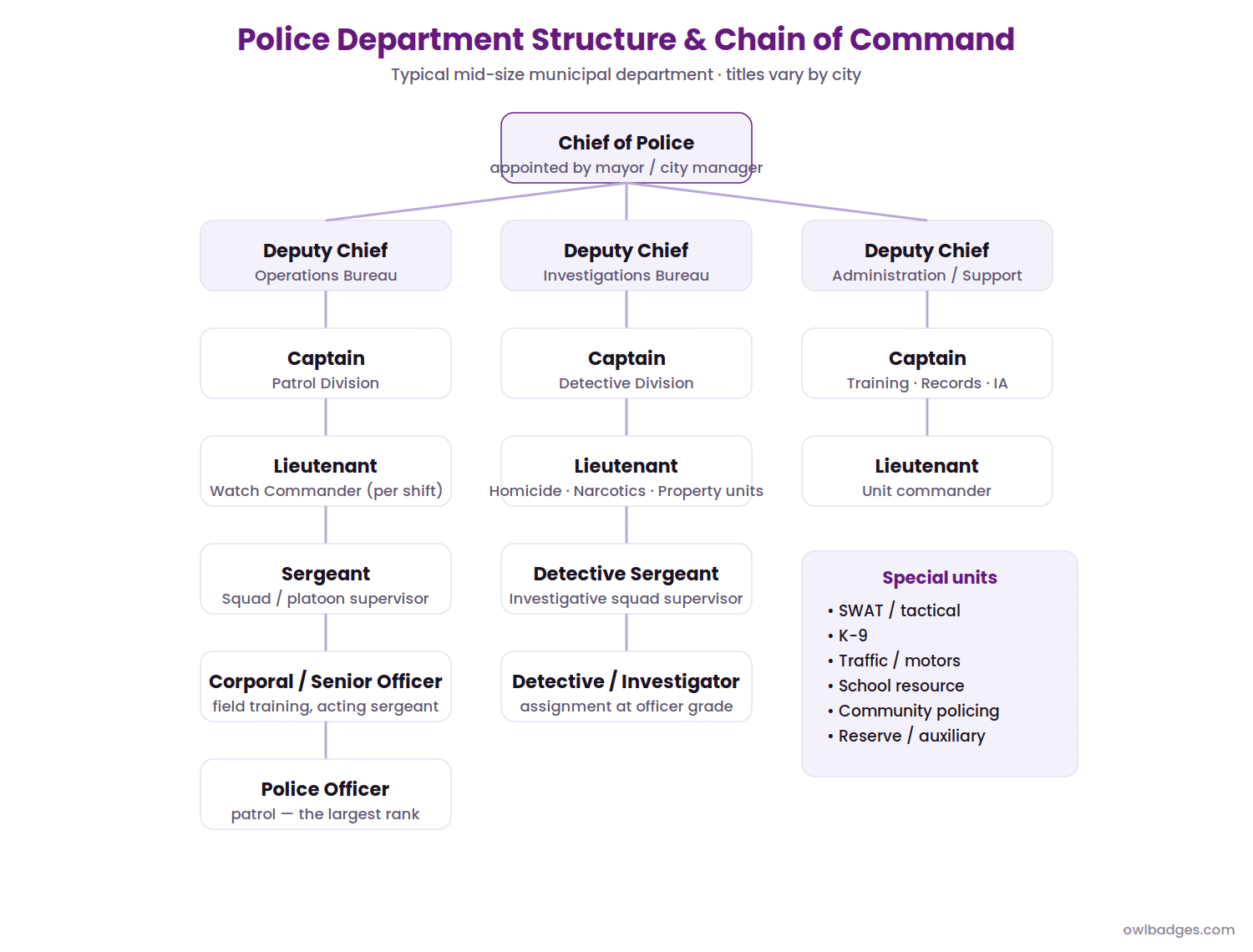
Police department divisions in a large city may also include internal affairs, communications, records, professional standards and community services; each is commanded at captain or lieutenant grade. The patrol division’s platoons are the largest units in any department, which is why police officer is by far the most common rank.
Types of Police Officers and Special Unit Ranks
Types of officers are assignments and jurisdictions, not ranks — a K-9 officer, a SWAT officer and a school resource officer can all be Police Officer II. Rank runs separately inside each. The main types of police officers in the United States:

SWAT ranks
SWAT ranks are not a separate rank ladder — a SWAT team is a unit staffed from the regular ranks. A typical team runs a SWAT commander (lieutenant or captain), team leaders (sergeants), and operators (officers and corporals), with snipers, breachers and medics as assignments within the team. SWAT officers wear their department rank insignia; the unit patch marks the assignment.
Security officer ranks
Private security has its own ladder — officer, senior officer, sergeant, supervisor, captain, director — that mirrors police titles without police authority. See our guide to security supervisor and director badges for how those ranks are marked.
Federal vs State vs Local Rank Differences
Police rank structures vary significantly across different levels of government. Understanding these differences helps clarify why law enforcement organizations across the country display such variety in their hierarchies.
Municipal Police Departments
Municipal (city) police departments typically follow the traditional rank structure described above: Officer, Sergeant, Lieutenant, Captain, and Chief. Medium to large cities add intermediate ranks like Corporal, Detective grades, Major, and Deputy Chief positions.
Characteristics:
- Report to city government (mayor or city manager)
- Chief is typically appointed, not elected
- Standardized insignia systems within the department
- Rank structure focused on geographic patrol divisions
- Police officer badges reflect municipal authority and jurisdiction
County Sheriff’s Offices
Sheriff ranks in order, from the bottom up, in a typical county sheriff’s office:
- Deputy Sheriff (Deputy)
- Corporal
- Sergeant
- Lieutenant
- Captain
- Chief Deputy or Commander
- Undersheriff (Assistant Sheriff)
- Sheriff — elected in most states
Sheriff’s office ranks, sheriff department ranks and county sheriff ranks all describe this same ladder; the deputy rank corresponds to the municipal police officer, and sheriff rank insignia use the same chevrons, bars and stars as city departments, usually on a star-shaped badge rather than a shield.
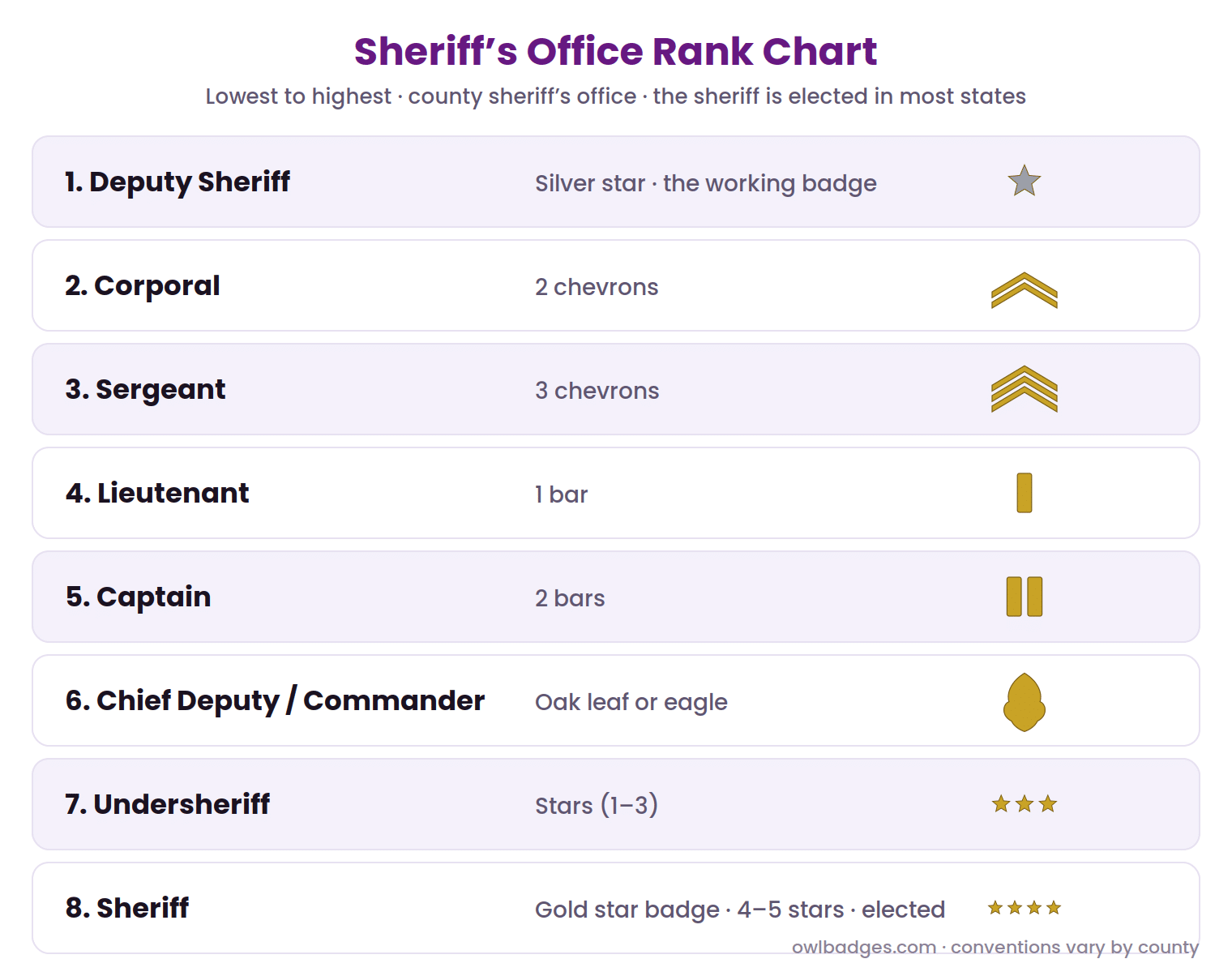
Sheriff’s offices often use similar but distinct terminology. Instead of “Police Officer,” they may use “Deputy Sheriff.” The elected Sheriff serves as department head, and some jurisdictions use “Undersheriff” instead of “Deputy Chief.”
Characteristics:
- Sheriff is elected by county voters
- May include jail operations and court security (see our bail enforcement requirements guide)
- Often use traditional star badges at all ranks
- May blend law enforcement and corrections ranks
State Police / Highway Patrol
State police ranks and state trooper ranks follow a more military ladder. Typical state police rank list, lowest to highest: Trooper → Trooper First Class → Master Trooper (a senior non-supervisory rank in several states) → Corporal → Sergeant → Lieutenant → Captain → Major → Lieutenant Colonel → Colonel, who is usually the Superintendent or Commissioner of the state police. Highway patrol ranks in states that use that name are the same ladder.
State police agencies and highway patrol organizations often use military-styled ranks including Trooper (equivalent to officer), with promotions through Corporal, Sergeant, Lieutenant, Captain, Major, Lieutenant Colonel, and Colonel. Some state agencies use “Superintendent” as the title for their agency head.
Characteristics:
- Statewide jurisdiction
- Often use military rank terminology
- May incorporate military-style insignia
- Typically smaller agency size relative to total state population
- State trooper badges reflect state authority
State police ranks by state
Most state police and highway patrol agencies use a military ladder that ends in a colonel or superintendent. Common state police ranks by state:
| Agency | Ranks, lowest to highest |
|---|---|
| Pennsylvania State Police | Trooper → Corporal → Sergeant → Lieutenant → Captain → Major → Lieutenant Colonel → Colonel (Commissioner) |
| Maryland State Police | Trooper → Trooper First Class → Corporal → Sergeant → First Sergeant → Lieutenant → Captain → Major → Lieutenant Colonel → Colonel (Superintendent) |
| Massachusetts State Police | Trooper → Sergeant → Lieutenant → Captain → Major → Lieutenant Colonel → Colonel (Superintendent) |
| Louisiana State Police | Cadet → Trooper → Trooper First Class → Senior Trooper → Master Trooper → Sergeant → Lieutenant → Captain → Major → Lieutenant Colonel → Colonel (Superintendent) |
| New York State Police | Trooper → Sergeant → Lieutenant → Captain → Major → Lieutenant Colonel → Colonel (Superintendent) |
| Texas DPS Highway Patrol | Trooper → Corporal → Sergeant → Lieutenant → Captain → Major → Regional / Division Director |
| California Highway Patrol | Officer → Sergeant → Lieutenant → Captain → Assistant Chief → Chief → Deputy Commissioner → Commissioner |
Rank titles and the number of steps change with each agency; check the agency’s own rank chart for current insignia.
Federal Law Enforcement
Federal agencies like the FBI, DEA, ATF, and U.S. Marshals Service use different nomenclature. Most federal agents start as “Special Agent” and advance through grades (GS-11, GS-12, GS-13, etc.) rather than traditional ranks. Supervisory positions include titles like Supervisory Special Agent, Assistant Special Agent in Charge (ASAC), and Special Agent in Charge (SAC).
Characteristics:
- Federal jurisdiction and authority
- Grade-based pay systems (GS scale)
- Less visible rank insignia
- Credential-based identification rather than badges in some agencies
- Federal agency badges emphasize department-specific designs
Regional Variations in Rank Systems
While the basic hierarchical principle remains consistent across American law enforcement, significant regional and departmental variations exist in how ranks are structured and designated.
Size-Based Variations
Small Departments (1-25 officers): Small departments typically use simplified structures with only 3-4 ranks: Officer, Sergeant, possibly Lieutenant, and Chief. Everyone may perform similar duties regardless of rank due to limited personnel.
Medium Departments (25-250 officers): Medium-sized departments generally employ standard structures: Officer, Corporal (sometimes), Sergeant, Lieutenant, Captain, and Chief, with possible Deputy Chief positions.
Large Departments (250+ officers): Large departments feature comprehensive rank structures including multiple intermediate and executive ranks, specialized positions, and often separate promotional tracks for patrol and investigative functions—much like the complex structures seen in major fire departments and EMS agencies.
Regional Terminology Differences
Northeast: Tends toward traditional structures with Detective as a distinct rank; often uses “Patrolman” terminology
South: Often employs Sheriff-based terminology even in municipal departments; may use military ranks more frequently
West: Shows more variation including sheriff systems in areas served elsewhere by police departments; California particularly shows diversity in rank structures
Midwest: Generally uses traditional rank systems; often includes Corporal rank more commonly than coastal regions. Cities like Chicago maintain unique badge traditions dating back over 170 years.
Specialized Agency Variations
University Police: May use traditional structures or hybrid systems blending academic and law enforcement terminology—see our guide to campus safety badges
Transit Police: Often follow the structure of the larger municipal department in their area
Port Authority/Airport Police: May use unique rank systems specific to their specialized jurisdictions
Tribal Police: Sovereign tribal nations design their own systems, sometimes incorporating traditional governance structures
Security Services: Private security officer ranks may mirror police structures or use company-specific hierarchies
Historical Evolution of Police Ranks
The development of police ranks in America closely mirrors the evolution of professional policing itself. Early American law enforcement consisted primarily of volunteer night watches and elected sheriffs with minimal formal structure. As cities grew during the Industrial Revolution, the need for organized, full-time police forces became apparent.
The first modern police departments, established in major cities during the 1830s and 1840s, initially borrowed rank structures directly from military organizations. This made practical sense for several reasons—many early police leaders had military backgrounds, the command structure needed to coordinate large numbers of officers mirrored military needs, and the quasi-military appearance lent authority and legitimacy to the new profession.
By the late 1800s, most major city police departments had adopted a standardized rank structure that included Patrolman, Sergeant, Lieutenant, Captain, and Chief. The introduction of badge numbering systems in the 1890s helped track officers and establish accountability.
The early 1900s saw the addition of Detective ranks as investigative specializations developed. The mid-20th century brought further refinements, including intermediate supervisory ranks like Corporal in some departments and executive ranks like Deputy Chief and Assistant Chief in larger agencies.
Modern police rank systems continue to evolve. Recent decades have seen some departments flatten their hierarchies to improve communication and reduce bureaucracy. Others have created specialized rank tracks for investigators, technicians, and community policing specialists that run parallel to the traditional command structure. Specialized roles like law enforcement chaplain badges represent newer additions to department structures, providing critical support services without traditional rank authority.
Historical Context
The first organized police force in America, the Boston Police Department established in 1838, initially used only three ranks: Constable, Marshal, and Chief Marshal. The complex rank structures we see today developed gradually throughout the late 1800s and early 1900s, heavily influenced by military organizational models. Cities like Chicago adopted distinct badge designs that evolved from simple tin stars in 1855 to the sophisticated 5-point star badges still used today. It’s fascinating how something that started so simple evolved into the multi-layered hierarchies we have now.
Key Takeaways
Key Takeaways
- Police ranks follow a hierarchical structure from Officer (entry level) to Chief of Police (highest command), creating clear chains of authority across all departments from municipal police to federal agencies
- The standard rank progression in most departments is: Officer → Sergeant → Lieutenant → Captain → Chief, though variations exist by size and region
- Badge insignia visually communicates rank through chevrons (sergeants), bars (lieutenants/captains), and stars (chiefs), though specific designs vary by department—understanding badge numbering systems adds another layer of identification
- Detective positions may be promotional ranks or lateral assignments depending on the department, representing specialized investigative roles similar to private investigator credentials
- Federal, state, and local law enforcement use different rank terminologies (Agent vs Trooper vs Officer) but follow similar hierarchical principles
- Approximately 85-90% of officers serve at patrol or detective ranks; only 10-15% reach supervisory positions during their careers
- Rank structure complexity typically correlates with department size—small agencies may use only 3-4 ranks while major departments employ 8 or more
- Modern rank systems evolved from military structures adopted in the 1800s, though contemporary departments continue refining and adapting hierarchies to include specialized roles like chaplain badges and advanced investigative positions
Frequently Asked Questions
What rank is 2 chevrons in the police?
Two chevrons almost always mark a corporal — the first step above police officer in departments that use the rank, and a senior-officer grade in some others.
What rank is 3 chevrons in the police?
Three chevrons mark a sergeant, the first-line supervisor, in virtually every American department. Added rockers beneath the chevrons indicate senior sergeant grades.
What do bars mean on a police uniform?
A single bar is a lieutenant; two connected bars (“railroad tracks”) are a captain. A small number of departments use three bars for captain or senior captain.
What are the police ranks in order?
The common ladder: officer, corporal, sergeant, lieutenant, captain, major or deputy chief, assistant chief, and chief of police — with detective grades running parallel to the supervisory track.
Do all police departments use the same rank insignia?
No. The military-style pattern is the dominant convention, but departments set their own sequences, and sheriff’s offices in particular vary — always read the title line on the badge alongside the insignia.
Is detective a rank or a position?
In most US departments detective is a position — an investigative assignment held by a police officer at officer pay grade — not a rank. Some large departments make it a formal rank. Detective sergeants and detective lieutenants are supervisory ranks in either case.
What rank is 1 star in the police, and what is 4 stars?
One star is usually a deputy chief or assistant chief. Four stars is the chief of police in a large department; three stars is a chief in a mid-size department or an assistant chief in a large one. Five stars appear only in the largest agencies.
What do 3 stripes on a police uniform mean?
Three stripes (three chevrons) mean sergeant. Two stripes mean corporal; one stripe means officer first class where that rank exists. A rocker under the chevrons marks a senior or staff sergeant.
What are sheriff ranks in order?
Deputy, corporal, sergeant, lieutenant, captain, chief deputy, undersheriff, sheriff. The sheriff is elected in most states; the undersheriff is the appointed second-in-command.
What do police rank abbreviations like Cpl and Sgt stand for?
Cpl is corporal, Sgt is sergeant, Lt is lieutenant, Capt is captain, Maj is major, Cmdr is commander, Ofc or PO is police officer, and Det is detective. Deputy chief and assistant chief are written Dep. Chief and Asst. Chief.
Conclusion
Understanding police ranks provides valuable insight into how law enforcement agencies organize themselves, establish authority, and create career pathways for officers. While specific rank titles, insignia designs, and structural details vary across the thousands of law enforcement agencies operating in the United States—from municipal police departments to county sheriff’s offices, state police agencies, and federal law enforcement organizations—the fundamental hierarchical principles remain remarkably consistent.
The rank system serves practical organizational needs—coordinating large numbers of personnel, establishing clear command during emergencies, defining career advancement opportunities, and maintaining accountability throughout the organization. Whether you encounter officers wearing Chicago’s historic 5-point star badges, traditional deputy sheriff stars, or specialized corrections officer badges, recognizing the basic rank structure helps you understand the roles and responsibilities of the officers you interact with.
As law enforcement continues evolving to meet contemporary challenges and community expectations, rank structures will likely continue adapting. Some departments experiment with flatter hierarchies to improve communication and responsiveness. Others maintain traditional structures while enhancing lateral career opportunities for specialists who prefer technical expertise over command responsibilities—from law enforcement chaplain badges to specialized investigators requiring bail enforcement credentials or bounty hunter licensure.
For those considering law enforcement careers, understanding the rank structure from the beginning helps set realistic expectations and career goals. For citizens, recognizing how police organizations structure themselves promotes better understanding of the complex institutions that serve public safety in communities across America.
Every rank on this page is available as a custom badge.
Silver for officers, gold for command — personalized with department, rank and badge number. One badge or a whole department.
Related Articles
Police Badge Numbering Systems Explained
Learn how police departments assign badge numbers through sequential, seniority-based, and division-coded systems. Understand NYPD, LAPD, and Chicago PD numbering methods.
12 min read
Chicago Police Badge History: 170 Years of the Iconic CPD Star
Discover 170 years of Chicago Police Department badge history from 1855 to 2026. Learn why CPD uses 5-point stars, badge evolution through the Great Fire, Prohibition era, and modern designs.
11 min read
Law Enforcement Chaplain Requirements
Complete guide to becoming a law enforcement chaplain badge. Learn certification requirements by denomination, training programs, badge authority limitations, and multi-faith chaplain badgecy standards.
10 min read
Bail Enforcement Agent Badge Requirements by State
Comprehensive state-by-state guide to bail enforcement agent badge laws, licensing requirements, and legal authority. Includes bounty hunter regulations and compliance standards.
13 min read
Are Bounty Hunter Badges Legal? State-by-State Laws
Detailed analysis of bounty hunter badge legality across all 50 states. Understanding fugitive recovery laws, badge restrictions, and legal compliance requirements.
14 min read
Corrections Officer Certification Requirements by State
State-by-state guide to corrections officer certification, training requirements, badge authority, and career paths in jail and prison systems nationwide.
12 min read
Sources and further reading
- Police ranks of the United States — Wikipedia overview of municipal, county, state and federal rank structures
- Bureau of Justice Statistics — Law Enforcement Management and Administrative Statistics (LEMAS) surveys on department size and structure
- International Association of Chiefs of Police — model policies on rank structure and promotion
- Individual agency rank charts (e.g., state police and highway patrol sites) for current insignia and titles
Owl Badges manufactures rank badges for police, sheriff and state agencies; the descriptions above reflect the conventions we see across departments nationwide. Reviewed September 2026.