


Federal Law Enforcement
FBI Badge: What It Looks Like, Credentials & History
Understanding the iconic shield badge and credentials of America's premier federal investigative agency.
Quick Answer
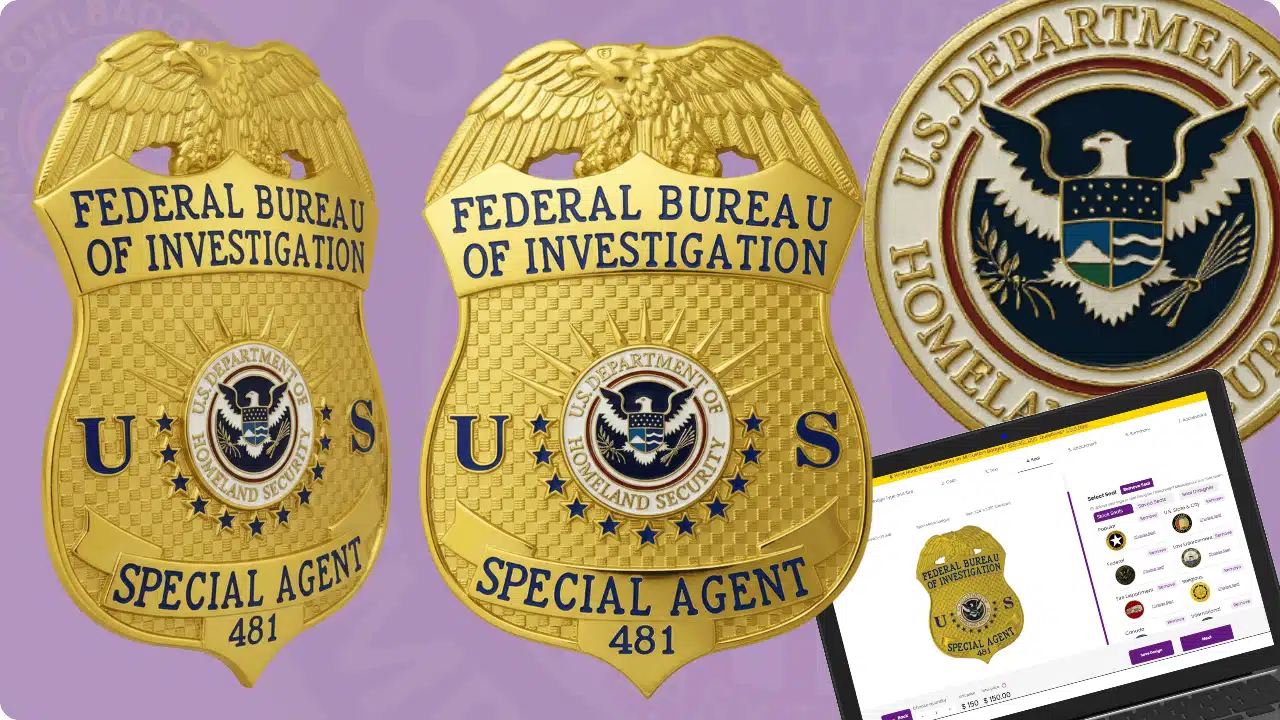
The FBI badge is a gold shield-shaped credential carried by Special Agents and other sworn personnel of the Federal Bureau of Investigation. Established in 1908, the FBI serves as the principal investigative arm of the U.S. Department of Justice. The distinctive FBI badge features a shield design with the DOJ seal, “Federal Bureau of Investigation” text, and “Department of Justice” inscription. Approximately 13,000 Special Agents carry FBI badges while investigating federal crimes, counterterrorism, counterintelligence, and cyber threats nationwide.
Overview of the Federal Bureau of Investigation showing history, leadership structure, priority missions, and key statistics
Key facts about the FBI badge
- An FBI badge is a gold-colored shield topped by an eagle, with the words Federal Bureau of Investigation, the holder’s title, and a badge number; it is carried in a credential case, not worn on a uniform.
- The badge is only half the identification: it is always paired with a photo credential, and a real agent shows both.
- FBI agents do have badge numbers, but there is no public lookup; verification goes through the local field office.
- The FBI seal and motto — Fidelity, Bravery, Integrity — are protected; reproducing the badge or seal for deception is a federal crime (18 U.S.C. §§ 701, 709, 712).
- Task force officers, investigative specialists and FBI Police carry credentials distinct from the special agent badge.
- Owl Badges does not manufacture FBI badges or any badge bearing a federal agency’s emblem; this page is a reference.
Reviewed and updated September 2026. Descriptions are drawn from the FBI’s own published material; no agency badge or seal is reproduced here.
History of the FBI
The FBI badge represents America’s principal federal investigative agency, with roots extending back to 1908. Attorney General Charles Bonaparte created the Bureau of Investigation (BOI) on July 26, 1908, with 34 agents tasked with investigating federal crimes that crossed state lines. This small force would grow into the world’s most recognized law enforcement agency.
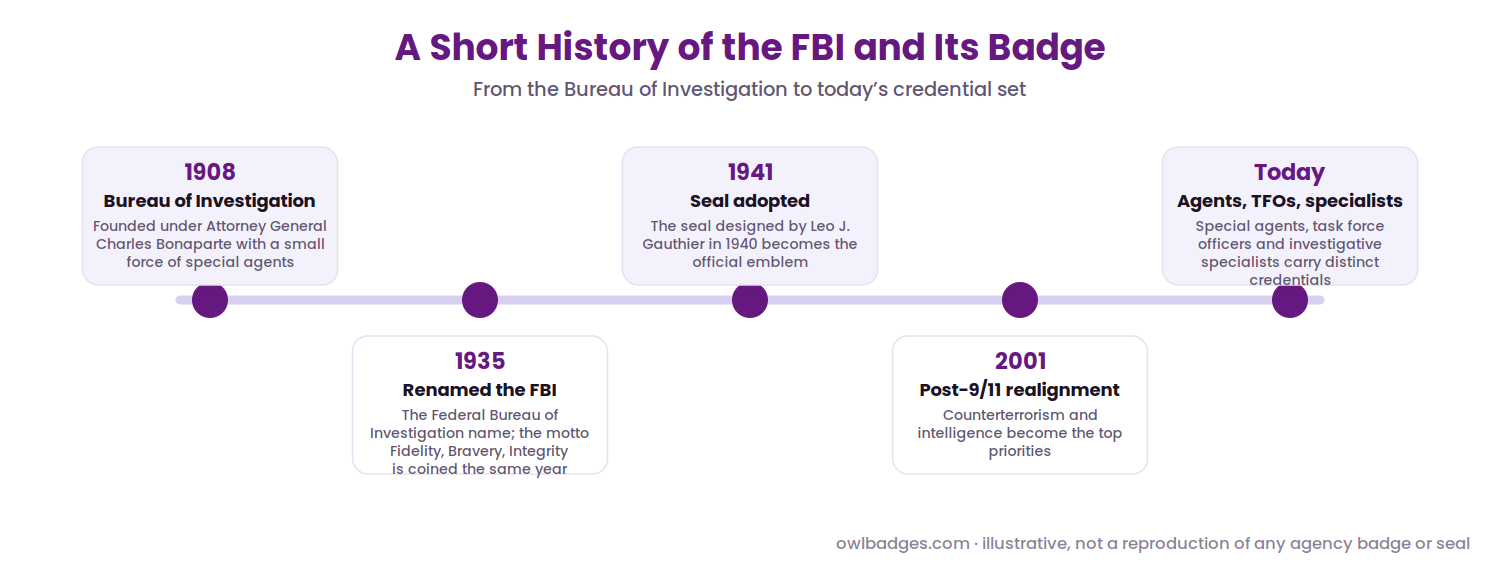
The Bureau underwent dramatic transformation under J. Edgar Hoover, who became Director in 1924. Hoover professionalized the agency, establishing the FBI Academy in 1935, the same year the Bureau was renamed the Federal Bureau of Investigation. Hoover’s emphasis on scientific methods, fingerprint collection, and agent training established standards adopted worldwide.
The FBI badge design has evolved significantly since 1908. Early Bureau agents carried simple identification cards rather than badges. The distinctive gold shield badge now associated with the FBI was developed as the agency’s profile and authority expanded. Today’s FBI badge is instantly recognizable worldwide, appearing in countless films, television shows, and news coverage of federal investigations.
The “G-Men” era of the 1930s brought national fame as FBI agents pursued notorious criminals including John Dillinger, “Baby Face” Nelson, and Bonnie and Clyde. This period established the FBI badge as a symbol of federal law enforcement power that transcended local jurisdictions. The agency’s reputation for methodical investigation and professional conduct elevated the FBI badge to iconic status.
Modern FBI operations expanded dramatically after September 11, 2001, with counterterrorism becoming the agency’s top priority. Today’s FBI badge holders investigate terrorism, espionage, cyber attacks, public corruption, civil rights violations, organized crime, and major white-collar offenses. Explore federal officer badge designs that honor this heritage.
What Does an FBI Badge Look Like?
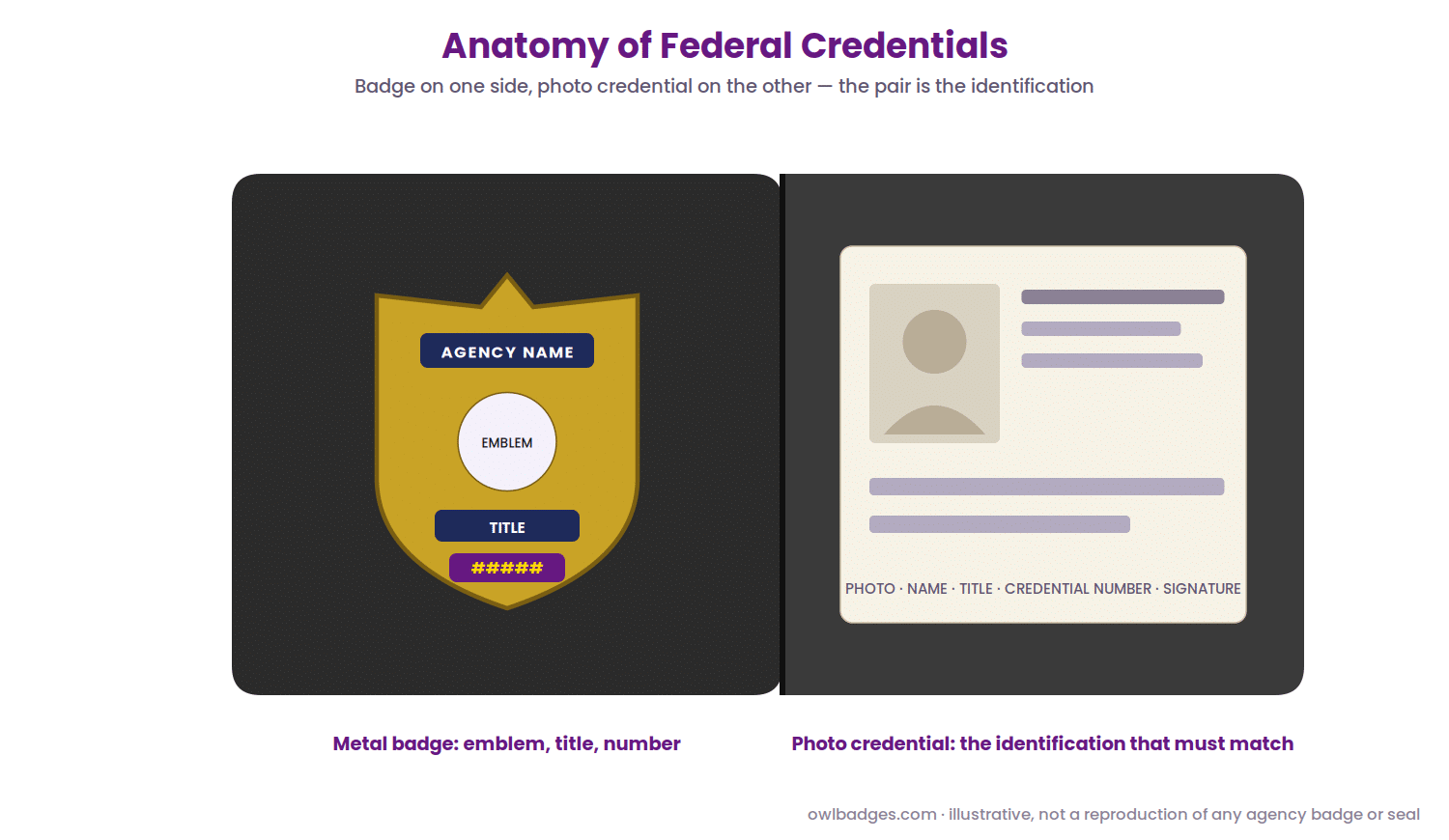
An FBI badge is a gold-colored shield with an eagle at the top. The words FEDERAL BUREAU OF INVESTIGATION run across the upper field, the holder’s title — usually SPECIAL AGENT — sits on a panel, the emblem of the Department of Justice occupies the center, and the badge number is stamped on a lower panel. It is small enough to sit in one side of a black leather credential case; the other side holds the photo credential. What does a real FBI badge look like in the hand? Heavy, die-struck metal with crisp raised lettering and a gold finish that has usually worn at the high points — and it is never presented alone. What do FBI badges look like on television is a different question: props are often oversized and shown without the credential, which is the first thing a real agent would never do.
The current FBI badge follows the design that has been in use for decades; the Bureau does not publish redesign dates, and “current FBI badge” searches usually come from people comparing a badge they were shown against the real thing — which is exactly the situation the verification section below covers.
FBI Badge Design Elements
The FBI badge features distinctive design elements that identify personnel of the Federal Bureau of Investigation. Unlike star-shaped badges carried by marshals or sheriffs, the FBI uses a shield design reflecting its position as an investigative rather than patrol-oriented agency.
The shield shape forms the foundation of FBI badge design. This shape connects the FBI to detective and investigative traditions, distinguishing it from the star badges associated with patrol and enforcement duties. The shield conveys protection, defense, and the investigative mission central to FBI operations.
Key Insight
The FBI badge incorporates the Department of Justice seal, establishing the agency’s position within the executive branch. As the principal investigative arm of the DOJ, the FBI operates under the Attorney General’s authority. This seal placement distinguishes FBI credentials from other federal agencies like the Department of Homeland Security or Treasury enforcement arms.
The “Federal Bureau of Investigation” text appears prominently on the badge, typically arranged in an arc above the central seal. This text establishes immediate agency identification. Additional text may include “Department of Justice” and “Special Agent” or other position designations depending on the badge variant.
The gold finish of FBI badges conveys federal authority and professional prestige. High-quality gold plating over brass substrates creates the distinctive appearance associated with FBI credentials. Blue enamel accents complement the gold, creating the blue and gold color scheme associated with the Department of Justice. Learn more about badge design traditions across law enforcement.
Badge numbers or identification codes link each FBI badge to specific personnel records. These numbers enable accountability and credential verification. Unlike some agencies where badge numbers appear prominently, FBI credentials typically emphasize the agency identification over individual numbers.
The FBI Seal, Motto and Symbols
The FBI seal — the emblem people also search for as the FBI logo — was designed in 1940 by Bureau employee Leo J. Gauthier and adopted in 1941. Its elements are symbolic rather than decorative: the blue field stands for justice; the scales above the shield for the weighing of evidence; the 13 stars for the original states and national unity; the red and white stripes carry the flag’s meaning of courage and purity; the laurel leaves (46 in total) for academic honor and the Bureau’s scientific work; and the gold border for the overall value of the Bureau’s mission. The scroll below the shield carries the FBI motto: Fidelity, Bravery, Integrity, coined in 1935 by Inspector W. H. Drane Lester as an expansion of the initials F-B-I. The seal appears on credentials, buildings and official publications; the badge itself carries the Department of Justice emblem rather than the full seal.
The “FBI warning” screen at the start of films is the anti-piracy notice the Bureau authorizes for copyright holders; it uses the seal under a specific license and is unrelated to agents or badges. Use of the seal, the name FBI or the badge design by anyone else — on merchandise, websites or products — is restricted by 18 U.S.C. § 709, which is why you will not see the seal reproduced on this page.
Badge vs. Credentials: Understanding the Difference
The term “FBI badge” often refers colloquially to the complete credential set carried by FBI personnel. However, technical distinctions exist between the metal badge and the credential case that houses both the badge and identification card. Understanding this distinction clarifies how FBI personnel identify themselves.
FBI Badge (Metal):
- ✓ Gold shield-shaped metal badge
- ✓ DOJ seal and FBI inscription
- ✓ Visual symbol of authority
- ✓ Mounted in credential case
FBI Credentials (Complete Set):
- ✓ Leather credential case
- ✓ Metal badge mounted inside
- ✓ Photo ID card with name
- ✓ Security features and expiration
The credential case contains both elements that together constitute official FBI identification. One side displays the metal badge; the other holds a photo identification card with the agent’s name, photograph, and authentication features. When FBI agents identify themselves, they typically display the opened credential case showing both elements simultaneously.
The photo ID card provides verifiable identification details that the badge alone cannot. Modern FBI credential cards incorporate security features including holograms, microprinting, and other anti-counterfeiting measures. The card includes the agent’s photograph, name, and authentication codes that can be verified through FBI headquarters.
This two-component system provides layered authentication. The badge establishes visual authority and agency affiliation, while the ID card provides individualized identification. Together, they form the complete FBI credential that Special Agents and other authorized personnel carry. Compare with federal marshal badge traditions that use different identification systems.
Detailed anatomy of the FBI badge showing key design elements and their significance
Do FBI Agents Have Badge Numbers?
Yes. Every FBI badge carries a badge number, and every credential carries its own serial. An FBI badge number identifies the badge in the Bureau’s inventory and ties it to the agent it was issued to; the number appears on the badge’s lower panel and is recorded on the credential. There is no public FBI badge number lookup — the Bureau does not publish rosters or badge numbers — so “fbi badge number lookup” searches lead nowhere useful. To confirm an agent, you contact the field office (below), not a database. FBI badge numbers are not sequential by seniority in any way the public can read, and a low number does not indicate rank.
FBI Positions and Badge Holders
The FBI badge is carried by various sworn personnel within the Bureau. Understanding who carries FBI credentials helps clarify the agency’s structure and the positions authorized to exercise federal law enforcement powers.
| Position | Badge Type | Role | Approximate Number |
|---|---|---|---|
| Director | Executive badge | Heads entire FBI, presidential appointee | 1 |
| Deputy Director | Executive badge | Second in command, operations oversight | 1 |
| Special Agent in Charge (SAC) | Special Agent badge | Commands field office | 56 (one per field office) |
| Assistant SAC (ASAC) | Special Agent badge | Division management | ~200 |
| Supervisory Special Agent (SSA) | Special Agent badge | Squad/unit supervision | ~1,500 |
| Special Agent (SA) | Special Agent badge | Field investigations, all programs | ~13,000 |
Special Agents form the investigative backbone of the FBI. These sworn law enforcement officers carry FBI badges and have full federal arrest authority. Special Agents investigate terrorism, espionage, cyber attacks, organized crime, public corruption, financial crimes, and civil rights violations. Entry requires a college degree and successful completion of the FBI Academy.
Special Agents in Charge (SACs) command each of the 56 FBI field offices across the country. SACs carry the same Special Agent badge but hold senior supervisory authority over all investigations and personnel within their geographic area. Major cases often require SAC-level approval and coordination.
FBI Police officers protect FBI facilities and personnel but carry different credentials than Special Agents. These uniformed officers provide physical security for FBI buildings, including the J. Edgar Hoover Building in Washington, D.C., and field office locations. Their badge designations differ from investigative agents. Compare with police rank structures in other agencies.
FBI Divisions and Specialty Assignments
Special Agents carrying the FBI badge work across numerous divisions and specialty units. While all carry the same basic credential, assignments vary dramatically from counterterrorism to art crime investigation.
Pro Tip
FBI Special Agents typically rotate through different investigative programs throughout their careers. An agent might begin working bank robberies, transfer to counterterrorism, then move to cyber investigations. This rotation develops broad investigative expertise while preventing burnout in high-stress specialty areas.
Counterterrorism Division became the FBI’s top priority after 9/11. Agents assigned to CT work prevent terrorist attacks through intelligence gathering, investigation of terrorist networks, and coordination with international partners. Joint Terrorism Task Forces (JTTFs) in each field office bring together FBI agents and local law enforcement.
Counterintelligence Division protects national security against foreign intelligence services. Agents investigate espionage, economic espionage, and foreign influence operations targeting the United States. This division coordinates closely with the Intelligence Community and allied foreign services.
Criminal Investigation Division handles traditional federal crimes including organized crime, violent crimes, major theft, and public corruption. This division traces its origins to the original Bureau of Investigation mission. Agents investigate cases ranging from bank robberies to international drug trafficking.
Cyber Division addresses the growing threat of computer-based crime. Agents investigate nation-state hackers, ransomware operators, and criminal cyber networks. The Cyber Division operates the Internet Crime Complaint Center (IC3) and coordinates with international partners on transnational cyber investigations.
Specialized teams within the FBI include Hostage Rescue Team (HRT), Evidence Response Teams, and SWAT teams. These tactical units deploy domestically and internationally for high-risk operations. Learn about other special unit badge designs.
Task Force Officer, Investigative Specialist and FBI Police Badges
Not everyone who works with the FBI carries the special agent badge. An FBI task force officer badge is issued to local and state officers deputized onto Bureau task forces (JTTF, Safe Streets, violent crime task forces); the TFO credential identifies the officer as working under FBI authority while remaining a member of their home agency. FBI investigative specialist badges and credentials belong to the Bureau’s surveillance specialists — professional staff who conduct physical surveillance but are not sworn agents — and are marked accordingly. The FBI Police, the uniformed force protecting FBI facilities, wears a police-style badge on a uniform, which is the one FBI badge you will see pinned rather than carried. Intelligence analysts, forensic examiners and other professional staff carry photo credentials without a metal badge.
Badge Materials and Specifications
The FBI badge meets exacting specifications reflecting the Bureau’s premier status among federal law enforcement agencies. Quality materials and precision manufacturing create credentials worthy of America’s foremost investigative agency.
FBI Badge Specifications
- Material: High-grade brass with gold plating
- Shape: Shield design with eagle topper
- Enamel: Blue and gold color scheme
- Finish: Protective clear coat, security features
Brass construction provides the durable foundation for FBI badges. High-grade brass alloys offer excellent resistance to daily wear while accepting precision detail work. The substantial weight of brass badges conveys quality appropriate for credentials carried throughout 20+ year federal careers.
Gold plating creates the distinctive appearance of FBI badges. Multiple plating layers ensure adhesion, appearance, and longevity. Quality gold plating maintains its finish for decades of regular use when properly maintained. The gold finish signifies federal authority and distinguishes FBI credentials.
Blue enamel work adds the distinctive Department of Justice color scheme. Hard-fired enamel resists chipping, cracking, and fading through years of daily carry. The blue and gold combination creates immediate visual association with the FBI and broader federal law enforcement.
Modern FBI badges incorporate security features that prevent counterfeiting and unauthorized reproduction. These include serialization, microprinting, and other authentication elements. Security specifications remain controlled to prevent replication by unauthorized parties. Explore the custom badge design gallery for related federal styling options.
How to Verify an FBI Agent (and Spot a Fake Badge)
Because the FBI badge is recognizable, it is a favorite prop for impersonators, and “real FBI badge” is one of the most-searched questions about it. The reliable test is not the badge; it is the credential and the phone call.
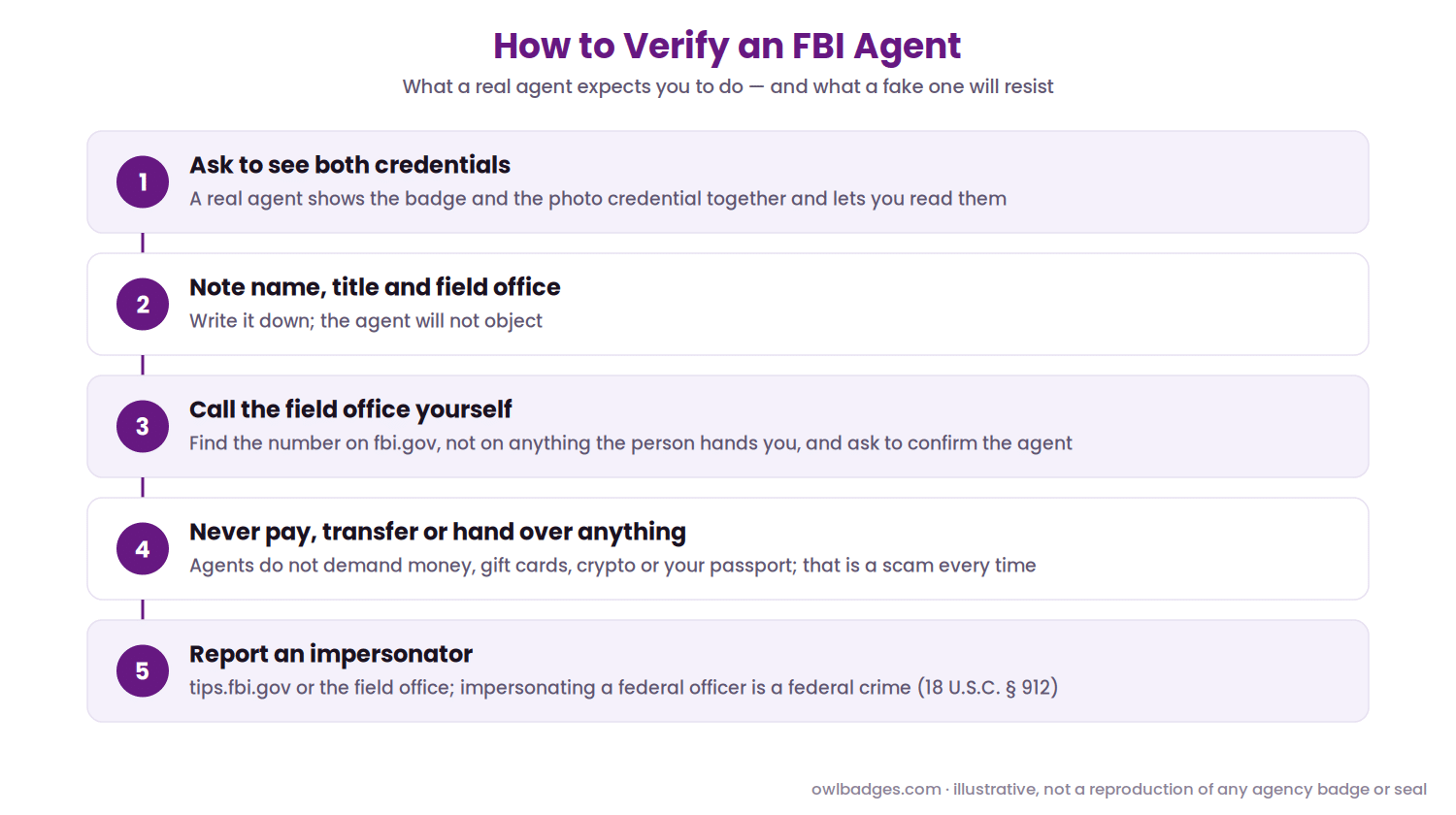
- Ask to see both the badge and the photo credential. A real agent expects this and lets you read the credential: name, title, photo, signature.
- Write down the name, title and field office.
- Call the field office yourself using the number on fbi.gov — not a number the person gives you — and ask them to confirm the agent.
- Never pay anything or hand over documents. The FBI does not collect fines, fees or bail by phone or in person, does not accept gift cards or cryptocurrency, and does not ask for your passport or bank logins.
- Report an impersonator at tips.fbi.gov or to the field office. Impersonating a federal officer is a crime under 18 U.S.C. § 912; manufacturing, selling or possessing a badge that imitates a federal agency’s is a crime under § 701 and § 712.
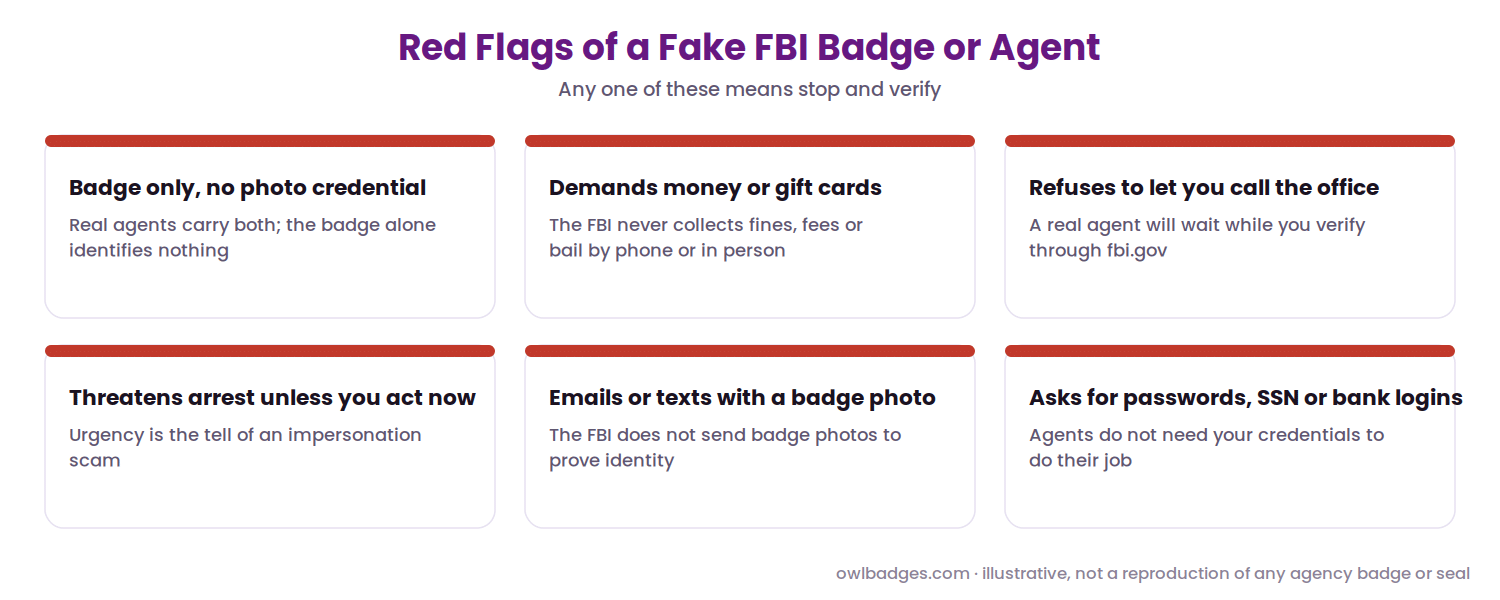
A fake FBI badge is usually given away by its company: no photo credential, a demand for money, urgency, and a refusal to let you call the office. The badge itself may look convincing — which is why the badge is never the test.
Frequently Asked Questions
Can you look up an FBI badge number?
No public database lists FBI badge or credential numbers. To verify an agent, call the nearest FBI field office and ask the operator to confirm the agent by name — the office will confirm or deny employment. Never rely on the badge alone.
What does FBI stand for?
FBI stands for Federal Bureau of Investigation. The agency was originally called the Bureau of Investigation (BOI) when created in 1908, then renamed the Division of Investigation (DOI) in 1933, and finally became the Federal Bureau of Investigation in 1935. The FBI serves as the principal federal investigative agency within the Department of Justice.
Why does the FBI badge have a shield shape instead of a star?
The FBI uses a shield shape connecting to detective and investigative traditions, while star shapes are associated with patrol and enforcement duties (U.S. Marshals, sheriffs). The shield symbolizes protection, defense, and the investigative mission. This shape distinction helps identify FBI agents as investigators rather than patrol officers.
How many FBI agents are there?
The FBI employs approximately 13,000 Special Agents who carry FBI badges. Total FBI employment exceeds 38,000 including Intelligence Analysts, Professional Staff, and other personnel. Special Agents are the sworn law enforcement officers with federal arrest authority and investigative responsibilities.
What jurisdiction does the FBI have?
The FBI has jurisdiction over more than 200 categories of federal crimes. This includes terrorism, espionage, cyber attacks, public corruption, civil rights violations, organized crime, financial crimes, and violent crimes crossing state lines. FBI agents can investigate and make arrests anywhere in the United States and work internationally through Legal Attaché offices.
What is the FBI motto?
The FBI motto is “Fidelity, Bravery, Integrity”—which also explains the “FBI” acronym. This motto was adopted in 1935 when the Bureau was renamed from the Division of Investigation. The three words represent core values expected of all FBI personnel and are incorporated into training, ceremonies, and agency culture.
Key Takeaways
- Established 1908: FBI began as Bureau of Investigation, renamed 1935
- Shield design: Reflects investigative rather than patrol mission
- DOJ affiliation: Principal investigative arm of Department of Justice
- Badge vs credentials: Complete set includes badge, ID card, and credential case
- 13,000+ agents: Special Agents carry FBI badges nationwide
- 56 field offices: Each led by Special Agent in Charge (SAC)
- Priority missions: Counterterrorism, counterintelligence, cyber, public corruption
- Motto: Fidelity, Bravery, Integrity—the values behind the badge
What does a real FBI badge look like?
A gold-colored shield topped by an eagle, with Federal Bureau of Investigation across the top, the holder’s title on a panel, the Department of Justice emblem in the center and a badge number below, carried in a black credential case opposite a photo credential. It is never presented without the credential.
Do FBI agents have badge numbers?
Yes. Every badge carries a number tied to the agent it was issued to. There is no public lookup; verification goes through the local field office.
Can you buy an FBI badge?
No. Manufacturing, selling or possessing a badge that imitates a federal agency’s is a federal crime (18 U.S.C. §§ 701, 712), and the seal is protected separately (§ 709). Owl Badges does not make FBI badges or any badge carrying a federal emblem.
What is the difference between an FBI badge and FBI credentials?
The badge is the metal shield; the credentials are the photo ID card carried opposite it. Together they are the identification; an agent is required to carry and show both.
What does the FBI seal mean?
Blue for justice, scales for weighing evidence, thirteen stars for the original states, red and white stripes for courage and purity, laurel leaves for honor and scientific work, and the motto Fidelity, Bravery, Integrity on the scroll.
What is the current FBI badge?
The gold eagle-topped shield described above, which has been in use for decades. The Bureau does not publish redesign dates; anyone asking because they were shown a badge should verify through the field office rather than by comparing designs.
Conclusion
The FBI badge represents over a century of federal investigative excellence. From the original 34 agents of the Bureau of Investigation to today’s 13,000+ Special Agents, the badge has symbolized the federal government’s commitment to investigating crimes that threaten national security and cross state boundaries. The distinctive gold shield design immediately identifies the bearer as a representative of America’s premier federal investigative agency.
Understanding the history, design elements, and organizational context of FBI credentials provides insight into federal law enforcement structure. The shield shape, Department of Justice affiliation, and “Fidelity, Bravery, Integrity” motto combine to create an instantly recognizable symbol of federal authority. Those who carry the FBI badge accept responsibility for protecting the nation against terrorism, espionage, cyber threats, and the full range of federal crimes.
Looking for badge information for your own agency?
Police rank badges, sheriff stars, security officer and fire badges each have their own guide — and the federal-agency category covers what agencies outside the FBI carry.
Sources and further reading
- FBI — Seal and Motto — the Bureau’s own explanation of the seal’s elements and the origin of the motto
- FBI Field Offices — the numbers to call when verifying an agent
- 18 U.S.C. § 701, § 709, § 712 and § 912 — the statutes on federal badges, the seal, and impersonation
- FBI — Government Impersonation Scams
This is an informational reference about the badge of a federal agency. Owl Badges manufactures custom badges for police, sheriff, security and fire departments and does not produce federal agency badges. Reviewed September 2026.
Related Articles
Federal Agency Badge Designs
Explore badges for federal law enforcement agencies
Federal MarshalsU.S. Marshal Badge Guide
America’s oldest federal law enforcement agency
Career GuideHow to Become an FBI Agent
Career path to earning an FBI badge
Written by
James Kator
Federal Law Enforcement Correspondent
Published: April 15, 2024
Last Updated: October 9, 2026
Tags: