


Federal Law Enforcement
Federal Marshal Badge: History, Design & U.S. Marshals Service Guide
Exploring America’s oldest federal law enforcement agency and the iconic star badge that represents over 235 years of service.
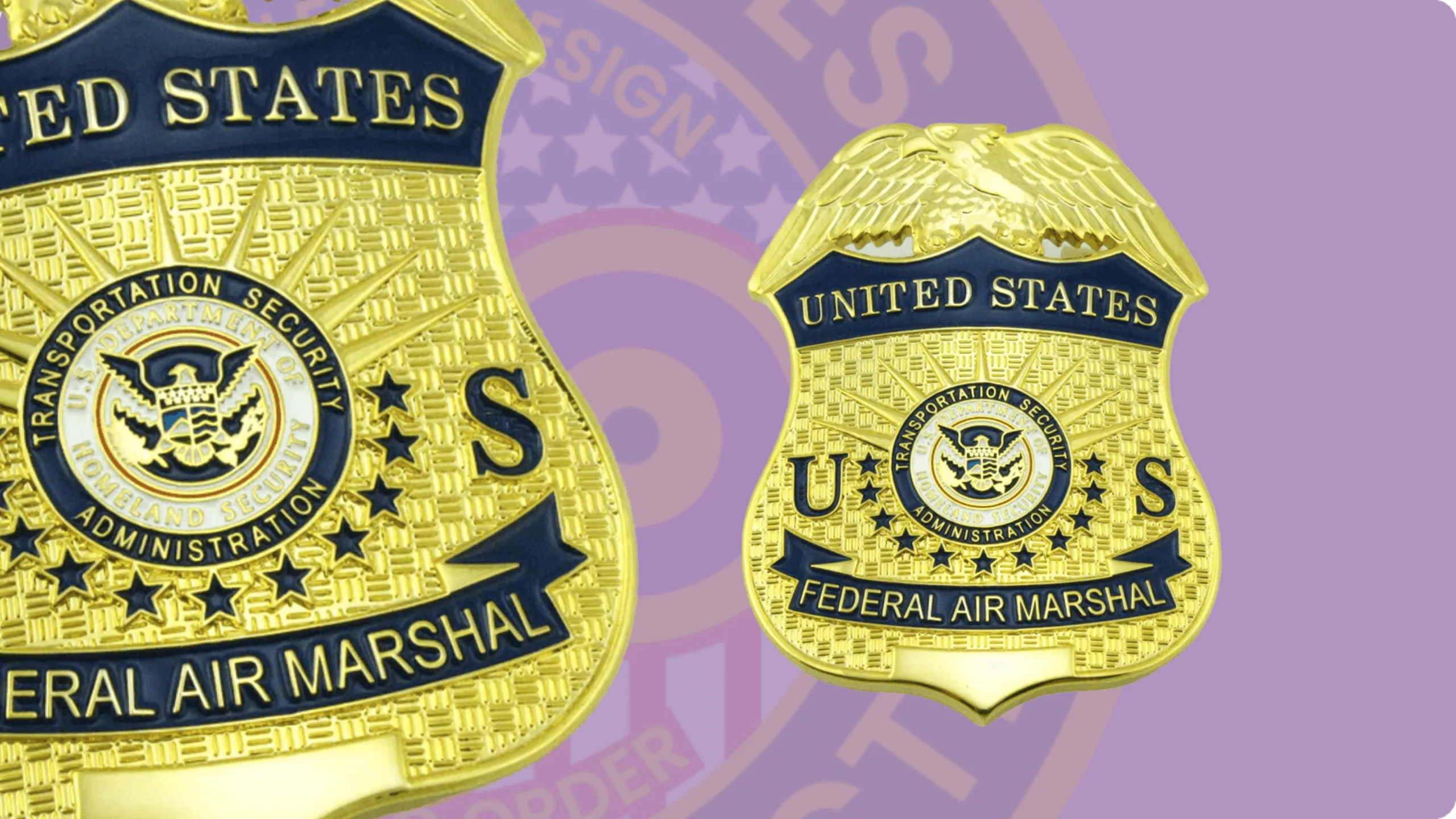 Marshal credential badge featuring distinctive gold star design with eagle and Department of Justice seal” />
The federal marshal badge is the official credential carried by Deputy U.S. Marshals and other personnel of the United States Marshals Service (USMS). Established in 1789, the USMS is America’s oldest federal law enforcement agency. The distinctive gold star badge features the Department of Justice seal, an eagle, and “United States Marshal” text. Modern federal marshal badges are issued to approximately 3,500 Deputy U.S. Marshals who perform fugitive apprehension, witness protection, prisoner transport, and judicial security nationwide.
Overview of the U.S. Marshals Service showing history, rank structure, duties, and key statistics
History of the U.S. Marshals Service
The federal marshal badge represents the oldest federal law enforcement agency in the United States. President George Washington signed the Judiciary Act of 1789, creating the U.S. Marshals Service just thirteen days after the Constitution went into effect. This legislation established one U.S. Marshal for each of the original thirteen federal judicial districts.
Early U.S. Marshals served as the principal enforcement arm of the federal courts. They conducted the census (until 1870), collected taxes, served court documents, and executed federal court orders. In frontier territories, marshals often represented the only federal presence, enforcing laws across vast, lawless regions of the expanding nation.
Legendary Deputy U.S. Marshal Bass Reeves, one of the first Black law enforcement officers west of the Mississippi, arrested over 3,000 felons during his 32-year career (1875-1907). Reeves never sustained a serious injury despite engaging in numerous gunfights while serving warrants in Indian Territory. His federal marshal badge represented federal authority in some of the most dangerous regions of the American West.
The frontier era produced many legendary marshals including Wild Bill Hickok, Wyatt Earp, and Pat Garrett. These lawmen carried distinctive star badges that became symbols of federal authority across the untamed West. The federal marshal badge earned respect—and sometimes fear—as marshals pursued outlaws across territorial boundaries that limited local law enforcement.
Modern federal marshals continue traditions established over two centuries ago. While their duties have evolved significantly, Deputy U.S. Marshals still serve as the enforcement arm of the federal judiciary, carrying badges that connect them to the nation’s founding era. Explore federal marshal badge designs that honor this heritage.
Federal Marshal Badge Design Elements
The federal marshal badge features distinctive design elements that identify personnel of the U.S. Marshals Service. Each component carries specific meaning connecting the badge to federal authority, Department of Justice affiliation, and the agency’s historic mission.
The star shape defines federal marshal badges. Unlike municipal police who may carry shields or circles, the 5-point or 6-point star immediately identifies federal marshals. This shape connects modern marshals to frontier traditions when star-shaped badges distinguished federal lawmen from local authorities across Western territories.
The Department of Justice seal appearing on federal marshal badges establishes the agency’s position within the executive branch. The USMS operates under DOJ authority, distinguishing marshals from Treasury enforcement (Secret Service, historically), Homeland Security agencies, or independent federal law enforcement. This seal placement creates immediate federal agency identification.
The eagle prominently featured on federal marshal badges symbolizes American federal authority. Positioned at the top of many marshal badges, the eagle connects the credential to national sovereignty and constitutional enforcement powers. Eagle placement varies between badge designs but remains a constant identifying element.
Text panels on federal marshal badges display “UNITED STATES MARSHAL” or “DEPUTY U.S. MARSHAL” identifying the specific position. Additional text may include district identification, badge numbers, or specialty unit designations. Gold lettering on blue enamel backgrounds creates high-contrast readability.
The characteristic gold finish of federal marshal badges reflects the agency’s premier status among federal law enforcement. High-grade gold plating over brass substrates provides both prestigious appearance and long-term durability. Learn more about badge design traditions across law enforcement agencies.
Marshal Service Rank Structure
The U.S. Marshals Service employs a structured rank system reflected in federal marshal badge designs and credentials. Understanding this hierarchy helps interpret different badge configurations and their meaning within the organization.
| Position | Appointment | Badge Style | Responsibilities |
|---|---|---|---|
| Director | Presidential appointment | Gold executive badge | Heads entire U.S. Marshals Service |
| U.S. Marshal | Presidential appointment | Gold star badge | Commands judicial district (94 total) |
| Chief Deputy | Career position | Gold deputy badge | Second-in-command of district |
| Supervisory Deputy | Career position | Gold supervisory badge | Supervises enforcement teams |
| Senior Deputy | Career position | Deputy badge | Experienced field deputy |
| Deputy U.S. Marshal | Career position | Deputy badge | Field enforcement, all USMS duties |
U.S. Marshals are presidential appointees confirmed by the Senate who lead each of the 94 federal judicial districts. Each Marshal serves a four-year term and commands all USMS operations within their district, from courthouse security to fugitive operations. Their federal marshal badges feature distinctive designs befitting their appointed status.
Deputy U.S. Marshals form the operational backbone of the service. These career law enforcement officers handle day-to-day enforcement duties including fugitive apprehension, witness protection, prisoner transport, and judicial security. Deputy badges identify them as sworn federal officers with nationwide jurisdiction. Compare with police rank structures in other agencies.
Detailed anatomy of the federal marshal badge showing key design elements and their significance
The Star Badge Tradition
The star shape of the federal marshal badge carries deep historical significance connecting modern marshals to frontier lawmen who established federal authority across the American West. Understanding this tradition reveals why the star remains the defining characteristic of marshal credentials.
During the mid-1800s, federal marshals and deputies needed credentials distinguishing them from local sheriffs and town marshals. The 5-point and 6-point star shapes emerged as specifically federal identifiers. Local lawmen often carried circles, shields, or irregular shapes—but stars became synonymous with federal marshals enforcing national law.
The number of points on a federal marshal badge often indicates the era or specific office. Traditional 5-point stars connect to the earliest marshal designs, while 6-point stars emerged later and are also associated with sheriff offices. Modern U.S. Marshals Service badges maintain these star traditions while incorporating contemporary security features.
The star’s points symbolically represented various aspects of federal authority. Some interpretations connect the 5 points to the original constitutional powers, while others associate them with marshal duties: protection, enforcement, pursuit, justice, and service. Regardless of specific symbolism, the star shape became instantly recognizable across territories and states.
Frontier marshals like Wyatt Earp, Bat Masterson, and Bill Tilghman made the star badge famous through their exploits enforcing law in lawless territories. Hollywood further cemented this association, making the federal marshal star one of the most recognized law enforcement symbols worldwide. Compare with sheriff badge traditions that share this star heritage.
U.S. Marshals Duties and Jurisdiction
Those who carry the federal marshal badge perform critical law enforcement duties that no other agency handles. The U.S. Marshals Service maintains unique responsibilities making deputy marshals essential to the federal justice system.
🎯 Primary Enforcement Duties:
- ✓ Fugitive apprehension (federal warrants)
- ✓ Federal prisoner transport
- ✓ Federal courthouse security
- ✓ WITSEC (Witness Protection)
🏛️ Court Support Duties:
- ✓ Judicial officer protection
- ✓ Courtroom security
- ✓ Seized asset management
- ✓ Warrant service
Fugitive apprehension represents the most publicly visible USMS mission. The Marshals Service leads federal fugitive operations, capturing more federal fugitives than all other agencies combined. Deputy marshals also assist state and local agencies through task forces targeting violent offenders, gang members, and sex offenders.
Witness Security Program (WITSEC) protects witnesses whose testimony threatens their lives. Since 1971, the USMS has protected over 19,000 witnesses and family members, with no WITSEC participant following program guidelines ever being harmed. This unique program exists nowhere else in the world.
Judicial security encompasses protection of federal judges, court officers, and facilities. Deputy marshals assess threats, provide protective details, and secure courthouses where federal proceedings occur. This mission has grown increasingly important as threats against judicial officers have escalated.
Federal prisoner operations include housing over 60,000 federal detainees daily in USMS custody and transporting prisoners between facilities and court proceedings. The Justice Prisoner and Alien Transportation System (JPATS) moves approximately 300,000 prisoners annually. Learn about related corrections badge designs.
Badge Materials and Specifications
Official federal marshal badges meet exacting specifications reflecting the prestige and authority of the U.S. Marshals Service. Quality materials and precise manufacturing create credentials worthy of America’s oldest federal law enforcement agency.
- Material: High-grade brass with gold plating
- Construction: Die-struck under high pressure
- Enamel: Hard-fired blue and gold accents
- Finish: Clear protective coating for durability
Brass construction provides the foundation for federal marshal badges. High-grade brass alloys offer excellent durability, corrosion resistance, and plating adhesion. The substantial weight of brass badges conveys quality and permanence appropriate for career credentials carried throughout 20-30 year federal careers.
Gold plating creates the distinctive appearance of federal marshal badges. Multiple plating layers ensure adhesion and longevity. Quality gold plating maintains appearance for decades of daily wear when properly maintained. The gold finish signifies federal status and distinguishes USMS credentials from local law enforcement.
Blue enamel accents appear on text panels and design elements, creating contrast against gold backgrounds. Hard-fired enamel resists chipping, cracking, and fading over extended wear. The blue and gold color scheme connects to Department of Justice branding and traditional federal law enforcement colors.
Modern federal marshal badges incorporate security features preventing counterfeiting and unauthorized reproduction. These may include microprinting, holographic elements, or serialization systems. Security specifications remain controlled to prevent replication. Explore the custom badge design gallery for styling options.
Frequently Asked Questions
❓ What is the difference between a U.S. Marshal and a Deputy U.S. Marshal?
U.S. Marshals are presidential appointees confirmed by the Senate who lead each of the 94 federal judicial districts, serving 4-year terms. Deputy U.S. Marshals are career federal law enforcement officers who perform the agency’s operational duties including fugitive apprehension, witness protection, and judicial security. Most enforcement work is conducted by deputies.
❓ Why do federal marshal badges have star shapes?
The star shape connects to frontier-era traditions when federal marshals needed credentials distinguishing them from local lawmen. Star badges became specifically associated with federal authority across Western territories. This heritage continued through generations, making the star shape the defining characteristic of U.S. Marshals Service badges today.
❓ What jurisdiction do U.S. Marshals have?
Deputy U.S. Marshals have nationwide federal law enforcement authority. They can enforce federal laws, execute federal court orders, and make arrests anywhere in the United States and its territories. Their jurisdiction extends to international operations when pursuing fugitives abroad, working with foreign law enforcement through established protocols.
❓ How old is the U.S. Marshals Service?
The U.S. Marshals Service was established by the Judiciary Act of 1789, making it America’s oldest federal law enforcement agency. The first 13 U.S. Marshals were appointed by President George Washington himself. In 2025, the agency celebrates 236 years of continuous service to the federal courts and American justice system.
❓ How many Deputy U.S. Marshals are there?
The U.S. Marshals Service employs approximately 3,500 Deputy U.S. Marshals across 94 federal judicial districts, plus headquarters personnel. These sworn officers handle all operational enforcement duties. Total USMS personnel including administrative staff exceeds 5,000. Deputies are supplemented by Special Deputy U.S. Marshals from partner agencies on task forces.
- Oldest federal agency: U.S. Marshals Service established 1789 by President Washington
- Star badge tradition: 5-point and 6-point stars distinguish federal marshals from local law enforcement
- DOJ affiliation: Department of Justice seal establishes executive branch authority
- 94 judicial districts: Each led by presidentially-appointed U.S. Marshal
- Primary duties: Fugitive apprehension, witness protection, judicial security, prisoner transport
- Nationwide jurisdiction: Federal authority across all U.S. states and territories
- Gold finish: Premium plating reflects federal prestige and authority
- Legendary history: Bass Reeves, Wyatt Earp, and other frontier lawmen established marshal traditions
🔗 Share This Guide
Found this helpful? Share with fellow law enforcement professionals and history enthusiasts.
Conclusion
The federal marshal badge represents over 235 years of American law enforcement history. From frontier lawmen taming the Wild West to modern deputies protecting federal courts and apprehending dangerous fugitives, the star badge has symbolized federal authority across every era of American history. The distinctive design connects today’s Deputy U.S. Marshals to legendary figures like Bass Reeves and the constitutional foundations of federal law enforcement.
Understanding the history, design elements, and significance of federal marshal badges provides appreciation for America’s oldest federal law enforcement agency. The star shape, Department of Justice seal, and gold finish combine to create credentials that command respect and represent the highest standards of federal service. These badges continue to symbolize justice, protection, and the rule of law across the nation.
Related Articles
Federal Agency Badge Designs
Explore badges for federal law enforcement agencies
Sheriff BadgesSheriff Star Badge Designs
Star badge traditions for county law enforcement
Career GuideHow to Become a U.S. Marshal
Career path to earning a federal marshal badge
Written by
Michael Torres
Federal Law Enforcement Correspondent
Published: March 10, 2024
Last Updated: December 2025
Tags:
Federal marshal badge guides reference the similar authority conveyed by appointed deputy badge worn by county law enforcement officers.