


Security Industry Guide
Private Security Badge: Complete Guide to Security Officer Credentials
Understanding badge requirements, design options, and state regulations for security professionals.
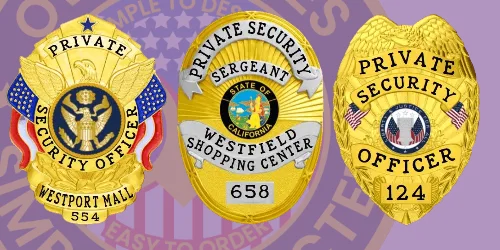
A private security badge is an official credential worn by licensed security officers to identify their authority, company affiliation, and licensing status. Unlike law enforcement badges, private security badges must comply with state-specific regulations that often require distinct designs to prevent confusion with police credentials. Most states require security badges to clearly display “Security” or “Private Security” text, company name, and in some cases, state license numbers.
Overview of private security badge types, industry statistics, and state requirement categories
Private Security Badge Overview
A private security badge serves as the primary credential for security officers working in commercial, residential, and industrial settings across the United States. Unlike law enforcement badges that carry governmental authority, private security badges represent the contractual authority granted by property owners and employers to protect assets, personnel, and premises.
The private security industry employs over 1.1 million licensed officers nationwide, making it larger than public law enforcement. This scale creates significant demand for professional credentials that meet regulatory requirements while projecting authority and professionalism. Quality security officer badges help officers command respect while maintaining clear distinction from police personnel.
Private security badges must clearly identify the wearer as security personnel rather than law enforcement. Most states prohibit designs that could be confused with police badges, requiring text like “Security,” “Private Security,” or “Security Officer” to be prominently displayed. Violation of these regulations can result in fines, license revocation, or criminal charges.
The evolution of private security credentials reflects broader industry professionalization. Early security guards often wore generic badges with minimal identification. Today’s regulations require specific design elements, company identification, and in many states, visible license numbers that enable verification of the officer’s credentials and training status.
Modern private security badges serve multiple functions beyond simple identification. They establish authority boundaries, facilitate access control, enable accountability through badge numbers, and project professionalism that reassures clients and the public. Understanding these functions helps security companies select appropriate badge designs for their operations.
State Licensing and Badge Requirements
State regulations governing private security badges vary significantly across jurisdictions. Some states mandate specific badge designs, while others allow flexibility within guidelines. Understanding your state’s requirements is essential before ordering credentials for security personnel. Learn how to obtain a security license in your state.
Using a private security badge that too closely resembles a law enforcement badge is illegal in most states. Penalties can include fines up to $10,000, imprisonment, and permanent license revocation. Always verify badge designs comply with state regulations before deployment.
| State | Badge Requirement | Required Elements | Approval Process |
|---|---|---|---|
| California | BSIS approval required | “Private Security” text, company name | Submit design for pre-approval |
| New York | State license required | Guard ID, company info visible | Registration with DOS |
| Texas | DPS regulations apply | “Security” designation required | Company maintains records |
| Florida | DOACS licensed | License number, “Security” text | Uniform compliance |
| Illinois | IDFPR requirements | PERC card visible, company ID | License verification |
California’s BSIS (Bureau of Security and Investigative Services) maintains some of the strictest badge regulations in the country. Security companies must submit badge and patch designs for approval before use, ensuring clear distinction from law enforcement credentials. See our guide on getting badge and patch designs approved by California BSIS.
New York requires security guards to display their state-issued guard identification card, which supplements rather than replaces company badges. The layered identification system ensures both company affiliation and state licensing status remain visible during security operations.
Companies planning to start a security company should research badge requirements early in the planning process. Badge compliance affects uniform design, procurement timelines, and operational readiness. Many states require badge designs on file before issuing company licenses.
Types of Private Security Badges
Private security operations require different badge types based on officer roles, licensing levels, and operational requirements. Understanding badge categories helps companies equip personnel with appropriate credentials for their specific assignments.
Security Officer badges represent the standard credential for unarmed security personnel. These security guard badges typically feature silver or nickel finishes with company identification, “Security Officer” designation, and badge numbers. Unarmed officers handle access control, patrol, observation, and reporting duties across various environments.
- Unarmed officers: Approximately 75% of private security personnel
- Armed officers: Approximately 15% with additional licensing
- Supervisors/Management: Approximately 8% of security workforce
- Specialized roles: Approximately 2% (executive protection, investigations)
Armed Security badges identify officers licensed to carry firearms during duty. Armed security officer badges often feature gold finishes or distinctive design elements that immediately signal enhanced authority and training. Armed officers require additional state licensing, background checks, and ongoing qualification requirements.
Supervisor badges designate team leaders, site supervisors, and management personnel within security operations. Security supervisor badges typically feature enhanced designs with eagle toppers, gold finishes, or distinctive rank designations that establish clear chain-of-command visibility for both security teams and clients.
Private Security badges for specialized roles include private security officer credentials for executive protection, event security, and residential patrol operations. These badges may incorporate client-specific elements while maintaining regulatory compliance and professional appearance.
Major security companies like Allied Universal maintain standardized badge programs across their operations. See our Allied Universal badge options for examples of corporate security credential programs.
Required and recommended design elements for compliant private security badges
Badge Design Elements and Compliance
Designing a compliant private security badge requires balancing professional appearance with regulatory requirements. Understanding which elements are mandatory, optional, and prohibited helps create effective credentials that meet state standards.
The most critical design element is clear security identification. Nearly all states require the word “Security,” “Private Security,” or “Security Officer” prominently displayed on badges. This text must be immediately visible and not obscured by other design elements. Font size and placement regulations vary by state, with some requiring specific minimum dimensions.
Choose badge shapes that differ from your local law enforcement agencies. If police in your area use shield-shaped badges, consider oval, circle, or uniquely styled shield designs. This proactive differentiation prevents confusion and demonstrates compliance intent to regulators.
Company identification typically appears on private security badges either as text or incorporated logos. Most states require company name visibility for accountability purposes. This element helps the public, clients, and authorities quickly identify which security firm employs the officer.
Badge numbers serve accountability functions similar to law enforcement credentials. Many security companies assign unique numbers to each officer, enabling complaint tracking, incident documentation, and personnel management. Some states mandate badge numbers, while others leave this to company discretion.
Prohibited elements typically include governmental seals (state, city, or federal), law enforcement terminology (“Police,” “Officer” without “Security” qualifier, “Deputy”), and designs too similar to local police badges. Understanding these restrictions helps avoid costly badge redesigns after regulatory rejection.
Badge vs. Patch: Which Do You Need?
Security companies often face decisions between metal badges and embroidered patches for officer identification. Both serve similar functions but offer different advantages depending on operational requirements, state regulations, and company image preferences.
🏅 Metal Badge Advantages:
- ✓ Professional, authoritative appearance
- ✓ Easily transferable between uniforms
- ✓ Long-lasting durability (10+ years)
- ✓ Higher perceived authority
🎖️ Embroidered Patch Advantages:
- ✓ Lower initial cost per unit
- ✓ Clearly distinct from police badges
- ✓ Full-color design options
- ✓ Easier regulatory approval in some states
Metal badges project stronger authority and professionalism, making them preferred for executive protection, armed security, and high-profile assignments. The investment in quality metal badges pays dividends through enhanced client confidence and officer pride. However, metal badges face stricter regulatory scrutiny regarding similarity to law enforcement credentials.
Embroidered patches offer cost-effective identification clearly distinct from police badges. Many states with strict badge regulations prefer patches because they eliminate confusion concerns entirely. Patches integrate seamlessly with security uniforms and allow full-color company branding.
Many security companies use both badges and patches strategically. Patches on uniform shirts provide constant identification, while clip-on badges add authority for specific situations. This dual approach satisfies regulations while maximizing professional appearance flexibility.
Materials and Quality Standards
Professional private security badges require construction materials and manufacturing quality that withstand years of daily wear while maintaining professional appearance. Understanding badge construction helps procurement decisions that balance budget with long-term value.
Security officers typically carry the same badge throughout their employment. A quality badge costing $40-60 that lasts 10+ years delivers better value than budget badges requiring replacement every 2-3 years. Additionally, professional-quality badges enhance company image and officer pride.
Brass represents the industry standard for professional security badges. Its durability, detail retention, and plating adhesion create badges that maintain appearance through years of use. High-quality brass badges accept gold, silver, and specialty finishes while resisting corrosion from sweat and environmental exposure.
Nickel silver provides natural silver-toned appearance without plating, making it ideal for security officer badges where silver finishes are standard. This alloy offers exceptional durability and maintains consistent appearance even under heavy wear conditions.
Zinc alloy offers budget-friendly badge production for companies with high turnover or limited budgets. While not matching brass durability, quality zinc badges can provide acceptable 3-5 year service life when properly manufactured and finished.
Specialized applications may require SORA Level 2 badges for New York State security officers meeting enhanced training requirements. See our SORA Level 2 badge options for compliant credential solutions.
Quality badge construction includes die-struck manufacturing, hand-finishing, durable enamel work, and protective clear coating. These elements combine to create badges officers carry proudly throughout their security careers. Explore the complete custom badge design gallery for quality options.
Frequently Asked Questions
❓ Do I need a license to wear a private security badge?
Yes, in most states you must hold a valid security guard license or registration to wear a private security badge while working. Wearing security credentials without proper licensing can result in criminal charges for impersonation. Always obtain appropriate state licensing before accepting security employment or wearing security identification.
❓ Can private security badges look like police badges?
No. Most states prohibit private security badges from closely resembling law enforcement credentials. Badges must prominently display “Security” or “Private Security” text and avoid police-style elements like governmental seals or law enforcement terminology. Violations can result in fines, imprisonment, and license revocation.
❓ What information must appear on a private security badge?
Required elements vary by state but typically include: “Security” or “Private Security” designation, company name, and often a badge number. Some states require license numbers displayed on badges. California’s BSIS has specific requirements including company name and “Private Security” text prominently displayed.
❓ How much does a private security badge cost?
Quality private security badges typically range from $30-80 depending on materials, design complexity, and finish options. Premium die-struck brass badges with enamel work fall in the $50-80 range. Budget zinc alloy options start around $20-35. Bulk orders reduce per-badge costs significantly for larger security companies.
❓ Do armed security officers need different badges?
While not always legally required, many security companies use distinct badge designs for armed personnel. Gold finishes, “Armed Security” or “Armed Officer” designations, and enhanced designs distinguish armed officers from unarmed personnel. This differentiation aids identification and reflects the additional training and responsibility of armed security work.
- State compliance: Badge requirements vary significantly—verify regulations before ordering
- Clear identification: “Security” or “Private Security” text required in most states
- Distinct design: Badges must not resemble local law enforcement credentials
- Company ID: Employer identification typically required for accountability
- Badge types: Different designs for unarmed, armed, and supervisory personnel
- Quality materials: Brass and nickel silver provide long-term durability
- Badge vs patch: Consider both for regulatory compliance and professional appearance
- Licensing first: Obtain proper security guard license before wearing credentials
🔗 Share This Guide
Found this helpful? Share with your security industry colleagues.
Conclusion
A private security badge represents both professional identity and regulatory compliance in an industry serving millions of clients nationwide. Understanding state requirements, design elements, and quality standards helps security companies equip their officers with credentials that project authority while meeting legal obligations. From unarmed guards to armed supervisors, the right badge design supports effective security operations.
Whether starting a new security company or updating existing credentials, invest time in understanding your state’s specific requirements before ordering badges. Quality badges that clearly identify officers as private security personnel protect both the company and individual officers from regulatory issues while enhancing professional image with clients and the public.
Related Articles
Security Officer Badges
Custom badge designs for security professionals
Business GuideHow to Start a Security Company
Complete guide to launching your security business
CaliforniaBSIS Badge Approval Guide
Getting your badge design approved in California
Written by
David Mitchell
Security Industry Consultant
Published: January 20, 2025
Last Updated: December 2025
Tags: