


Badge Basics
What Do Police Badge Numbers Mean?
How to decode and understand the numbering systems used by law enforcement agencies across the United States.
Quick Answer
What do police badge numbers mean? Badge numbers are unique identifiers assigned to individual officers. Depending on the department, they may simply be sequential identifiers, or they may encode information about rank, division, precinct, or seniority. Some departments use the first digit to indicate rank (1 = patrol, 2 = sergeant, etc.), while others use random assignment for security. There’s no universal system—each of the 18,000+ U.S. law enforcement agencies sets its own rules.
Key facts about police badge numbers
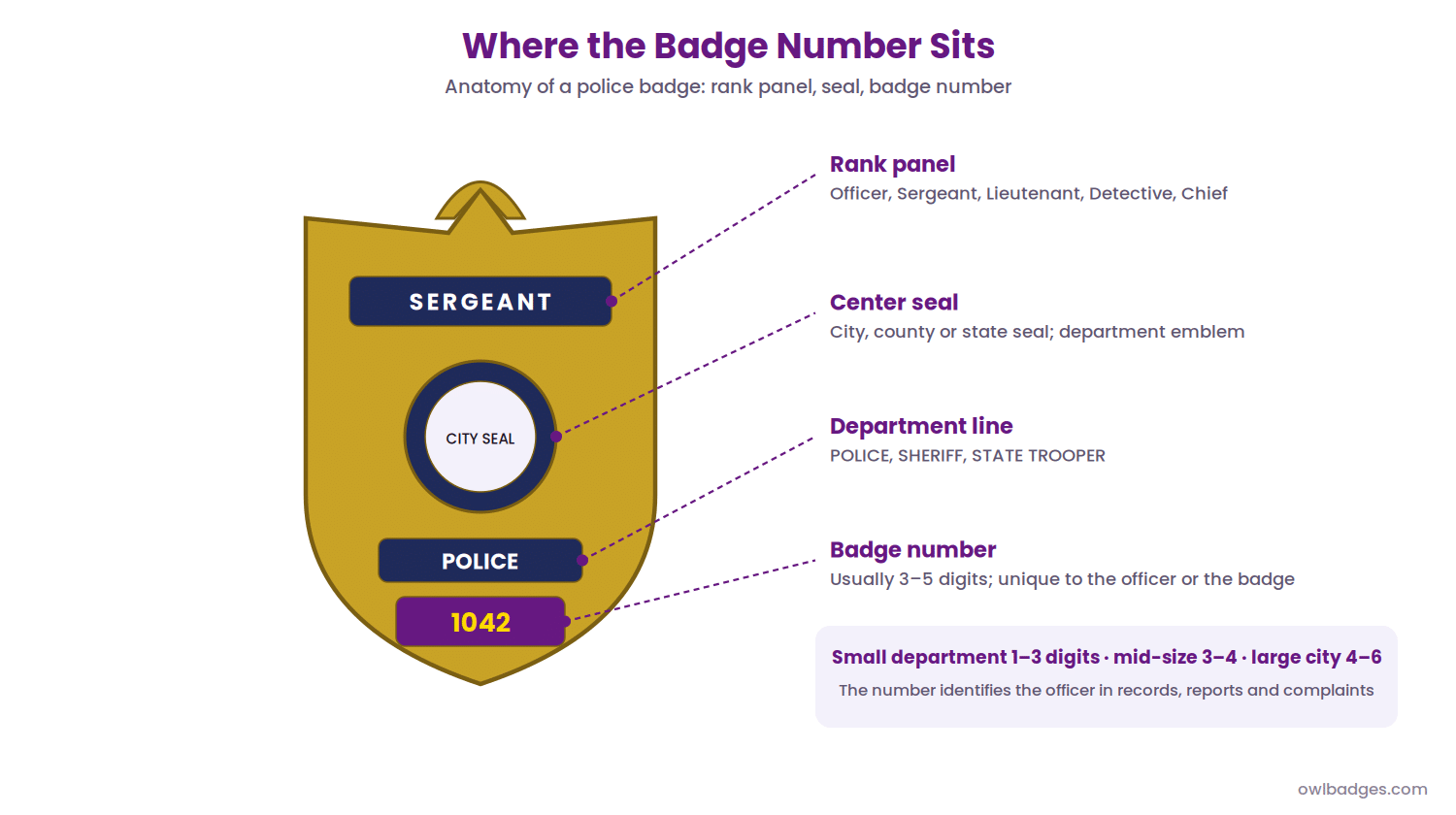
- A police badge number is usually 3 to 5 digits; small departments use 1–3, the largest cities up to 6.
- The number identifies the officer in records — reports, citations, complaints — and is the accountability half of the badge.
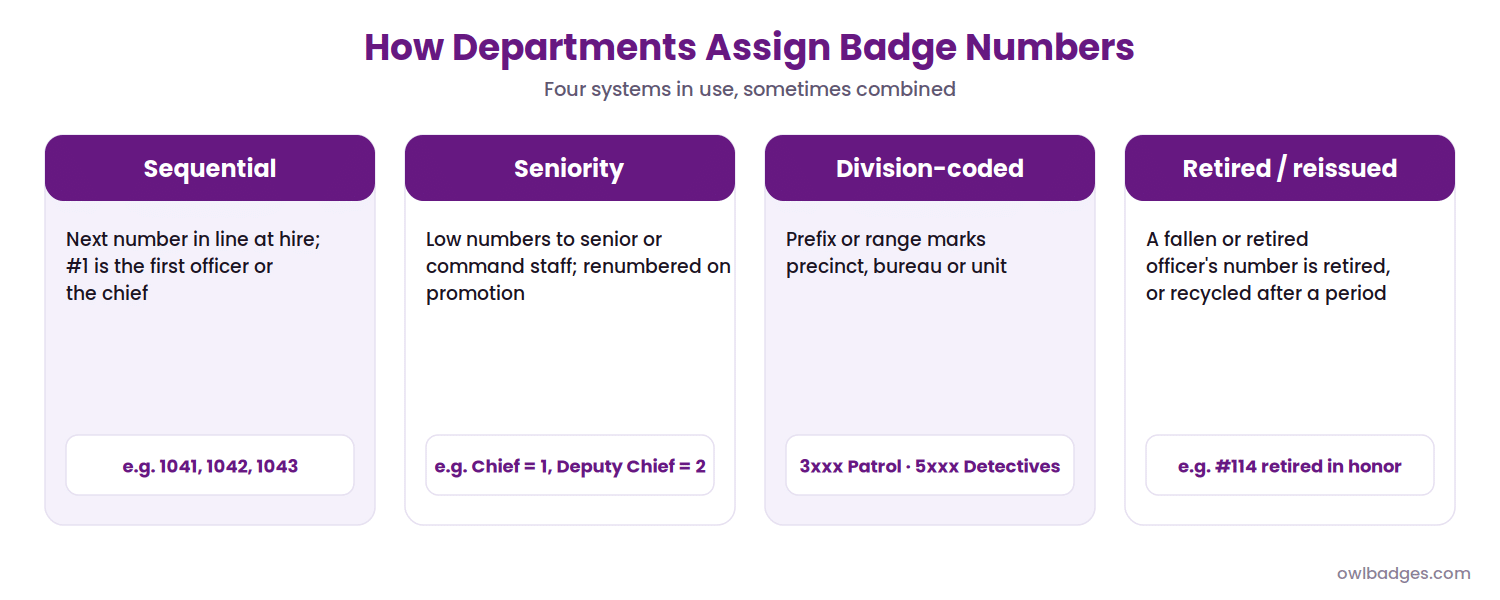
- Departments assign numbers sequentially, by seniority, by division code, or by reissue; there is no national system.
- NYPD uses shield numbers, LAPD serial numbers, Chicago star numbers — different words for the same identifier.
- Badge #1 is often the chief or the sheriff; numbers of fallen officers are frequently retired.
- There is no public national lookup; the department, a records request, or the state certification board are the routes.
Reviewed and updated September 2026. Numbering practices vary by department; examples are illustrative.
How Many Digits Is a Police Badge Number?
A police badge number is usually 3 to 5 digits. How many numbers are in a badge number depends on the size of the department: a small-town department may issue one- to three-digit numbers (#7, #23, #114), a mid-size city three or four (#1042), and a large city four to six (#21854). How many digits is a police badge number in the biggest agencies? The NYPD shield number runs to five digits, the LAPD serial number to six, and Chicago star numbers to five. There is no national standard — the number is assigned by each department, which is why how many numbers are on a police badge varies from one town to the next.
There is no standard length. Each of the roughly 18,000 law enforcement agencies in the United States sets its own badge numbering system, so the digit count varies from department to department. How long a given agency’s numbers run depends on its size, whether it reissues retired numbers, and whether the number encodes rank or division.
Four things determine how long a badge number runs:
- Department size. An agency that has numbered more officers over its history needs more positions to keep every number unique.
- Numbering method. Sequential systems grow longer over time as new officers are added. Coded systems tend to hold a fixed length, because each position carries a specific meaning — first digit for rank or assignment type, second for precinct or division, the rest identifying the individual officer.
- Whether numbers are recycled. Departments that reissue numbers after an officer retires stay within a shorter range. Departments that permanently retire numbers keep climbing.
- Letters and prefixes. Some agencies place letters alongside the digits to mark specialty assignments — D for detective, K for K9, T for traffic, S for SWAT — and some units use a letter prefix in place of a plain number entirely.
Police Badge Number Examples
A badge number example is easier than a definition. The numbers below are illustrative — real numbers are assigned by each department — but the lengths and formats are typical:
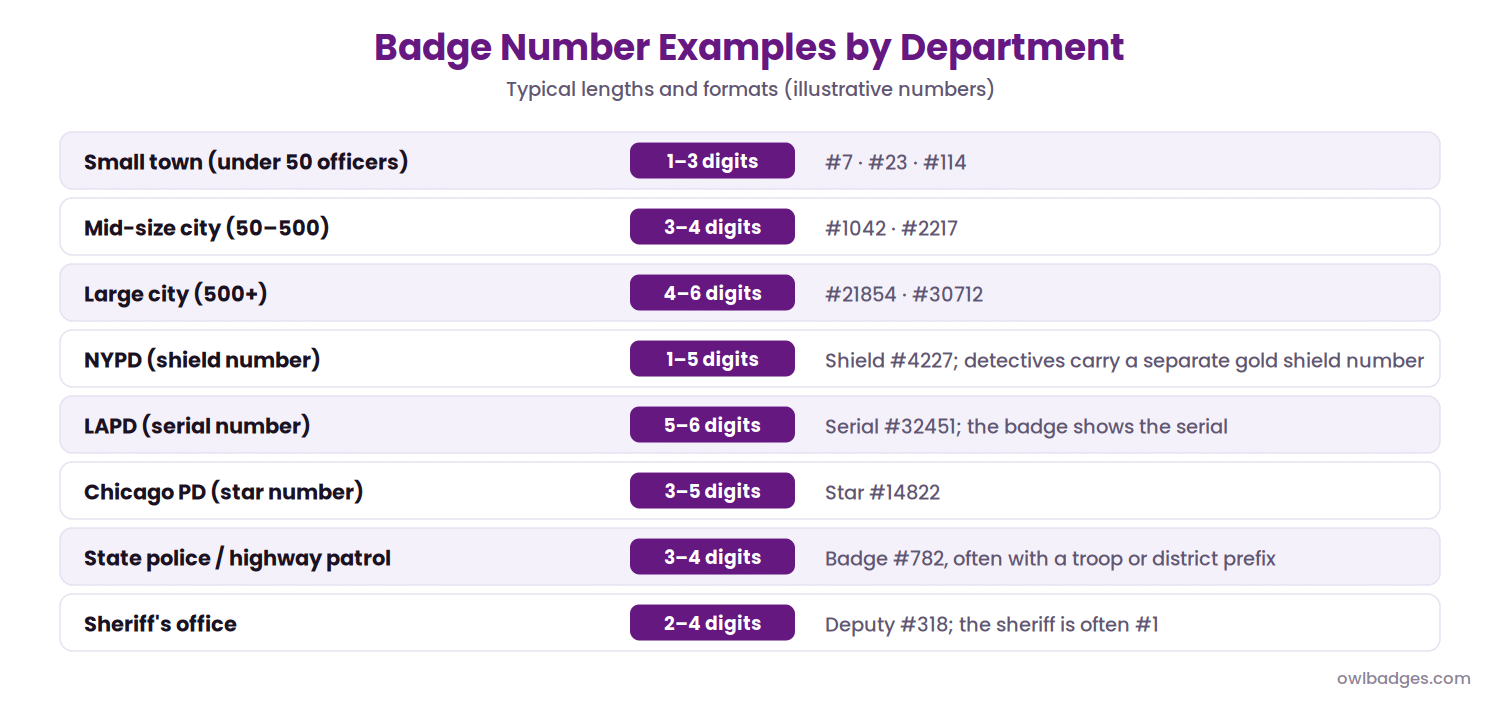
| Department | Typical length | Example | What the format tells you |
|---|---|---|---|
| Small town, under 50 officers | 1–3 digits | #23 | Sequential by hire; low numbers often mean seniority |
| Mid-size city, 50–500 officers | 3–4 digits | #1042 | Sequential, sometimes with a division range |
| Large city, 500+ officers | 4–6 digits | #21854 | Sequential from the department’s founding roster, or a coded prefix |
| NYPD | 1–5 digits (shield number) | Shield #4227 | Shield numbers are reissued; detectives carry a separate gold shield |
| LAPD | 5–6 digits (serial number) | Serial #32451 | The serial identifies the officer for a career; the badge displays it |
| Chicago PD | 3–5 digits (star number) | Star #14822 | Star numbers are reassigned as officers leave |
| State police / highway patrol | 3–4 digits | #782 | Often paired with a troop or district identifier |
| Sheriff’s office | 2–4 digits | Deputy #318 | The sheriff is frequently badge #1 |
A police badge number example from your own department will follow one of these patterns; cop badge numbers, officer badge numbers and police badge id numbers are the same thing under different names. The number on the badge is the officer’s identifier in reports, citations and complaints, which is why a citation always carries it.
Types of Badge Numbering Systems
Understanding what police badge numbers mean starts with recognizing that different departments use fundamentally different systems. There’s no national standard—each agency develops its own approach based on size, history, and administrative needs.
Sequential Numbering
The simplest system assigns numbers in order of hiring. Officer #1 was the first hired, #2 was second, and so on. Many smaller police departments still use this approach. The advantage is simplicity—the number itself reveals seniority. The disadvantage is that number ranges can become uneven as officers retire or leave.
Coded Numbering
Larger departments often use coded systems where different digits carry specific meanings. A badge might use:
- First digit: Indicates rank or assignment type
- Second digit: Indicates precinct or division
- Remaining digits: Individual officer identifier
For example, badge #3-12-456 might indicate: Rank 3 (Sergeant), Precinct 12, Officer 456. Understanding police rank structures helps decode these systems.
Random Assignment
Some departments deliberately randomize badge numbers for security. If numbers are sequential, someone could estimate total department size or identify newer officers. Random assignment prevents this intelligence gathering. Federal agencies like the FBI and US Marshals often use this approach.
Hybrid Systems
Many departments use hybrid approaches. Numbers might be sequential within each rank—all patrol officers get 1000-series numbers, sergeants get 2000-series, etc.—but random within each series. This provides some organizational logic while limiting intelligence exposure.
| System Type | Example | Information Revealed | Common Users |
|---|---|---|---|
| Sequential | #247 | Hire order/seniority | Small departments |
| Coded | #2-07-1842 | Rank, precinct, individual | Large city departments |
| Random | #58291 | Nothing (intentional) | Federal agencies |
| Hybrid | #3XXX (Sgt series) | Rank category only | Medium departments |
What Does a Badge Number Mean? The Purpose of the Police Badge
The purpose of a police officer’s badge is threefold: it identifies the officer (department, rank and badge number), it signals lawful authority (the badge is issued only to a sworn officer and must be surrendered on separation), and it creates accountability (the badge number ties the officer to every report, stop and complaint on record). The badge is not the credential — the department ID card is — but the badge is the public-facing half of the pair: what a citizen sees at a traffic stop and what a citation quotes. That is why the purpose of the badge number specifically is accountability: a citizen who notes the number can identify the officer through the department without knowing a name.
How to Decode Badge Numbers
While there’s no universal decoder ring for badge numbers, you can often figure out what a department’s system reveals with some observation.
Look for Patterns
If you see multiple officers from the same department, compare their numbers:
- Do sergeants have similar first digits?
- Do officers in the same precinct share number patterns?
- Are detective badges in a different number range than patrol?
- Do K9 unit badges have distinctive numbers?
Check Public Information
Many departments explain their numbering systems in policy manuals, union contracts, or transparency reports. Some publish this information on their websites. Media coverage of officer promotions sometimes mentions badge number changes that reveal the system.
Decoding Tip
When an officer gets promoted, do they get a new badge number? If yes, the system likely encodes rank. If they keep the same number, rank is indicated by badge design rather than number.
Common Encoding Patterns
Here are patterns used by many departments:
- 1-digit prefix for rank: 1=Officer, 2=Corporal, 3=Sergeant, 4=Lieutenant, etc.
- 2-digit prefix for precinct: 01=Central, 02=North, 03=South, etc.
- Letter prefix for specialty: D=Detective, T=Traffic, K=K9, etc.
- Year suffix: Last two digits indicate hire year (e.g., -19 for 2019 hires)
Example of how to decode a coded badge number. Actual systems vary by department.
How to Look Up a Police Officer by Badge Number
There is no public national database for a police badge number lookup. To find a police officer by badge number you go through the department or the state, and it usually takes a phone call or a written request rather than a search box.
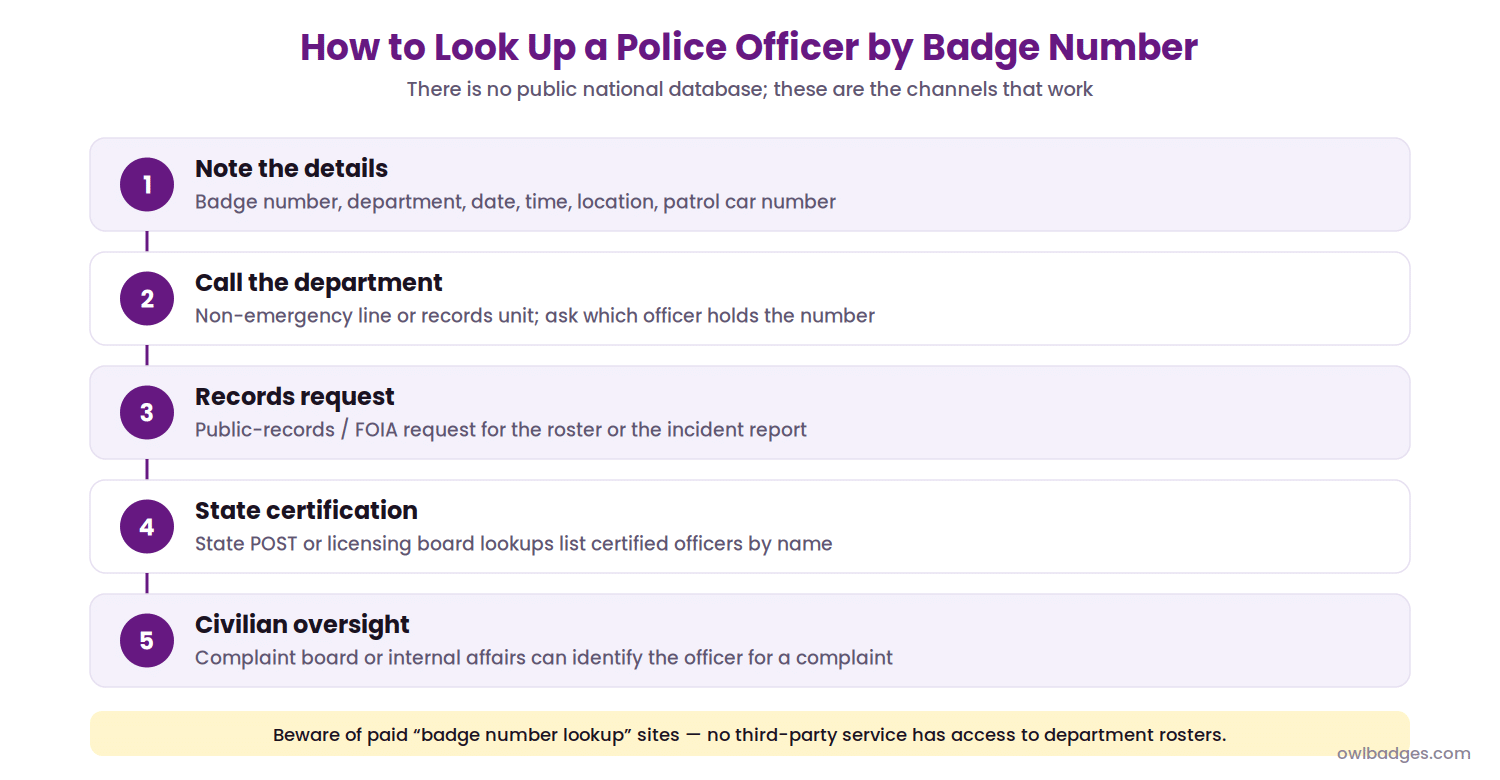
- Write down what you have. The badge number, the department, the date, time and location, and the patrol-car number if you saw it. A police officer lookup by badge number without the department name is a dead end — numbers repeat across agencies.
- Call the department’s non-emergency line or records unit. Ask which officer is assigned that badge number. Most departments will confirm an officer’s name and assignment; some require the request in writing.
- File a public-records request. Under state public-records law (FOIA at the federal level, a state equivalent locally) you can request the roster or the report tied to the incident, which identifies the officer.
- Use the state certification lookup. Most states’ POST commissions or officer-licensing boards publish searchable lists of certified officers by name; once the department gives you a name, this confirms certification status and history.
- Go through civilian oversight. If the reason for the search is a complaint, the department’s internal affairs unit or the city’s civilian complaint board will identify the officer as part of intake — you do not need the name to file.
Avoid paid “search police officer by badge number” sites. No third-party service has access to department rosters; what they sell is public-records aggregation you can request yourself for free. To look up a badge number legitimately, the department is the only source.
Major Department Systems Explained
Let’s examine how some major departments structure their badge numbers.
NYPD Badge Numbers
The NYPD uses a complex system with over 35,000 active badge numbers. Patrol officers receive tax registry numbers (often called “shield numbers”) that are generally sequential but have been issued over nearly 180 years. Detectives receive separate gold shield numbers in their own series. Command staff have yet another numbering system. An officer’s number typically stays with them throughout their career unless they change from patrol to detective or vice versa.
LAPD Badge Numbers
LAPD badge numbers are called “serial numbers” and are assigned sequentially upon hiring. Officers keep their serial number throughout their career regardless of promotions or assignments. The number appears on their badge, ID card, and all official documents. Seniority is immediately visible—lower numbers mean longer tenure.
Chicago PD Badge Numbers
Chicago uses “star numbers” that have been recycled throughout the department’s history. A current officer might wear the same star number previously worn by an officer in the 1920s. The department maintains records linking each number to its historical holders. Different star designs (rather than numbers) indicate rank.
Key Insight
In departments that recycle numbers, knowing a badge number tells you nothing about seniority. In departments with permanent numbers, lower numbers generally indicate more experienced officers. Always know which system your local department uses.
State Police Systems
State trooper badges often use systems tied to training academy classes. All graduates of a particular academy class might receive consecutive numbers. This creates cohort identification—troopers with similar numbers went through training together. The differences between state police and local departments often extend to their numbering philosophies.
How Different Agency Types Number Badges
Badge numbering conventions vary significantly across different types of law enforcement and security agencies.
Sheriff’s Offices
Sheriff badges often work differently than city police. The elected sheriff might wear badge #1, undersheriff #2, and chief deputies in single digits. Regular deputies get higher numbers. Constable badges in some jurisdictions follow similar patterns.
Federal Agencies
Federal agency badges typically use longer numbers with agency identifiers. The format might be: [Agency Code]-[Office Code]-[Individual Number]. This allows identification of both the specific agent and their assigned field office. Agents keep their numbers throughout their career regardless of transfers.
Corrections
Corrections badges often use facility-based numbering. Officers at different prisons have different number ranges, making it easy to identify where an officer is assigned. This helps with security—an officer from Facility A shouldn’t be in Facility B without explanation.
Campus & Specialty Police
Campus safety badges at universities often use smaller number ranges reflecting smaller forces. Public safety officers with combined police/fire/EMS duties might have badges indicating their cross-training certifications.
Private Security
Security officer badges from private companies like Allied Universal typically link to state license numbers rather than internal company systems. Loss prevention officers and event security personnel often display employee ID numbers that clients can verify with the company.
Private investigator badges typically display state license numbers, which can be verified through state databases. Learn more about becoming a private investigator and licensing requirements. Similarly, bail enforcement agents, bounty hunters, and fugitive recovery agents use license-based numbering in states that regulate these professions. See our bail enforcement licensing guide for details.
Specialty credentials like SORA Level 2 badges in New York display state-issued license numbers. Concealed carry badges are not official credentials and don’t follow any standardized numbering.
Special Numbers and Their Meanings
Certain badge numbers carry special significance in many departments.
Badge #1
In most departments, badge #1 belongs to the chief of police. It’s a symbol of ultimate authority. When a new chief takes office, they receive badge #1, and the outgoing chief surrenders theirs. Some departments award the previous chief a commemorative version upon retirement.
Low Numbers for Command Staff
Many departments reserve low numbers (2-10) for command staff. The deputy chief might wear #2, assistant chiefs #3-5, and so on. This creates instant visual identification of the chain of command—anyone with a single-digit badge is brass.
Retired Numbers
Some badge numbers are permanently retired to honor fallen officers, similar to retired jersey numbers in sports. These numbers become memorials—never to be worn again. Ceremonies retiring these numbers are solemn occasions.
Legacy Numbers
Many departments allow officers to request specific numbers, particularly if a family member previously wore that number. These “legacy” requests are often honored when available. For those becoming police officers, asking about family badge traditions shows respect for department culture.
Interesting Numbers
Badge #7: Some departments consider 7 lucky and reserve it for distinguished officers. Badge #13: Superstitious departments sometimes skip 13 entirely. Badge #007: Often requested but rarely granted—departments prefer dignity over pop culture references.
Fire & EMS Numbers
Fire fighter badges and EMT badges often use station-based numbering. All personnel at Station 5 might have 500-series numbers. Chaplain badges may use letter prefixes (CH-1, CH-2) rather than numbers to distinguish them from line personnel.
Frequently Asked Questions
Does a lower badge number mean a more senior officer?
In departments with permanent sequential numbering (like LAPD), yes—lower numbers indicate earlier hire dates and more seniority. In departments that recycle numbers (like Chicago), no—the number doesn’t indicate seniority.
Can I tell an officer’s rank from their badge number?
In some departments, yes—if they use coded systems where certain digits indicate rank. In others, rank is indicated by badge design (shape, color, metal) rather than number. You’d need to know your specific department’s system.
Do officers keep the same badge number throughout their career?
It varies. In LAPD and similar departments, yes—your number is permanent. In NYPD, patrol officers keep their number but receive a new number if promoted to detective. In some departments, officers get new numbers with each promotion.
Is there a universal police badge numbering system?
No. Each of the approximately 18,000 law enforcement agencies in the United States sets its own numbering system. There is no national standard, and systems vary dramatically between departments.
Why do some badges have letters and numbers?
Letters often indicate specialty assignments: “D” for detective, “K” for K9, “T” for traffic, “S” for SWAT. Some departments use letters for precincts or divisions. Letters can also indicate rank level without revealing the specific coding system.
Key Takeaways
- No universal system exists—each department creates its own badge numbering rules
- Sequential systems reveal seniority; coded systems reveal rank/division; random systems reveal nothing
- Badge #1 typically belongs to the chief in most departments
- Some numbers are retired to honor fallen officers
- Letter prefixes often indicate specialty units (D=Detective, K=K9, etc.)
- Private security badges typically display state license numbers rather than company numbers
- Understanding your local department’s system requires research into their specific policies
How many numbers are in a police badge number?
Usually three to five. Small departments issue one- to three-digit numbers, mid-size cities three or four, and the largest agencies up to six. The count is set by the department, not by any national rule.
Is a badge number the same as an officer’s ID number?
Often, but not always. Some departments use one number for the badge, the ID card and the payroll record; others keep a separate employee or serial number. The LAPD serial number is an example of a career-long identifier that is also displayed on the badge.
Can two officers have the same badge number?
Not in the same department at the same time. Numbers are unique within an agency, but the same number exists in thousands of departments, which is why a lookup needs the department name as well as the number.
What is a shield number?
The NYPD’s term for the badge number. NYPD officers carry a shield; detectives carry a gold shield with its own number series. Chicago uses “star number” and the LAPD “serial number” for the same idea.
Do detectives have badge numbers?
Yes. In most departments a detective keeps the same badge number on assignment; in the NYPD a promotion to detective comes with a new gold shield and shield number.
How long is a badge number?
Between one and six digits, most commonly three to five. Length tracks department size and the numbering system, not rank.
Ordering badges with sequential numbers for a department?
Sequential badge numbering is included on every department order — tell us the starting number and every badge comes from one mold, in order.
Sources and further reading
- Bureau of Justice Statistics — department size distributions (LEMAS) behind the digit-count guidance
- IADLEST — the association of state POST directors; links to state certification lookups
- Your state’s public-records statute and the department’s records-request page for identifying an officer by badge number
Owl Badges manufactures numbered badges for departments nationwide; the numbering practices above reflect what departments specify when they order. Reviewed September 2026.
Related Articles in This Series
Browse All Badge Categories
Written by
James Kator
Law Enforcement Industry Expert
Published: December 2025
Last Updated: October 9, 2026
Tags: